Journal/Care Basics · 6 min read
How to Care for an Aloe Vera Plant

By Wren Hollis · Houseplants & Indoor Styling
How to care for aloe vera indoors: how often to water, the right light and soil, repotting pups, and fixes for mushy, brown, or drooping leaves.
Quick answer
Aloe vera wants a very bright windowsill with some direct sun, a gritty cactus mix in a pot with drainage, and a deep watering only when the soil is completely dry — roughly every 2–3 weeks in summer and monthly in winter. Overwatering, not neglect, is what kills most aloes.
Aloe vera is the rare houseplant that earns its keep twice — a sculptural, easy-going succulent, and a first-aid kit growing on your windowsill. It is also one of the most frequently killed plants we see, and almost always for the same reason: too much love. Watered on a weekly schedule, potted in rich compost, tucked into a dim corner because the leaves look tough enough to cope, an aloe quietly rots from the roots up. This guide covers what an aloe actually needs, which is less than you think — and how to read the leaves when something is off.
Light: the brighter, the better
Aloe vera comes from arid regions and wants the sunniest spot you have. A south- or west-facing windowsill is ideal; it will tolerate bright indirect light but stretches and flops without real sun. A leggy, pale aloe with thin, downward-bending leaves is telling you it is light-starved — the rosette opens out flat instead of standing upright, and new leaves come in narrower than the old ones.
One caveat: an aloe kept in a dim corner will scorch if moved suddenly into strong summer sun — leaves turn reddish-brown or orange when sunburnt. Move it in stages over a week or two, giving it an hour or two more direct light each day. Outdoors in summer, give it morning sun and light afternoon shade at first, then let it take more once the leaves have hardened off.
Watering: the two-to-three-week rule
The fleshy leaves are water storage — this plant is built for drought. Water deeply until it runs from the drainage holes, then leave it alone until the soil is bone dry all the way down (poke a finger or a wooden skewer to the bottom of the pot to check). In a warm bright spot that is roughly every 2–3 weeks in the growing season and about once a month in winter. Light, frequent sips are worse than useless: they keep the surface damp while the deep roots stay dry.
- Leaves turn translucent, swollen, or mushy
- Leaves yellow from the base upwards
- A sour or musty smell coming from the soil
- Brown, collapsing roots when you unpot the plant
Underwatered aloes, by contrast, get thin, puckered, curled leaves — and recover within days of a good soak. That is the useful asymmetry to remember: thirst is a reversible problem, rot usually is not. When in doubt, wait another week. Aloe forgives drought, never soggy feet.
Warning: Never let an aloe sit in a saucer of water, and skip pots without drainage holes entirely. Root rot from waterlogged soil is the number one cause of death, and by the time leaves go mushy it is often too late.
Soil and pot
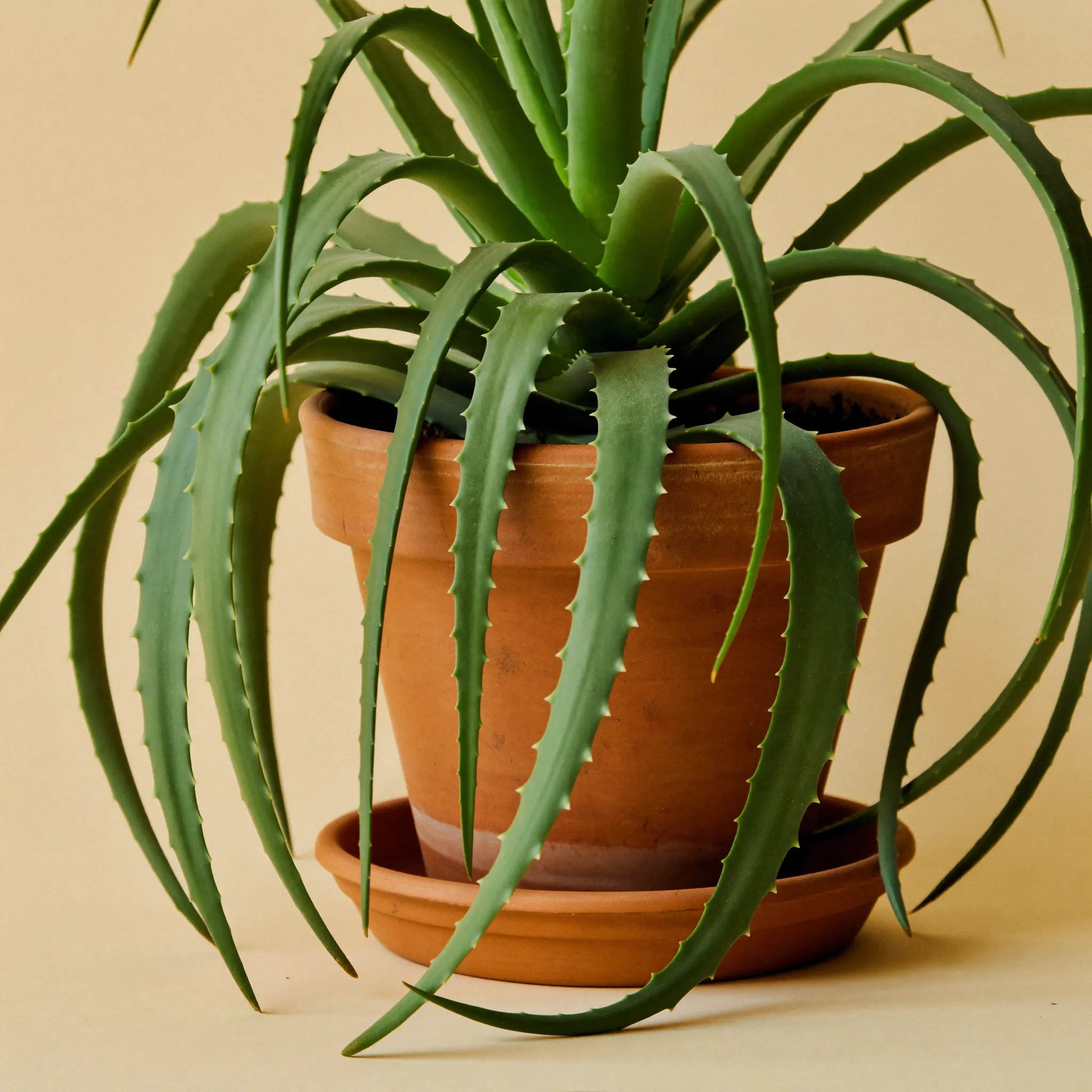
Use a cactus/succulent mix, or make your own from two-thirds ordinary compost cut with one-third coarse sand, perlite, or pumice. The goal is a mix that wets through quickly and then drains just as quickly, leaving air around the roots. Terracotta pots are perfect because they wick moisture out of the soil and their weight balances the top-heavy rosette. Choose a pot only slightly wider than the root ball — a too-big pot holds water for too long, which is exactly the condition aloe cannot tolerate.
Temperature and feeding
Aloe is happy in normal room temperatures, roughly 10–27°C. It is not frost hardy; below about 10°C growth stops and cold, wet compost quickly turns lethal, so bring outdoor aloes in well before the first frost. Feeding is nearly optional: half-strength balanced or succulent fertiliser once a month in spring and summer is plenty. Never feed in winter, when the plant is barely growing and unused fertiliser salts simply build up in the soil.
Worth knowing before you pick a spot: aloe vera is mildly toxic to cats and dogs if chewed, causing vomiting and lethargy — so keep it out of a curious pet's reach, or give it a high shelf in the brightest window.
Repotting and pups
A happy aloe produces offsets — "pups" — around its base. When pups reach about a quarter of the parent's size, unpot the whole plant, tease or cut the pups away with some roots attached, let the wounds dry for a day, then pot each one in barely-moist succulent mix. Wait a week before the first watering so the cut surfaces can seal. Repot the parent every 2–3 years or when it becomes root-bound and top-heavy, going up just one pot size at a time.
Tip: a mature aloe pup makes a great gift plant — pot one up in terracotta and it will establish within a month.
Harvesting the gel
To use the gel, choose a thick outer leaf and cut it at the base with a clean knife. Stand it cut-end down for ten minutes to drain the yellow latex (aloin) near the skin — it is an irritant — then fillet the clear inner gel. The wound on the plant seals itself; leaves do not grow back once cut, so harvest from the outside and let the centre keep growing. A plant with at least eight or ten good leaves can spare one every few weeks without looking bare.
Common problems at a glance
- Mushy, translucent leaves → overwatering; unpot, trim rotten roots, repot in dry mix
- Brown or reddish leaves → sunburn or cold stress; move the plant gradually
- Thin, curled leaves → thirst; soak deeply and let it drain
- Flat, floppy rosette → not enough light
- Brown soft base and toppling → rot at the crown; take healthy pups and start over
If your aloe looks off and you are not sure why, photograph it in PlantMe — the app identifies the species and diagnoses the likely problem from the leaf pattern, then gives you a step-by-step treatment plan.
Frequently asked questions
How often should I water aloe vera?
Only when the soil is completely dry — typically every 2–3 weeks in spring and summer, monthly in winter. Always water deeply, then let it drain fully.
Can aloe vera take full sun?
Yes, once acclimatised. Introduce direct sun gradually over 1–2 weeks; a sudden move from shade to summer sun will scorch the leaves reddish-brown.
Why is my aloe turning brown?
Reddish-brown usually means sunburn or cold stress; soft dark-brown mushy patches mean overwatering and possible rot. Check the soil moisture to tell them apart.
Is aloe vera safe for pets?
No — the latex in the leaves is mildly toxic to cats and dogs, causing vomiting and lethargy if chewed. Keep it out of reach.
Try it yourself
Diagnose it instantly with PlantMe
Snap a photo of any plant or leaf. Get the species, the diagnosis, and a care plan in seconds.
Download on theApp Store