Journal/Seasonal · 6 min read
Winter Care: Why Your Plants Sulk from November to March
Less light, drier air, colder windows — winter changes every rule of houseplant care. The full seasonal adjustment plan.
Quick answer
In winter, cut watering by 30–50%, stop fertilizing entirely from November to February, move plants away from cold windows and hot radiators, raise humidity above 50% with a humidifier, and expect minimal growth. Most "winter deaths" are actually overwatering plus cold, dark conditions.
Between November and March, your houseplants aren't unhappy — they're dormant. Their care requirements change dramatically and if you keep watering and feeding them like it's summer, you'll kill them. Here's the seasonal shift.
1. Less water — a lot less
In winter, plants photosynthesise less and grow less, so they use less water. Meanwhile, cool rooms mean soil dries slower. Combine those two and "weekly watering" becomes overwatering. Extend intervals by 30–50%: what you watered every 7 days now goes 10–14 days, sometimes longer.
2. No fertiliser
Feeding a dormant plant is like force-feeding a hibernating bear. The plant can't use the nutrients; salts build up and burn roots. Stop feeding from November and don't resume until you see clear new growth in March or April.
3. Move away from cold glass
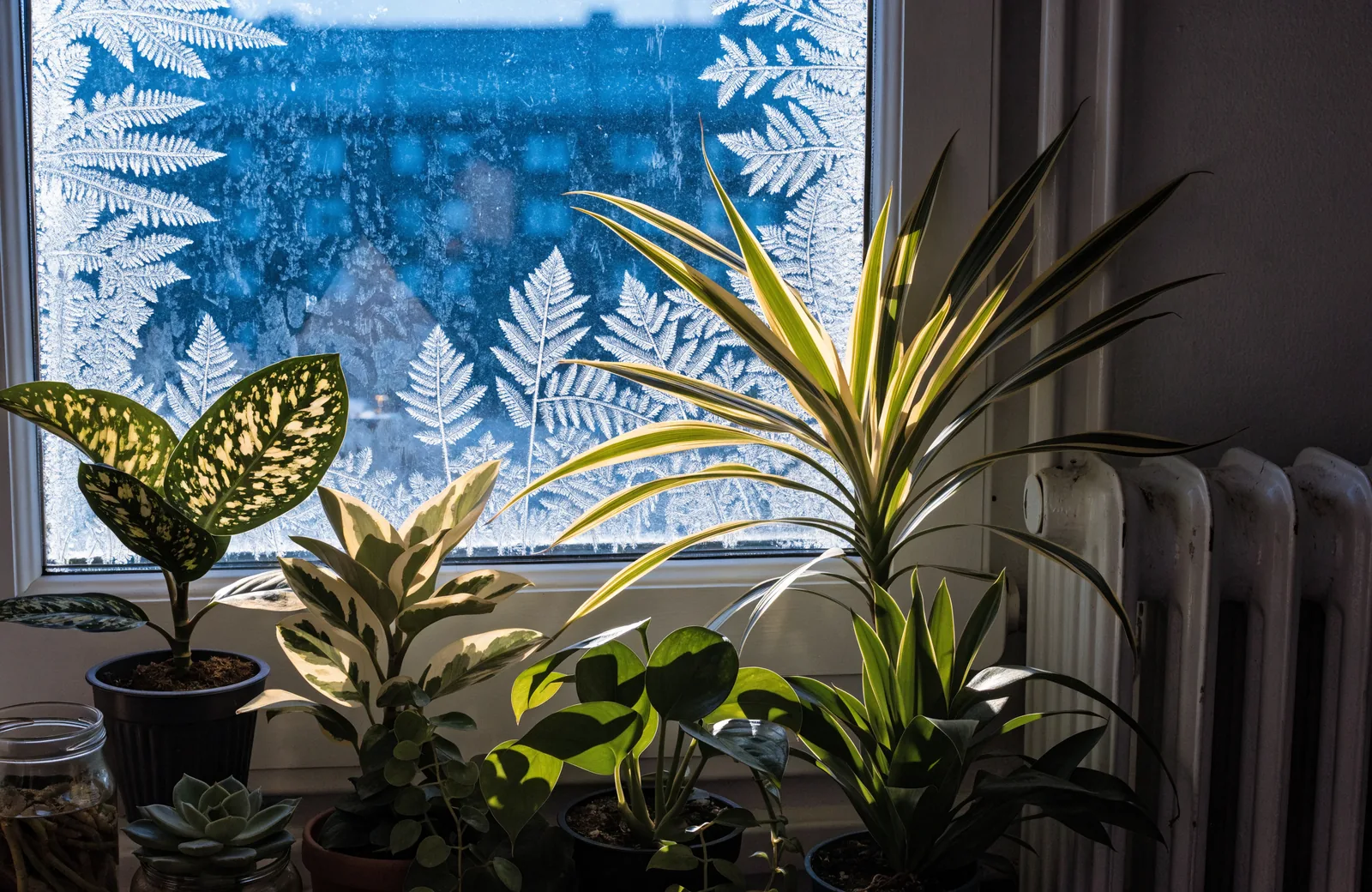
The air right against a single-glazed window can be 5–10°C colder than the room. Tropical plants pressed against cold glass often show sudden leaf drop and black spots (cold damage). Pull them 20–30 cm back or add a cardboard baffle.
4. Move away from radiators
The opposite problem — radiators create dry air pockets that crisp leaves within days. Any plant directly above or next to a radiator will suffer.
5. Boost humidity
Central heating pushes indoor humidity to 25–35% — bone dry for tropical houseplants. Group plants together, run a cool-mist humidifier, or move plants to a bright bathroom. Aim for 50%+.
6. Maximise light
Days are 8–9 hours long instead of 16, and often overcast. Move plants closer to windows for winter (the sun's angle is low, so direct-sun risk drops). South-facing windows that would burn a monstera in July are usually fine in December.
7. Skip repotting
Don't repot in winter unless you're rescuing from root rot. Damaged roots can't regrow in a dormant plant.
8. Expect some leaf loss
Older leaves often drop in winter — the plant is conserving energy. As long as new growth resumes in spring, it's normal.
The winter checklist
Summer vs winter care
| Factor | Summer | Winter |
|---|---|---|
| Watering (typical foliage) | Every 5–7 days | Every 10–14+ days |
| Fertiliser | Every 2 weeks half strength | None |
| Ideal humidity | 50–60% | 50%+ (harder to hit) |
| Repotting | Yes if needed | No |
| Expected growth | New leaves every 3–6 weeks | Minimal to none |
PlantMe adjusts care reminders seasonally so watering intervals shift automatically as days get shorter.
Frequently asked questions
Do I need a grow light in winter?
For low-light-tolerant plants like pothos and snake plants, no. For high-light plants (ficus, alocasia, most succulents) in a dark climate, a full-spectrum LED for 8–12 hours a day helps significantly.
Why is my plant dropping leaves suddenly in autumn?
Almost always the heating coming on. Sudden dry air, cold nights near windows, and shorter days all combine. Move away from the source and hold steady — most plants stabilise in 2 weeks.
Can I still propagate cuttings in winter?
You can, but success rates are 30–50% lower than in spring. Roots grow slowly in cold, low-light conditions. Wait until March if you can.
About the author

Houseplants & Indoor Styling
Wren has killed enough houseplants to know exactly why yours is struggling — and kept hundreds more thriving in a small, bright flat that doubles as her test lab. She writes about reading plants instead of following rules, and believes every windowsill deserves at least one leaf.
Try it yourself
Diagnose it instantly with PlantMe
Snap a photo of any plant or leaf. Get the species, the diagnosis, and a care plan in seconds.
Download on theApp Store