Journal/Seasonal · 5 min
How to Grow Paperwhites Indoors
Paperwhites need no chilling: set the bulbs on pebbles and water in November and they flower in four to six weeks. A planting timetable, the pebble-bowl method, and the Cornell-tested trick for shorter stems.
There are garden jobs you can postpone and ones the calendar simply closes on you. Paperwhites are the rare third kind: a job with a long, forgiving window and a disproportionate payoff. Pot a handful of bulbs this week, in the first days of November, and you will have scented flowers on the table by mid-December without owning a greenhouse, a grow light, or any particular talent.
Why paperwhites are the easiest bulbs you will ever force
Paperwhites (Narcissus papyraceus) are tender daffodils from the western Mediterranean, and that geography is the whole secret. Unlike tulips, hyacinths and hardy daffodils — which refuse to flower indoors unless you give them twelve or more weeks of cold first — paperwhites need no chilling at all. The flower is already formed inside the bulb when you buy it. You are not coaxing anything; you are providing water and a windowsill while the bulb does what it had already decided to do.
I will be honest about the trade-off: because they are tender, spent paperwhite bulbs are not hardy outdoors in a cold climate and cannot be forced a second time. These are cut flowers that happen to arrive as bulbs. Buy them, enjoy them, compost them.
The timetable
At ordinary room temperature, most batches flower four to six weeks after planting — allow a little longer in a cold house. That makes early November the moment to start if you want flowers in the run-up to the holidays, and it makes repeat planting the real trick: a fresh bowl every two weeks keeps the relay going from late November into March.
Paperwhite planting calendar for continuous winter flowers
| When you plant | When they flower |
|---|---|
| Early November | Around mid-December |
| Mid to late November | Christmas and New Year |
| Mid-December | Mid to late January |
| A new bowl every two weeks until late January | A relay of flowers into March |
The pebble-and-water method
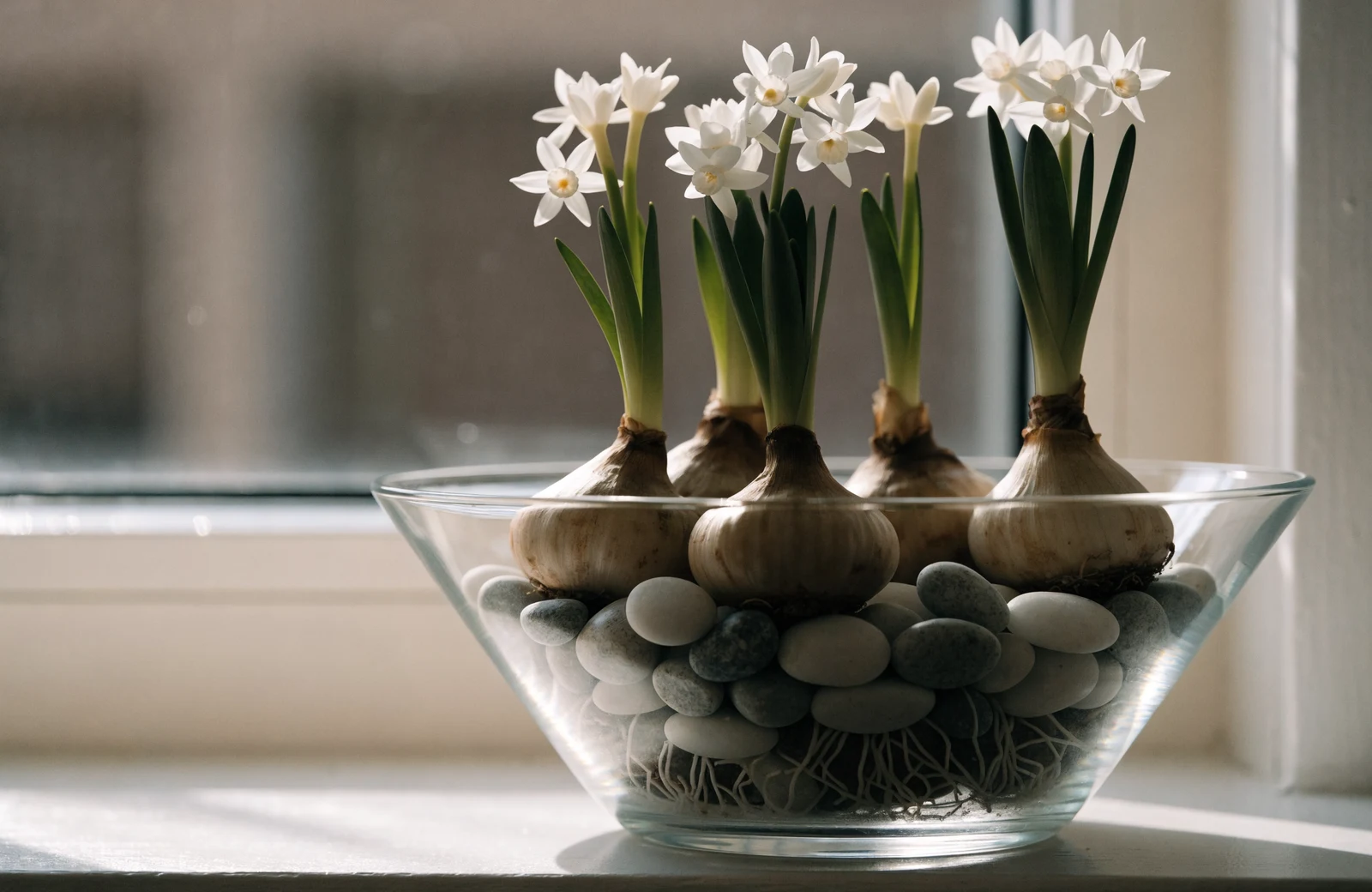
You can grow paperwhites in potting mix like any other bulb, but the classic pebble bowl is simpler, cleaner, and lets you watch the roots work. Five minutes per bowl:
- 1. Choose a watertight bowl with no drainage holes, at least 5–8 cm deep — glass is ideal because you can see the water level.
- 2. Fill it most of the way with washed pebbles, gravel or coarse grit.
- 3. Set the bulbs on top, pointed end up, shoulder to shoulder — a crowded bowl flowers better than a sparse one.
- 4. Tuck more pebbles around the bottom quarter of each bulb to anchor it, leaving the tips clear.
- 5. Add water until it sits just below the base of the bulbs, and keep it at that line.
That water line is the only rule that genuinely matters. Roots will find their way down into the water; the bulb itself must stay dry. A bulb sitting in standing water rots long before it flowers, which is the cause of most paperwhite failures I hear about.
Cool start, bright finish
For the first two to three weeks, while roots form, keep the bowl somewhere cool and dim — a spare room, a porch, an unheated hallway at roughly 10–15 °C suits them. Once the shoots are a few centimetres tall, move the bowl to the brightest window you have. Good light and moderate warmth keep the stems short and sturdy; a warm, dim living room is precisely the recipe for the lanky, collapsing paperwhites people complain about. When the buds open, moving the bowl out of direct sun and somewhere cooler at night will stretch the display by days.
The gin trick — garden folklore that is actually true
I am professionally suspicious of kitchen-cupboard garden hacks, so let me report one that survives contact with the evidence. Researchers at Cornell University's Flower Bulb Research Program found that watering paperwhites with a dilute 4–6% alcohol solution — once the shoots are several centimetres tall — stunts the stems and leaves by a third to a half while leaving the flowers just as large, fragrant and long-lasting. The mix from a standard 40% spirit such as gin or vodka is one part spirit to seven parts water; drain the bowl and refill with the solution from then on. Two cautions from the same work: anything above about 10% alcohol damages the plant, and beer and wine are no good because of their sugars. If the drinks shelf stays shut, a few twigs and a loop of twine do the same structural job.
Cultivars worth seeking out
'Ziva' is the paperwhite you will find everywhere, and it earns its ubiquity: fast, reliable, heavily scented — though that musky fragrance divides households more than any other plant I can think of. If you are in the camp that finds it overpowering, 'Grand Soleil d'Or' trades the white flowers for golden-yellow ones with a sweeter, fruitier scent, and takes a week or two longer to bloom. Plan the timetable accordingly.
Jobs to pair with it this week
- Pot one bowl of paperwhites now and diary the next batch for two weeks' time.
- Start an amaryllis alongside — it wants six to ten weeks, so a bulb planted now flowers in the deep of winter when you will want it most.
- Get any remaining hyacinths into their forcing pots — unlike paperwhites, they do need their weeks of cold, and the clock is running.
- The garden proper still has a short list open — see what to plant in November before the ground closes for winter.
Sources & further reading
About the author

Vegetable Garden & Seasons
Arthur has worked the same allotment for thirty years and measures the calendar in sowings, not months. He writes practical, no-nonsense guides to growing food and keeping a garden honest through the seasons — and has little patience for folklore that doesn't survive contact with a real plot.
Try it yourself
Diagnose it instantly with PlantMe
Snap a photo of any plant or leaf. Get the species, the diagnosis, and a care plan in seconds.
Download on theApp Store