Journal/Care Basics · 6 min read
How to Care for a Monstera Deliciosa
A practical Monstera Deliciosa care guide: light, water, humidity, soil, and fixes for yellow leaves, no fenestration, and root rot.
Quick answer
A Monstera deliciosa wants bright indirect light, watering when the top 2–3 cm of soil is dry (roughly weekly in summer, every 10–14 days in winter), 50–70% humidity, and a chunky, airy potting mix. Give it a moss pole and it will fenestrate.
The Monstera Deliciosa is the fastest way to make a room feel alive. It's forgiving, dramatic, and — with a little structure — grows huge, fenestrated leaves indoors. This guide walks you through everything a healthy Monstera actually needs, without the folklore.
Light
Monsteras want bright, indirect light. Think a spot two to three metres back from a south- or west-facing window, or right next to an east-facing one. Direct midday sun scorches the leaves and turns them pale. Deep shade, on the other hand, is the number one reason people ask why their Monstera stopped producing splits — a mature Monstera needs real light to fenestrate.
Watering
Water when the top 2–3 cm of the soil is dry to the touch. In a warm, bright room that usually means once a week; in winter, every 10–14 days. Water deeply until it runs from the drainage holes, then empty the saucer. Monsteras hate sitting in water — soggy roots are the fastest route to yellow, mushy stems.
Humidity and temperature
Anything above 50% humidity keeps a Monstera happy; 60–70% is ideal. Grouping plants, running a small humidifier, or moving it to a bright bathroom all work. Keep it between 18–27°C and away from radiators and cold draughts.
Soil and pot
Use a chunky, airy mix — a standard houseplant compost cut with orchid bark, perlite, and a handful of coco coir. Any pot is fine so long as it has drainage. Repot every 18–24 months, one size up.
Support and pruning
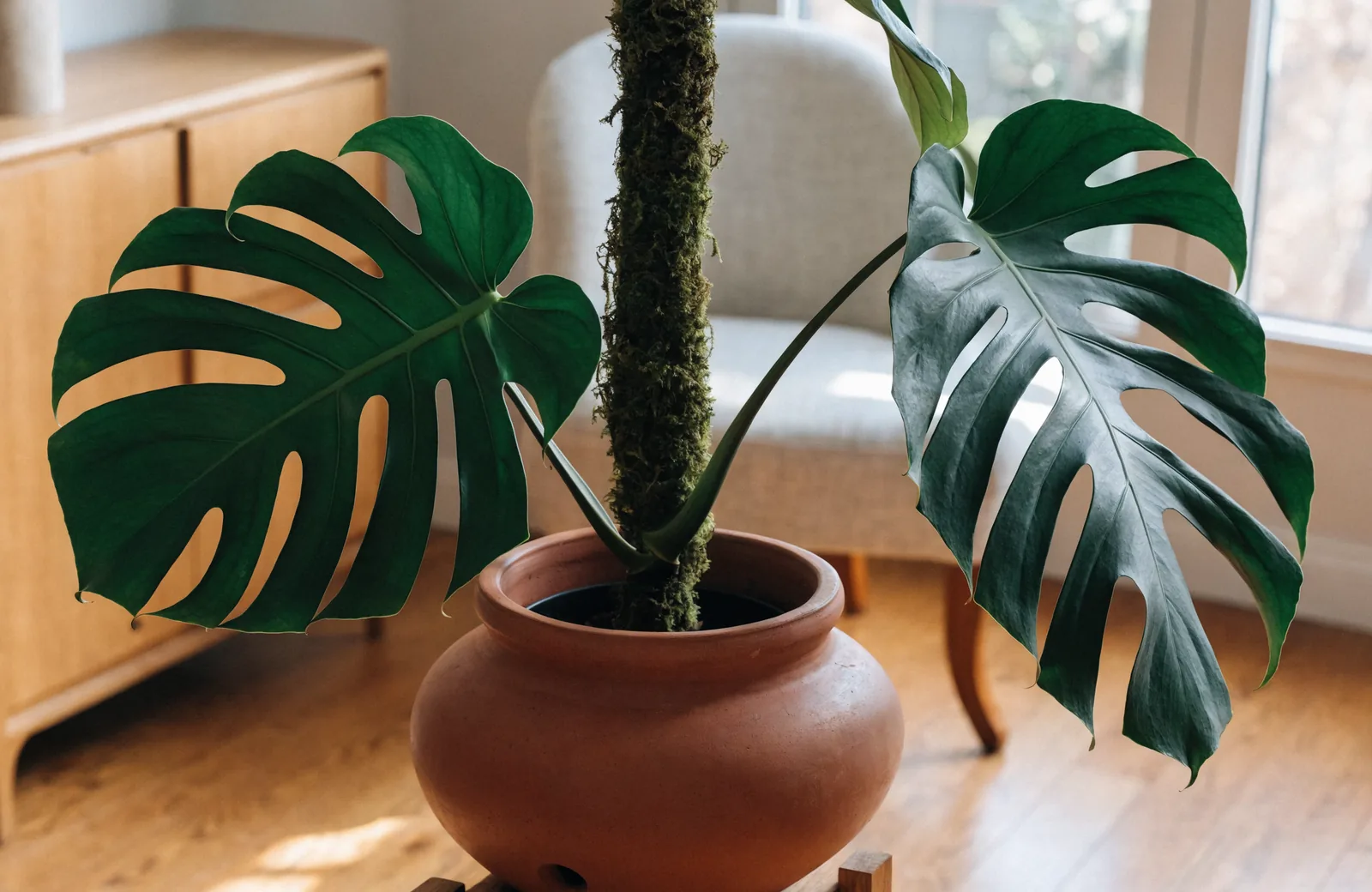
A moss pole or coir pole encourages bigger, more fenestrated leaves — the aerial roots grip and the plant reads it as a tree to climb. Prune leggy stems just above a node; they'll root easily in water.
Common problems
- Yellow leaves usually mean overwatering. Check the roots for mush.
- Brown crispy edges point to low humidity or tap-water salts.
- No splits on new leaves? Move it closer to the light.
- Sudden leaf drop is almost always cold shock or a dried-out root ball.
If you're not sure what's wrong, snap a photo and let PlantMe diagnose it — the app cross-checks the leaf pattern against a database of common Monstera problems and returns a treatment plan in seconds.
Sources & further reading
About the author

Houseplants & Indoor Styling
Wren has killed enough houseplants to know exactly why yours is struggling — and kept hundreds more thriving in a small, bright flat that doubles as her test lab. She writes about reading plants instead of following rules, and believes every windowsill deserves at least one leaf.
Try it yourself
Diagnose it instantly with PlantMe
Snap a photo of any plant or leaf. Get the species, the diagnosis, and a care plan in seconds.
Download on theApp StoreKeep reading
See also