Journal/Troubleshooting · 6 min read
Brown Leaf Tips: Why They Happen and How to Stop Them
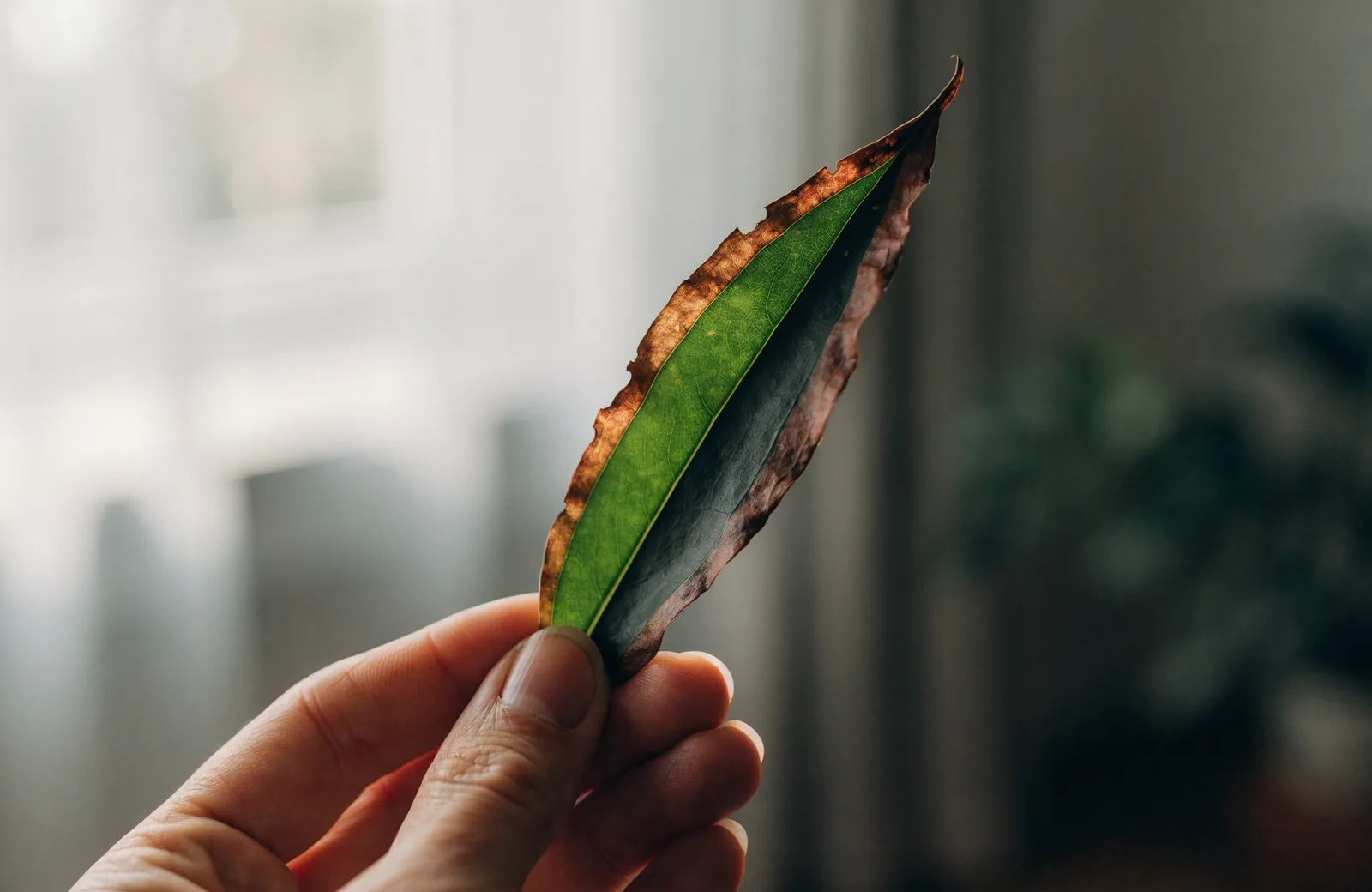
Brown, crispy leaf tips come down to five causes: dry air, inconsistent watering, tap-water salts, fertiliser burn, or cramped roots. Here's how to tell which.
Quick answer
Brown leaf tips are almost always a water-delivery problem: dry air, inconsistent watering, or a build-up of salts from tap water or fertiliser. The tip browns because it's the very end of the leaf's plumbing — the first place to run dry. Fix the cause, then trim the dead tissue just inside the brown edge; it won't turn green again.
Few things nag at a plant owner like a collection of otherwise healthy leaves, every one finished with a crisp brown tip. It looks like disease, but it almost never is. Brown tips are a plumbing report: the very end of the leaf is the last stop on the plant's water-transport system, so whenever supply falters — or the water arriving is loaded with salts — the tip is the first tissue to dehydrate and die. Read the tip, and you can usually read the cause.
Why the tip, specifically?
Water moves through a leaf under tension, from the stalk out to the margins. The tip and edges sit at the dead end of that network, so they're the first to be short-changed when the soil dries out, when humidity drops, or when dissolved salts in the root zone make it harder for roots to pull water in at all. That's why the damage is so symmetrical: it's not an infection spreading, it's a supply line failing at its furthest point. A fungal problem, by contrast, tends to appear as spots or patches in the middle of the leaf, often with a yellow halo — a different diagnosis entirely.
Cause 1: dry air
This is the big one for tropical foliage plants — calatheas, prayer plants, ferns, spider plants, palms. Centrally heated or air-conditioned rooms often sit at 30–40% relative humidity, while these plants evolved for 60% and up. In dry air the leaf loses water faster than the roots can replace it, and the tips pay the price. The tell: browning appears on many leaves at once, on a plant whose soil moisture is otherwise fine, and often comes with crispy edges as well as tips. Grouping plants together, moving humidity-lovers to a bright bathroom or kitchen, or running a small humidifier nearby all raise the local humidity meaningfully. Misting, for what it's worth, raises it for about ten minutes — pleasant, but not a fix.
Cause 2: inconsistent watering
A plant that swings between bone-dry and soaked keeps losing the fine root hairs that do the actual absorbing, so even after you water, uptake lags. The tell: browning that follows a drought-and-flood pattern, drooping between waterings, soil that has pulled away from the sides of the pot. The fix isn't a calendar, it's a trigger — check the top 2–3 cm of soil with a finger twice a week and water thoroughly when it's dry, letting the excess drain away completely. When a root ball has dried so hard that water races straight through, stand the pot in a basin of water for 20–30 minutes to rewet it properly.
Cause 3: tap-water salts
Hard tap water carries dissolved minerals; softened water carries sodium; and some plants — dracaenas, spider plants, cordylines, calatheas and other prayer-plant relatives — are also sensitive to the fluoride added to many municipal supplies. These salts accumulate in the pot with every watering, and once concentrated they draw water away from the roots. The tells: a white crust on the soil surface or pot rim, and brown tips that keep advancing no matter how well you water. Flush the pot every couple of months — run through a volume of plain water equal to several times the pot's volume and let it drain — and for the sensitive species use rainwater, filtered water, or tap water left to stand overnight.
Cause 4: fertiliser burn
Fertiliser is salt too. Overdo the dose or the frequency and you get the same osmotic squeeze as hard water, faster. The tells: browning that appears within days of feeding, sometimes with the leaf margins yellowing first. Flush the pot thoroughly, skip the next two feeds, and when you resume, feed at half the label strength — for most houseplants, every 2–4 weeks in spring and summer and rarely or never in winter is plenty.
Cause 5: cramped or damaged roots
A badly root-bound plant simply can't take up water fast enough for its leaf area, however often you water; roots damaged by rot can't either. The tells: roots circling out of the drainage holes, water flashing straight through the pot, a plant that wilts within a day or two of a thorough watering. Slide the plant out and look — a dense mat of circling roots means it's time to pot up one size; brown, mushy, sour-smelling roots mean rot, which is a different rescue job.
Telling the causes apart at a glance
Brown-tip diagnosis cheat sheet
| Clue | Most likely cause |
|---|---|
| Many leaves at once, soil moisture fine, edges crispy too | Dry air |
| Soil swings from parched to soaked; drooping between waterings | Inconsistent watering |
| White crust on soil or pot; sensitive species (dracaena, spider plant, calathea) | Tap-water salt build-up |
| Browning within days of feeding | Fertiliser burn |
| Roots out of drainage holes; water runs straight through | Root-bound |
| Spots or patches mid-leaf with yellow halos | Not tips at all — likely fungal, diagnose separately |
Should you cut the brown tips off?
Yes, for looks — the browned tissue is dead and will never recover, and once it dries fully it can slowly creep further. Use clean, sharp scissors and cut just inside the dead zone, following the leaf's natural shape rather than cutting straight across. Leave a hair's breadth of brown: cutting into live green tissue creates a fresh wound that will brown over again. And remember that trimming is cosmetic — if you haven't fixed the underlying cause, new tips will brown just as the old ones did.
Prevention in one paragraph
Water on a soil-check rather than a schedule, keep humidity-lovers above 50% or accept a few crisp edges as rent, flush pots with plain water every couple of months, feed at half strength, and pot up when roots fill the container. Do those five things and brown tips become rare enough to be interesting.
Still not sure which cause you're looking at? Photograph the worst leaf in PlantMe and let the app do the pattern-matching — its diagnosis model recognises over 500 plant diseases and disorders and comes back with the likely cause and a treatment plan in seconds.
Sources & further reading
Frequently asked questions
Will brown leaf tips turn green again?
No. The browned tissue is dead and can't be revived. Trim it for appearance and focus on the cause — the reward is that new leaves emerge with clean tips.
Does misting prevent brown tips?
Not really. Misting raises humidity for a few minutes at most. A humidifier, a pebble tray with water, or grouping plants together raises it for hours, which is what actually protects the tips.
Which plants get brown tips most often?
Thin-leaved tropicals: calatheas, prayer plants, ferns, palms, spider plants and dracaenas. The last two are also sensitive to fluoride in tap water, so they can brown even in humid rooms if watered from the tap.
About the author
Plant Rescue & Troubleshooting
Camille spent years behind the counter of a plant shop where every customer arrived with the same question: what's wrong with it? She writes the Journal's rescue guides — calm, diagnosis-first, no guilt — because most 'dying' plants are one correct decision away from recovery.
Try it yourself
Diagnose it instantly with PlantMe
Snap a photo of any plant or leaf. Get the species, the diagnosis, and a care plan in seconds.
Download on theApp Store