Journal/Vegetable Garden · 7 min read
How to Start a No-Dig Garden
Arthur Meade on starting a no-dig bed: lay cardboard over grass or weeds, cover with 10–15cm of compost, and let winter do the cultivation. The build order, the autumn-versus-late-winter question, and the first season's rules.
Quick answer
To start a no-dig garden, mow the vegetation low, lay plain brown cardboard over it, soak the cardboard, and cover it with 10–15cm of compost. You can plant straight into the mulch if it is well rotted and at least 10cm deep. Autumn is a sensible time to build — the bed settles over winter and is ready by spring — and from then on the whole system runs on roughly 5cm of fresh compost a year.
Every autumn a certain kind of gardener looks at an emptying vegetable bed and reaches for the spade, because that is what autumn was always for. You can put it down. The case for not digging at all has quietly become the establishment position — the RHS now recommends preparing beds by covering the ground rather than turning it — and the method for starting a new bed this month involves more flattened cardboard than exercise. What follows is the reasoning, the calendar, and the build, in that order.
Why the spade stays in the shed
The short version: digging undoes work the soil has already done. Turning the ground collapses the drainage channels earthworms have built, disturbs the fungal networks that help roots reach water and nutrients, and releases carbon the soil was storing. It also hauls buried weed seeds up to the light, where they promptly germinate — one reason dug plots need so much weeding in spring. Leave the profile alone and feed it from the top, and the soil life does the cultivating for you. The cardboard is not wasted either: earthworms feed on it as it breaks down, aerating the bed and leaving their castings behind.
The calendar question: build now or wait for February?
You can start a no-dig bed in any month the ground isn't frozen or waterlogged, and the advice splits on which is best. The RHS's preferred window for spreading compost is late winter — February into early March — partly because nutrients in a mulch spread too early can be washed through by months of winter rain. Oregon State University Extension, meanwhile, recommends autumn for the cardboard build itself, because the smothering layer works slowly and a bed assembled now has quietly finished the job by spring. The two are easy to reconcile if you let the state of the ground decide. Turf or weeds to kill? Build now and give the cardboard the whole winter to work. An existing bed that is already clean? Then there is nothing to smother, and the compost can wait for late winter. Either way the bed asks nothing of you in the meantime — there is still plenty worth planting in November while it settles.
The build, in order
- 1. Mow or strim the vegetation as low as it will go. Leave the clippings where they fall; they are now part of the bed.
- 2. Evict the thugs first. Oregon State's horticulturists are blunt that sheet mulch will not smother bindweed, brambles or couch grass — dig those roots out now or they will surface through your new bed in May.
- 3. If the ground is badly compacted, open it with a garden fork rocked gently back and forth. Do not turn the soil over — this is aeration, not digging.
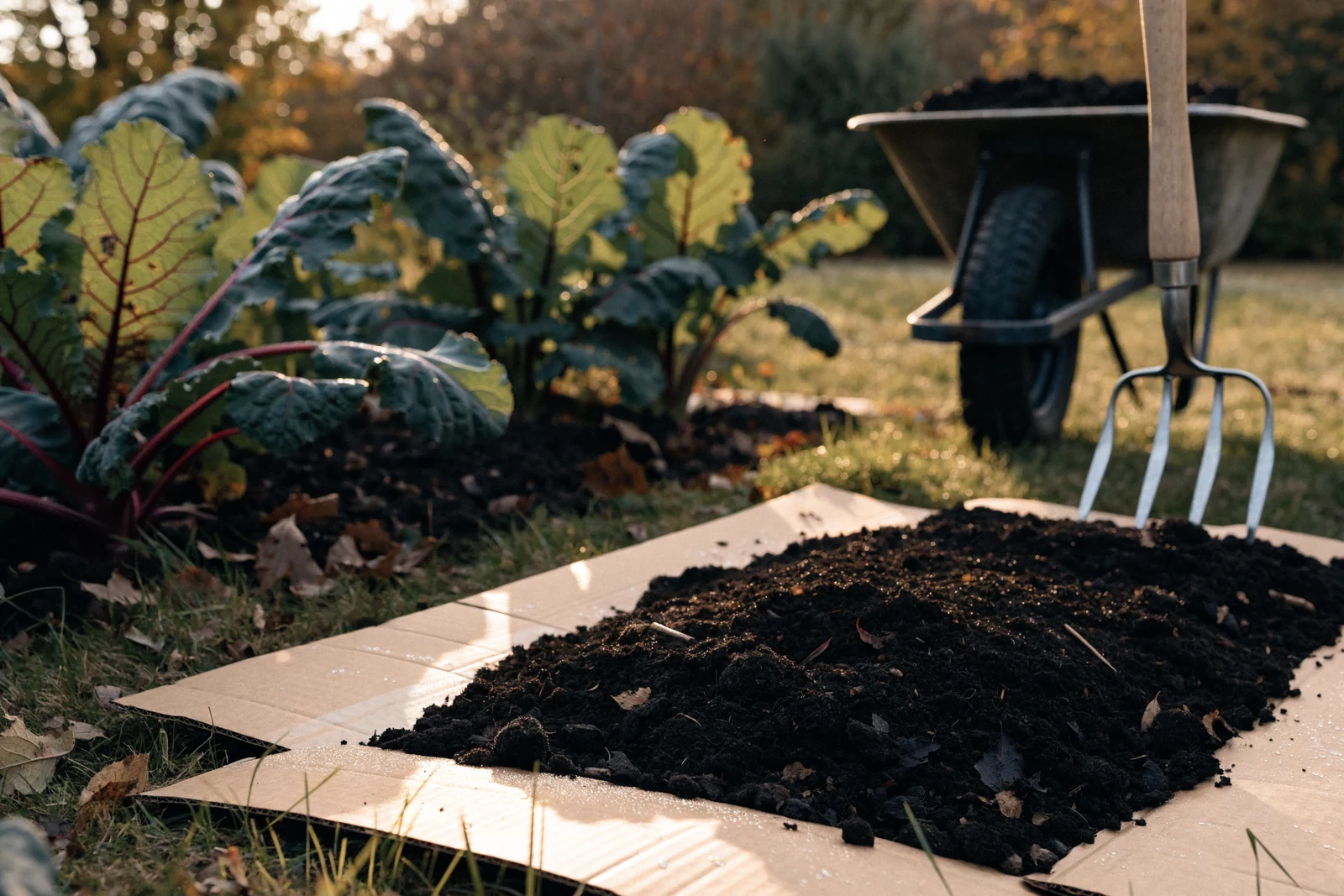
- 4. Lay the cardboard. Plain brown corrugated board only: tape and staples off, shiny printed card rejected. A double layer with edges overlapped by a good 20cm is the RHS standard under a thick mulch; on rough, weedy ground Oregon State goes to four to six layers. Soak it thoroughly once it is down.
- 5. Cover with 10–15cm of organic matter — ideally compost you made yourself, which is where every garden's autumn waste should have been heading anyway.
- 6. Mark out beds about 1.2m wide with 45cm paths between, so every part of the bed is reachable from a path. Then adopt the only hard rule in the system: nobody walks on the beds again.
Short of compost? The lasagne build
Ten to fifteen centimetres of compost over a whole bed is a serious volume, and most gardens don't have it on hand. The workaround is to build the depth from raw materials and let the bed compost itself in place. On top of the soaked cardboard, alternate nitrogen-rich layers — grass clippings, raw vegetable scraps, rotted manure — with carbon-rich ones: autumn leaves, straw, shredded paper. Keep each layer somewhere between 2 and 15cm, scatter a few handfuls of soil between layers to introduce the organisms that do the work, and always finish with a carbon layer on top so nothing edible is left exposed. Built in autumn, a lasagne bed is ready to plant in roughly six months — call it April — or sooner if you cap it with 5–8cm of finished compost and plant into that. The leaves you were about to consign to the leaf mould bin are legitimate browns here, and if materials are genuinely scarce, a green manure sown over winter will hold and feed the soil until you can mulch properly.
The first season on a new bed
If the surface layer is well rotted and at least 10cm deep, you can plant the same day you build. Module-raised plants settle in well — the RHS notes they tend to take less slug damage than direct-sown seedlings in fresh mulch. Through the season the rules stay short. Harvest root crops by twisting or pulling them out rather than forking the bed. Top the surface up with about 5cm of compost once a year and let the worms take it down. Keep the edges honest where lawn borders the bed, because grass treats a no-dig bed as an invitation. And note what no-dig does not exempt you from: hungry crops like tomatoes may still want feeding where the soil runs short, and crop rotation still applies, because soil-borne diseases have not read the literature.
That is the whole system. In exchange for all the digging you are no longer doing, it asks only for restraint — stay off the soil, keep the mulch coming — and for a steady supply of cardboard. The recycling pile behind any supermarket is a start, and for once nobody will ask why you want it.
Sources & further reading
About the author

Vegetable Garden & Seasons
Arthur has worked the same allotment for thirty years and measures the calendar in sowings, not months. He writes practical, no-nonsense guides to growing food and keeping a garden honest through the seasons — and has little patience for folklore that doesn't survive contact with a real plot.
Try it yourself
Diagnose it instantly with PlantMe
Snap a photo of any plant or leaf. Get the species, the diagnosis, and a care plan in seconds.
Download on theApp Store