Journal/Care Basics · 6 min read
Majesty Palm Care Guide
The giant palm sold for a small price: why majesty palms struggle in living rooms, the light and water they actually need, the winter spider-mite problem, and whether yours is worth the effort.
It usually happens in the big-box garden aisle. A palm taller than you are, fronds like green fountains, for less than the price of a decent dinner. You wheel it home feeling like you've got away with something. Here's the honest version: the majesty palm is one of the cheapest large houseplants to buy and one of the hardest to keep looking the way it did in the shop. That's not a reason to give up on yours. It's a reason to understand it this week, not after the first brown frond.
Know what you've brought home
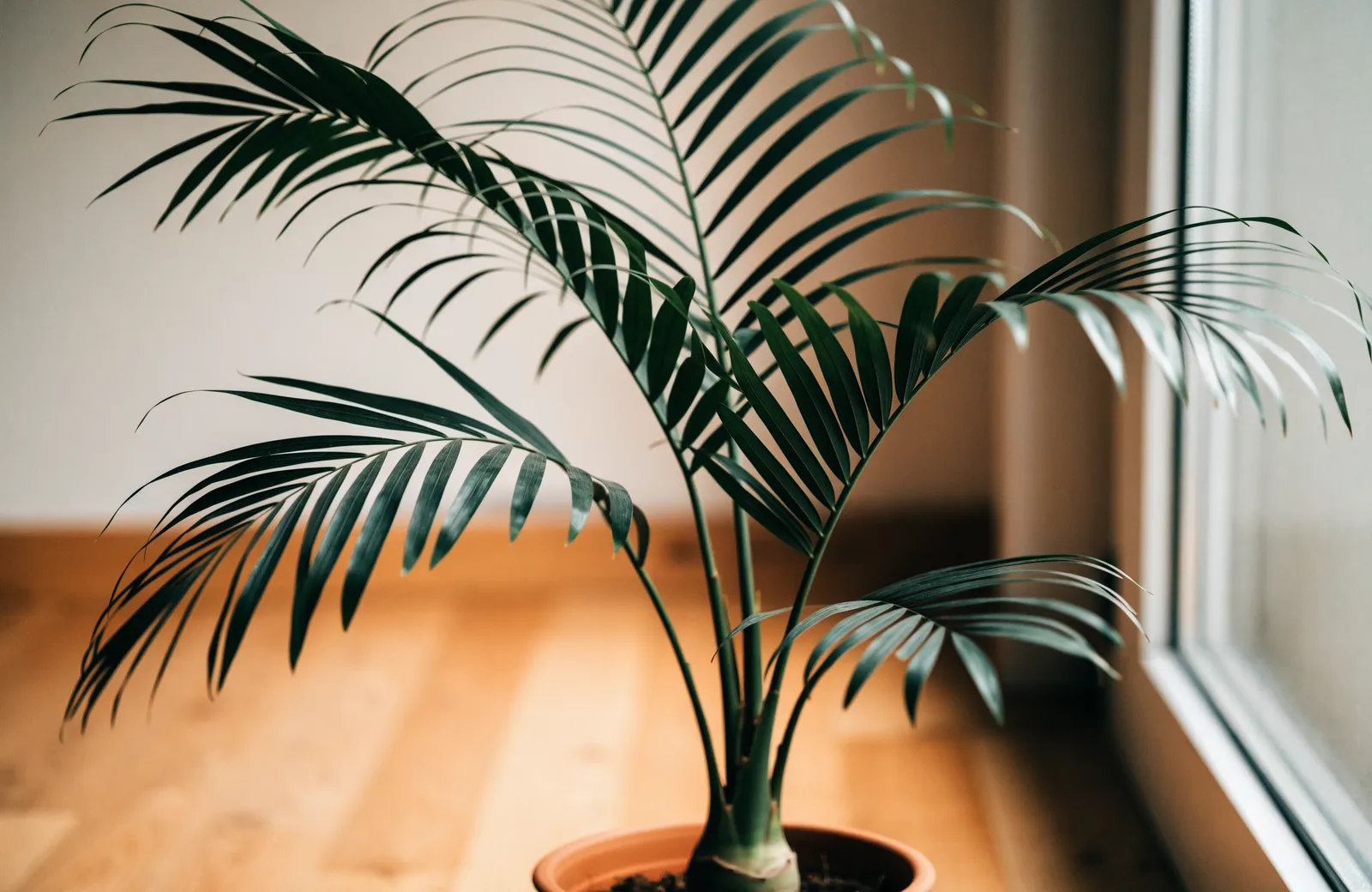
Ravenea rivularis grows along riverbanks in Madagascar — the species name literally means 'of the rivers' — where it towers to thirty metres with its feet in reliably damp soil. North Carolina State Extension notes it's becoming rarer in the wild as that habitat shrinks, which makes the supermarket version feel stranger still. Indoors it stays a polite one-and-a-half to three metres, with arching feathered fronds that can run longer than the plant is tall. One more shop secret: a majesty palm is a solitary palm, a single stem by nature. That lush multi-stemmed pot you bought is several young palms planted together for fullness — which is why the centre of a crowded pot sometimes thins out as the strongest ones compete.
Light: more than the label says
The little care tag probably says 'low to medium light'. The riverbank says otherwise. A majesty palm wants your brightest spot — right by an east- or west-facing window, or near a south-facing one with the harsh midday beam softened by a sheer curtain. Extension guidance allows it a couple of hours of gentle direct sun a day; what it can't take is fierce midday glass-magnified sun, which scorches the fronds, or a dim corner, which starves them slowly. In low light the palm doesn't complain loudly. It just stretches, pales, and sheds its lower fronds one by one. If you're honestly not sure what your rooms offer, start with how much light houseplants actually need — this is a plant worth measuring for.
Water like a riverbank, drain like a pot
Most houseplant watering advice — let it dry out, when in doubt don't — gets quietly reversed here. A river-edge palm wants consistently moist soil, and letting the root ball go bone dry is how fronds brown from the tips inward. Water when the top couple of centimetres have just dried, soak until water runs from the drainage holes, and never let it sit in a full saucer: moist is the goal, swampy is root rot, and both extension services that profile this palm name overwatering as its one serious killer. A free-draining mix in a pot with real drainage holes is what lets you water generously without fear.
Humidity, winter, and the spider-mite tax
Winter is when most majesty palms are lost, and it's rarely the cold itself — homes in the 18–29°C range suit it fine, away from cold draughts and radiator blasts. It's the dry air. Central heating drops indoor humidity just as the light fades, the frond tips crisp and brown, and then the real trouble arrives: spider mites adore a dust-dry palm, and a majesty palm in January is their favourite address in the house. Check under the fronds for fine webbing and speckled leaflets every time you water — caught early it's a solvable problem, and our spider mite guide covers the campaign. Prevention is cheaper: group it with other plants, run a small humidifier nearby, or station it in a bright bathroom. Our humidity guide is frank about which tricks genuinely move the number and which just feel virtuous.
Feeding, trimming, and the one thing you shouldn't do
Feed lightly — a liquid houseplant fertiliser at half strength once a month through spring and summer, nothing in winter. Trim a browned frond off at the base once it's more brown than green; it won't recover, and the palm has already withdrawn what it needs. What you shouldn't do is cut the growing tip or 'top' the palm to control height — unlike a leggy pothos, a palm grows from one central point per stem, and a beheaded stem is finished. Repot only when roots circle the pot, one size up, disturbing the root ball as little as possible.
An honest verdict
- Choose a majesty palm if you have real brightness, a watering habit you actually keep, and ideally a humidifier — or a sunny bathroom that needs a tree.
- Its quiet superpower: extension listings class it as non-toxic to cats and dogs, which very few statement plants can say.
- If your rooms run dim and your watering runs forgetful, a parlor palm forgives almost everything a majesty palm punishes.
- Want the same feathered look with a little more tolerance? The areca palm sits between the two.
None of this makes the majesty palm a bad plant. It makes it an outdoor river tree doing its best in a living room — and the gap between those two places is exactly the list above. Close the gap and the fountain of green you carried out of the shop is what you keep.
Sources & further reading
Frequently asked questions
Why are my majesty palm's fronds turning yellow?
The usual suspects, in order: not enough light, soil that swung too dry between waterings, or soil kept swampy with no drainage. Dry indoor air and hungry roots in old compost can contribute. Check light and watering rhythm first — and remember the lowest, oldest fronds yellowing occasionally is normal ageing, not a crisis.
Is a majesty palm safe for cats and dogs?
Yes — Ravenea rivularis is listed as non-toxic to cats and dogs. A cat chewing the fronds will scuff the palm's looks, but it won't poison the cat.
Can my majesty palm spend summer outside?
Happily — a shaded or partly shaded patio in the warm months suits it, and the extra light and humidity often perk it up. Move it out after nights stay reliably mild, keep it out of harsh direct midday sun at first, and bring it back in well before autumn chill: it's hardy outdoors year-round only in frost-free climates (roughly USDA zones 10–11).
About the author

Houseplants & Indoor Styling
Wren has killed enough houseplants to know exactly why yours is struggling — and kept hundreds more thriving in a small, bright flat that doubles as her test lab. She writes about reading plants instead of following rules, and believes every windowsill deserves at least one leaf.
Try it yourself
Diagnose it instantly with PlantMe
Snap a photo of any plant or leaf. Get the species, the diagnosis, and a care plan in seconds.
Download on theApp Store