Journal/Troubleshooting · 7 min read
Spider Mites: How to Get Rid of Them for Good
Fine webbing and speckled leaves? A complete spider mite treatment plan: washing, insecticidal soap, neem, predatory mites — and why one spray never works.
Quick answer
To get rid of spider mites: isolate the plant, shower the foliage to knock mites off, then spray every surface — especially leaf undersides — with insecticidal soap or horticultural oil, repeating every 5–7 days for two to three weeks to catch newly hatched mites. Raise humidity while you treat; spider mites thrive in hot, dry air.
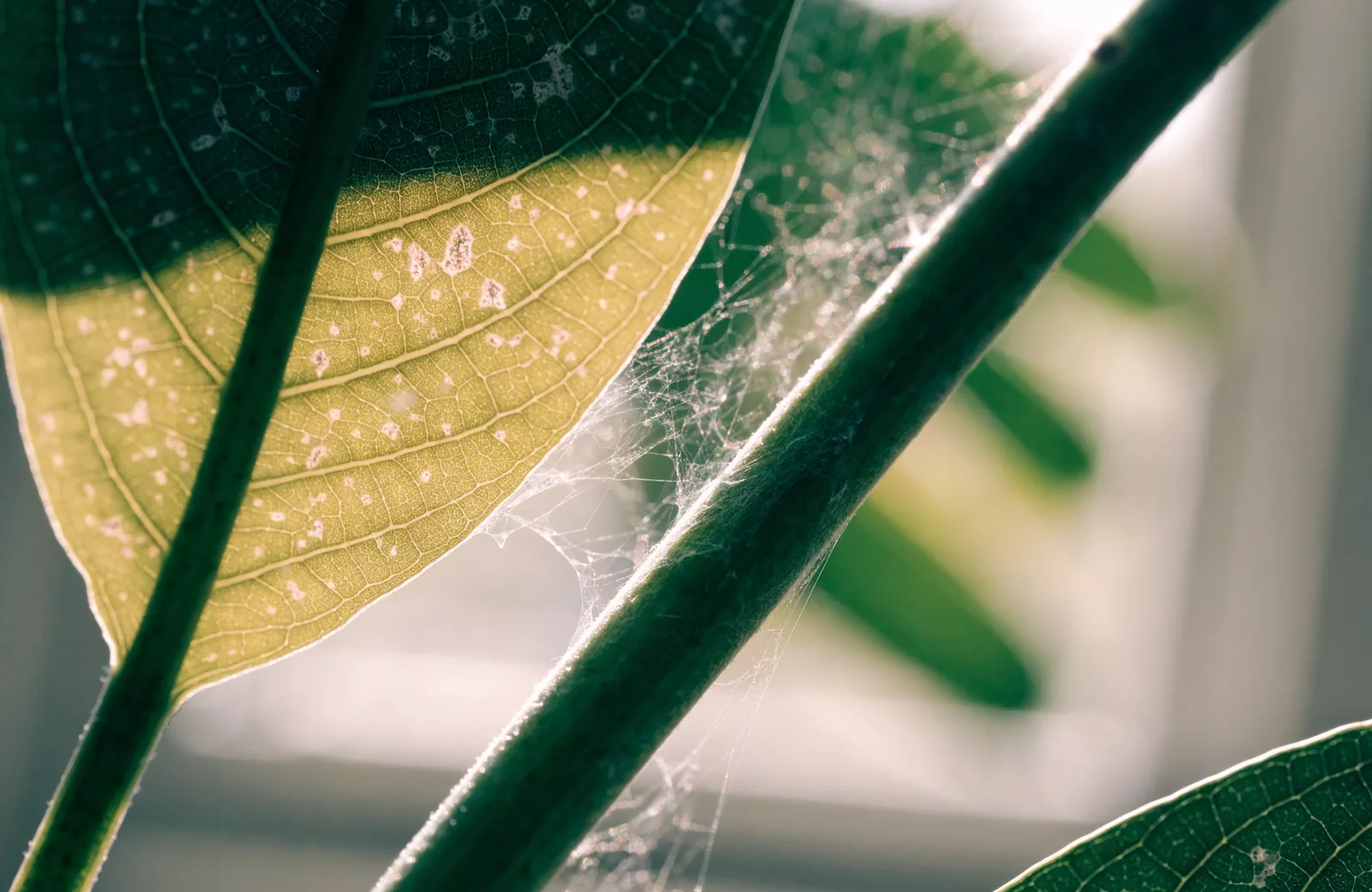
Spider mites are the pest most likely to be discovered too late. They're barely half a millimetre long, they start on the undersides of leaves, and by the time you spot the classic fine webbing strung between stem and leaf, there are usually thousands of them. Summer is their season — hot, dry rooms are spider mite paradise, and a heatwave can take a population from a few stowaways to a full infestation in under a fortnight. Here's how to confirm them, clear them, and keep them from coming back.
Confirming it's spider mites
The early sign isn't webbing — it's stippling: hundreds of tiny pale-yellow dots peppering the upper leaf surface, where mites have pierced individual cells and drained them. Leaves take on a faded, dusty, almost bronzed look and may curl at the edges. To confirm, hold a sheet of white paper under a suspect leaf and tap it sharply: spider mites fall as tiny specks that start crawling within a few seconds. A hand lens shows the mites themselves — oval, eight-legged, often with two dark patches (the two-spotted spider mite, the species behind most houseplant infestations). Webbing means the colony is already large.
Why they explode in summer
Spider mite generations run on temperature. In a cool room a generation takes a month; at 27–30°C it can be done in little over a week, with each female laying up to a hundred eggs. Dry air helps them twice over — it suits their biology and it stresses the plant, making leaf cells easier to feed on. That's why infestations so often appear during heatwaves and in rooms with radiators or air conditioning, and it's also the first lever you can pull against them: humidity is a weapon.
The treatment plan
- Step 1 — Isolate. Move the plant well away from the rest of the collection, and check its neighbours with the paper-tap test. Mites walk between touching leaves and hitch rides on hands and sleeves.
- Step 2 — Wash. Take the plant to the shower or hose and rinse the foliage firmly, especially the undersides. A good wash physically removes a large share of mites, eggs and webbing before any product is involved. Let the plant drip dry out of the sun.
- Step 3 — Spray. Coat every leaf surface — undersides above all — with insecticidal soap or a horticultural oil such as neem. These work on contact by suffocating mites, so coverage matters far more than brand. Spray in the evening or out of direct light to avoid leaf scorch.
- Step 4 — Repeat. Soaps and oils don't kill eggs. Re-spray every 5–7 days for two to three weeks, so each new hatch is killed before it can breed. Skipping the repeats is the single most common reason treatment 'fails'.
- Step 5 — Reassess. After three weeks, paper-tap test again. If mites persist, switch to the other product (soap to oil, or oil to soap) and continue, or move to biological control below.
While you treat, make the environment hostile: raise humidity around the plant with a pebble tray or humidifier and keep it out of hot direct sun. Wipe down the windowsill, pot rim and saucer too — mites and eggs can survive off the plant for days.
Biological control: fighting mites with mites
For large collections, conservatories or recurring infestations, predatory mites are the professional solution. Phytoseiulus persimilis — a fast, orange-red predator — eats spider mites at every life stage, eggs included, and keeps hunting until the pests are gone. They arrive by post in a vial or sachet, get sprinkled onto affected plants, and need warmth and humidity to work well, which conveniently is exactly what you're providing anyway. One rule: don't combine them with sprays — soaps and oils kill the predators as readily as the pests. Spray first, wait a week, then release.
What not to do
Skip the broad-spectrum bug killers. General insecticides often fail against spider mites — mites aren't insects, and the two-spotted spider mite is notorious for evolving resistance to overused chemicals — while wiping out the natural predators that keep mite numbers down. It's the classic way to trade a small infestation for a chronic one. And know when to fold: a small plant that's more web than leaf is a mite factory endangering the rest of your collection. Binning one badly overrun plant (in a sealed bag, not the compost) is often the cheapest treatment of all.
Keeping them from coming back
Every returning infestation is either a survivor or a new arrival. Against survivors: finish the full three weeks of repeat treatments, and keep susceptible plants (calatheas, palms, ivy, alocasias, hibiscus) off hot, dry windowsills. Against arrivals: quarantine every new plant for two weeks before it joins the collection, and paper-tap test anything that's spent the summer outdoors before bringing it back in. A 30-second undersides check whenever you water is the habit that catches the next infestation while it's still a dozen mites instead of ten thousand.
If you're not certain whether you're looking at spider mites, thrips or something else entirely, photograph the leaf in PlantMe — the app recognises the damage patterns of the common houseplant pests and diseases and tells you which treatment plan you actually need, so you're not spraying blind.
Sources & further reading
Frequently asked questions
Where do spider mites come from?
Almost always hitchhiking: on a new plant, on cut flowers, on a plant returning from a summer outdoors, occasionally through an open window on the breeze. Quarantining new arrivals for two weeks intercepts most infestations.
Can spider mites live in the soil?
They don't feed or breed in soil, but females can shelter in the top layer and in crevices around the pot during treatment. That's why washing the pot, saucer and windowsill — and repeating sprays for three weeks — matters.
Do spider mites bite humans or harm pets?
No. Plant-feeding spider mites can't bite people or animals — they're strictly a plant problem. The webbing is harmless too, just unsightly.
About the author

Plant Rescue & Troubleshooting
Camille spent years behind the counter of a plant shop where every customer arrived with the same question: what's wrong with it? She writes the Journal's rescue guides — calm, diagnosis-first, no guilt — because most 'dying' plants are one correct decision away from recovery.
Try it yourself
Diagnose it instantly with PlantMe
Snap a photo of any plant or leaf. Get the species, the diagnosis, and a care plan in seconds.
Download on theApp Store