Journal/Care Basics · 7 min read
Orchid Finished Flowering? What to Do Next
Your orchid isn't dead when the flowers drop. Where to cut the spike, how to care for it between blooms, and the cool-night trick that triggers reflowering.
Quick answer
When a moth orchid (Phalaenopsis) finishes flowering, cut the spike: down to the base if it has turned brown, or just above the second or third node from the bottom if it is still green — a green spike can branch and rebloom. Then keep the plant in bright indirect light, water weekly by soaking and draining, and feed lightly. A few weeks of cooler nights around 13–18°C is the usual trigger for a new flower spike.
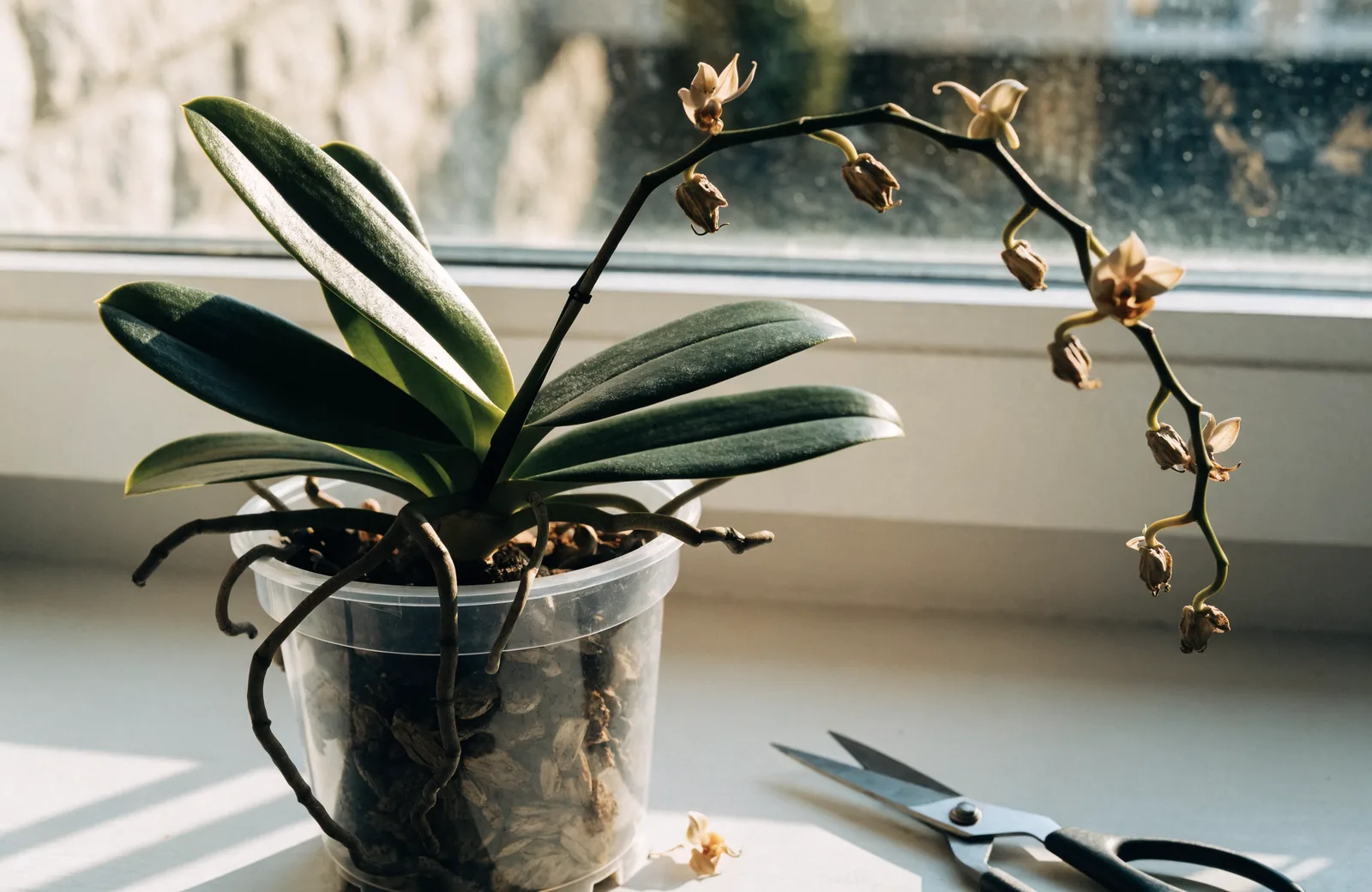
The last flower drops, the bare spike stands there like a question mark, and thousands of orchids quietly go in the bin every week at exactly this point. Which is a shame, because a moth orchid that has finished flowering is not dying — it is resting. With a small amount of the right care, the same plant will flower again, usually within a year and often for decades. Here is what to actually do.
First: your orchid is not dead
The supermarket orchid — the one with broad flat leaves and sprays of flowers on an arching stem — is almost always a Phalaenopsis, the moth orchid. In nature it flowers in cycles: bloom, rest and store energy, bloom again. Dropping all its flowers after two or three months is the normal end of one cycle, not a health problem. As long as the leaves are firm and green and the visible roots are plump and silvery-green, the plant is fine.
What to do with the flower spike
- If the spike has turned brown or yellow and papery: it is finished. Cut it off at the base with sterilised scissors or secateurs. The plant will put its energy into leaves and roots, then send up a fresh spike later.
- If the spike is still green and firm: you have a choice. Cut just above the second or third node (the little raised bumps ringed on the stem) from the base, and the spike may branch and produce a smaller secondary flush of flowers within a couple of months.
- If you want the biggest possible display next time: cut even a green spike to the base. The plant rests properly and the next spike tends to be stronger, with more flowers.
Always cut with a clean, sterilised blade — wipe it with rubbing alcohol first. Orchids are vulnerable to rot and viruses that spread on dirty tools. And note that this rebloom-from-the-old-spike trick is a Phalaenopsis speciality: most other orchids, such as Dendrobium or Cymbidium, flower on new growth, so their spent spikes can simply be removed.
Care between blooms
The months after flowering are when the plant rebuilds its reserves, and the care is refreshingly simple. Light: bright but indirect — an east-facing windowsill is close to perfect, and a metre back from a brighter window also works. Direct summer sun scorches the leaves. Water: roughly once a week, and by the soak-and-drain method rather than the ice-cube folklore — take the inner pot to the sink, drench the bark thoroughly with lukewarm water, and let it drain completely before it goes back in its cover pot. Water when the roots have turned silvery-grey; if they are still bright green, wait. Never leave the pot standing in water.
Feed with a fertiliser formulated for orchids, at the dilution on the label or weaker, two to three times a month while the plant is in growth, skipping it now and then to flush the bark with plain water. Orchids in bark get almost no nutrition from their medium, but their roots are easily burnt by strong feed — 'weakly, weekly' is the old growers' rule for a reason. Humidity around 50% or more keeps the leaves and buds happy; a pebble tray under the pot helps in a dry room.
Should you repot?
Just after flowering is the ideal window to repot, but only if the plant needs it: bark that has broken down into mush, roots rotting in the middle of the pot, or a plant heaving itself over the rim. Orchids actively like being snug, so go up only one pot size or reuse the same pot, and always into fresh orchid mix — chunky bark, often with some perlite, sphagnum moss or coco chips — never ordinary potting compost, which suffocates the roots. Trim off any dead, hollow or mushy roots while you are there; healthy ones are firm and pale green to silver.
The trick that actually triggers reblooming
If a healthy Phalaenopsis refuses to send up a new spike, the missing ingredient is nearly always a temperature cue. In the wild, flowering is set off by the slightly cooler nights at the end of the warm season. Indoors you can recreate it: give the plant three to four weeks of cooler nights, ideally around 13–18°C, while keeping days normal. In practice, moving it closer to a window in autumn, or into a cooler room, is usually enough. A few weeks later, look for a new spike emerging between the leaves — it looks like a root at first, but grows upwards with a flattened, mitten-shaped tip.
Warning: never cut off healthy leaves, and don't be alarmed if the lowest leaf yellows and drops after flowering — sacrificing an old leaf is normal. But wrinkled, limp leaves across the whole plant mean a watering or root problem, not a resting phase, and are worth investigating before you think about reblooming.
How long until it flowers again?
Patience is part of the deal. A spike cut to a node may reflower in eight to twelve weeks; a plant cut to the base typically takes six months to a year to bloom again, flowering once — sometimes twice — a year thereafter. If months pass with lush leaves and no spike, check the two usual suspects: not enough light, or no cool-night trigger.
If you are not sure your orchid's leaves and roots look as they should, photograph it in PlantMe. The app identifies the plant from among 35,000+ species and cultivars, checks it against a library of over 500 diseases and disorders, and tells you whether what you are seeing is a resting orchid or a struggling one.
Frequently asked questions
Should I cut the stem off my orchid after the flowers fall off?
Yes — but where you cut depends on its colour. A brown, dried spike should be cut right at the base. A green spike can be cut just above the second or third node from the bottom, and may branch and rebloom within a couple of months.
How often do orchids rebloom?
A healthy Phalaenopsis typically flowers once a year, sometimes twice, with each display lasting two to three months. After cutting the spike to the base, expect six months to a year before the next full bloom.
Why won't my orchid rebloom?
The two most common reasons are insufficient light and the lack of a cool trigger. Give it a bright spot out of direct sun, then provide three to four weeks of cooler nights around 13–18°C in autumn — that temperature drop is what usually prompts a new flower spike.
About the author

Houseplants & Indoor Styling
Wren has killed enough houseplants to know exactly why yours is struggling — and kept hundreds more thriving in a small, bright flat that doubles as her test lab. She writes about reading plants instead of following rules, and believes every windowsill deserves at least one leaf.
Try it yourself
Diagnose it instantly with PlantMe
Snap a photo of any plant or leaf. Get the species, the diagnosis, and a care plan in seconds.
Download on theApp Store