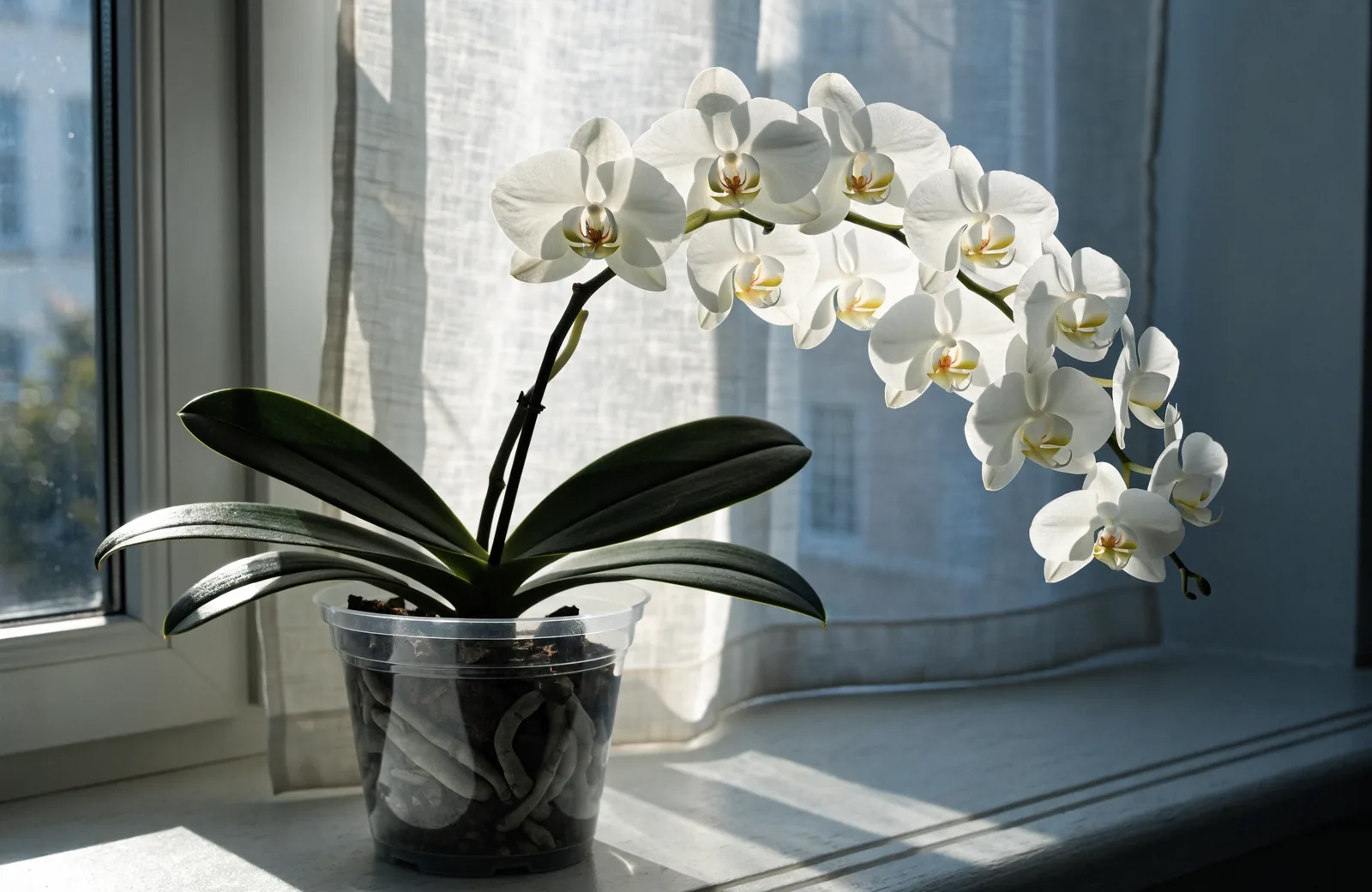
Journal/Care Basics · 7 min read
How to Care for Orchids Indoors
How to care for orchids indoors: light, watering by soaking, bark mix, feeding, and how to make a Phalaenopsis rebloom year after year.
Quick answer
Phalaenopsis orchids want bright indirect light, a soak-and-drain watering roughly once a week (only when the roots turn silvery), an airy bark mix instead of soil, and temperatures of 18–27°C. To trigger reblooming, give the plant a few weeks of cooler nights around 16–18°C after the old flowers drop.
Orchids have a reputation as divas, but the moth orchid — Phalaenopsis, the one sold in every supermarket — is genuinely easy once you unlearn regular-houseplant habits. It doesn't grow in soil, it doesn't want a splash of water every few days, and the roots are supposed to look like that. This guide covers everything a Phalaenopsis needs to flower for months and come back year after year.
Understand what an orchid actually is
In the wild, Phalaenopsis grows as an epiphyte — anchored to tree bark in tropical forests, roots exposed to air, rain and filtered light. Nothing about a pot of dense compost resembles that, which is why orchids are potted in chunky bark and why the single fastest way to kill one is to treat it like a fern. Keep the epiphyte picture in mind and every rule below makes sense.
Light
Bright, indirect light is the target: an east-facing windowsill is close to perfect, and a spot near (not in) a south- or west-facing window works too. Direct midday sun scorches the leaves; too little light is the most common reason a healthy-looking orchid never reblooms. A well-lit orchid has bright grass-green leaves — very dark green leaves usually mean it wants more light, while a reddish tinge means it's getting slightly too much.
Watering: soak, drain, done
Forget schedules based on the calendar alone and read the roots instead. Through the clear inner pot, plump green roots mean the plant is hydrated; silvery-grey roots mean it's time to water. In most homes that works out to roughly once a week in summer and every 10–14 days in winter.
- Lift the inner pot out and soak it in a basin of room-temperature water for 10–15 minutes, or run water slowly through the bark for a minute.
- Let it drain completely before returning it to the cover pot — an orchid must never sit in standing water.
- Water in the morning, and keep water out of the crown (the centre where leaves meet). Water trapped there causes crown rot; blot it out with a paper towel if you splash.
- Skip the famous ice-cube trick. It won't necessarily kill the plant, but tepid water suits the roots of a tropical epiphyte far better than melting ice, and a proper soak wets the bark evenly.
Warning: soft, yellowing, concertina-limp leaves plus brown mushy roots mean overwatering and root rot — the number one orchid killer. Unpot, trim the dead roots with clean scissors, and repot in fresh bark.
Potting mix and repotting
Orchids need an orchid mix — chunky pine bark, sometimes with perlite and a little sphagnum moss. Ordinary potting compost suffocates the roots within weeks. Repot every one to two years, or whenever the bark has broken down into something resembling soil, ideally just after flowering. Choose a clear plastic pot only one size up; orchids flower best slightly snug. Aerial roots reaching out of the pot are normal and healthy — don't cut them off and don't force them into the pot.
Temperature, humidity and feeding
Phalaenopsis likes the same temperatures you do: 18–27°C by day, not below about 15°C at night, and away from radiators, cold windowsills and draughts. Around 50% humidity is plenty. Feed "weakly, weekly": a quarter- to half-strength orchid fertiliser with most waterings during spring and summer, roughly monthly in winter, with a plain-water flush once a month to rinse out salts.
How to make an orchid rebloom
This is the question everyone asks, and the answer is mostly temperature. When the last flower drops, cut the spike: either right above the second or third node (the small bumps on the stem) to encourage a side-shoot of new buds, or at the base if the spike has browned. Then give the plant a few weeks of cooler nights — around 16–18°C, which many homes reach naturally in autumn near a window — while keeping the light bright. A healthy, well-lit Phalaenopsis treated this way typically sends up a new flower spike within one to three months and blooms for two to four months at a stretch.
Tip: a new spike and a new root look similar at first. Roots grow downward with rounded silvery-green tips; spikes emerge from between leaves, flatten as they grow, and look like a mitten. If it reaches for the light, it's a spike — give it a small stake and clip as it lengthens.
Common problems at a glance
- Buds shrivelling and dropping before opening: sudden temperature change, draughts, or the plant drying out — common right after bringing one home.
- Wrinkled, leathery leaves: usually underwatering or dead roots failing to take up water. Check the roots to tell which.
- Yellow lower leaf: one old leaf yellowing and dropping is normal ageing; several at once points to overwatering.
- Sticky droplets on stems or leaves: often harmless sap, but check for scale insects and mealybugs, which love orchids.
- Limp, silvery roots that never plump up after watering: the bark has decomposed — time to repot.
If you're not sure what you're looking at, photograph the plant in PlantMe — the app identifies over 35,000 plant classes and its Plant Doctor matches leaf and root symptoms against 500+ diseases to give you a diagnosis and treatment plan in seconds.
Sources & further reading
Frequently asked questions
How often should I water my orchid?
When the roots turn silvery-grey and the pot feels light — roughly weekly in summer, every 10–14 days in winter. Soak thoroughly, then drain completely. Never leave it standing in water.
Should I cut the stem after the flowers fall off?
Yes. Cut above the second or third node on a green spike to encourage a side branch of new flowers, or cut it at the base if it has turned brown, and let the plant put energy into new leaves and roots.
Why are my orchid's roots growing out of the pot?
Those are aerial roots and they're completely normal for an epiphyte. Leave them alone — don't cut them off or bury them. Lots of vigorous aerial roots are a sign of a healthy plant.
Can I repot an orchid while it's flowering?
Better not, unless it's an emergency like root rot. Repotting is a shock and usually costs you the flowers. Wait until the last bloom drops, then repot into fresh bark.
About the author

Houseplants & Indoor Styling
Wren has killed enough houseplants to know exactly why yours is struggling — and kept hundreds more thriving in a small, bright flat that doubles as her test lab. She writes about reading plants instead of following rules, and believes every windowsill deserves at least one leaf.
Try it yourself
Diagnose it instantly with PlantMe
Snap a photo of any plant or leaf. Get the species, the diagnosis, and a care plan in seconds.
Download on theApp Store