Journal/Plant Science & Curiosities · 6 min read
10 of the Rarest (and Priciest) Houseplants in the World
From the Monstera obliqua to the £6,000 Anthurium — a guided tour of the world's rarest houseplants and why they cost what they do.
Quick answer
The rarest houseplants — Monstera obliqua, Philodendron spiritus-sancti, Anthurium warocqueanum 'dark form', Monstera Thai Constellation, and others — sell for £500 to £20,000+. Rarity comes from slow propagation, difficult sourcing, or, in a few cases, deliberate speculation.
In 2022, someone in New Zealand paid the equivalent of £19,000 for a single variegated Rhaphidophora tetrasperma cutting. Rare-plant collecting is now a genuine sub-culture, and prices go where scarcity and social media meet.
1. Monstera obliqua (Peru form)
The 'ghost' monstera — leaves are mostly hole. Extremely slow-growing and often confused with the (much more common) Monstera adansonii. True Peru forms sell for £500–2,000 for a small plant.
2. Philodendron spiritus-sancti
Discovered in Brazil in 1984, only around 12 wild specimens are known. Cultivated cuttings routinely sell for £3,000–8,000. Long, narrow drooping leaves.
3. Anthurium warocqueanum 'dark form'
The 'queen anthurium'. Long velvet leaves with pale silvery veining. Ordinary forms are collectible; the true dark form fetches £1,000–5,000.
4. Monstera Thai Constellation
Yellow-splashed cream variegation, produced only through tissue culture in Thailand. Went from £500 to widely available £150–400 in five years — a good case study in how rarity collapses.
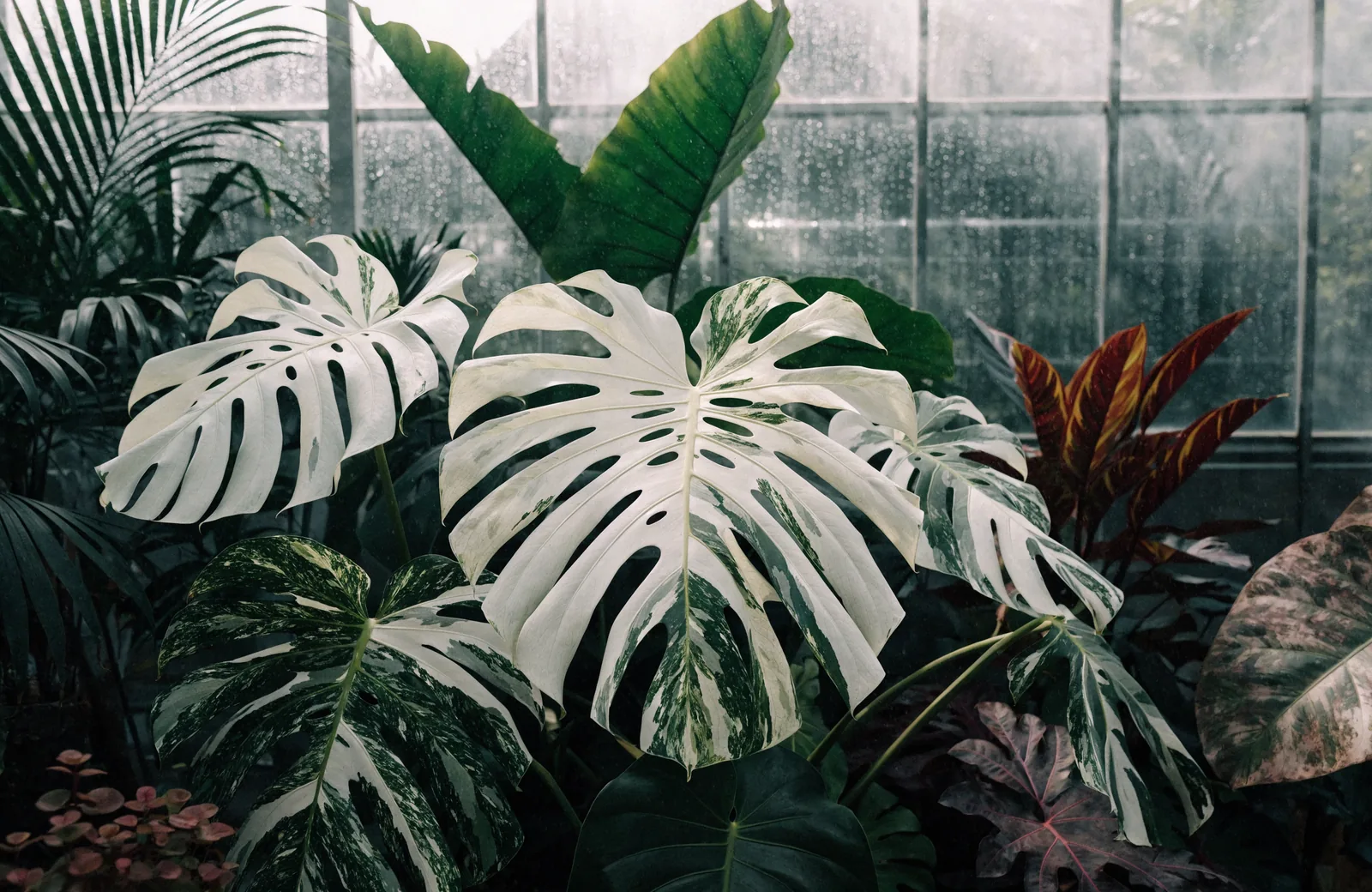
5. Monstera deliciosa 'Albo Variegata'
Pure white variegation. Naturally unstable, only propagated by cuttings, so supply grows slowly. Small rooted cuttings still sell for £200–600 in 2026.
6. Philodendron Pink Princess (real form)
Bubblegum-pink variegated leaves. The 'real' cultivar with strong pink is £100–300; the recent flood of tissue-cultured stock is much cheaper but often less pink.
7. Alocasia azlanii
Metallic bronze leaves with electric pink veins, native to Borneo. Difficult to propagate and finicky about humidity. £200–800 typical.
8. Variegated Syngonium 'Aurea'
Bright yellow variegated arrowhead vine. Grows fast once established, which has moderated prices from £500 to around £100 for a rooted cutting.
9. Philodendron gloriosum 'variegata'
A crawling philodendron with velvety heart-shaped leaves and cream variegation. Slow spreader, so cuttings are limited. £300–1,500.
10. Anthurium 'papillilaminum × warocqueanum'
Hybrid crosses in the collector anthurium world routinely change hands for £2,000+ when the parents are prized.
Why prices collapse
Tissue culture — mass-producing plants in labs — can turn a £1,000 rarity into a £50 plant in 3–4 years. Buying rare plants is not a reliable investment strategy. Buy what you love.
PlantMe's ID model can tell a true Monstera obliqua from a common adansonii — worth checking before you spend serious money.
Frequently asked questions
Are rare houseplants harder to care for?
Not necessarily. Most rare aroids need the same bright indirect light, chunky mix, and warm humid conditions as their common cousins. The variegated ones just grow slower.
Where do rare plants come from?
A mix of specialist growers in the Netherlands, Thailand, Indonesia, and Ecuador; and hobbyist collectors selling cuttings on Instagram and dedicated marketplace sites.
Is buying rare plants ethical?
Tissue-cultured or nursery-propagated plants are fine. Wild-collected plants of protected species (many Anthurium and orchid species) are not — check for CITES certification.
About the author

Plant Science & Curiosities
Lena is a botanist who thinks the strangest thing about plants is how rarely we ask why they do what they do. She covers the science side of the Journal — photosynthesis, plant communication, disease biology — translating research into things you can actually use at the potting bench.
Try it yourself
Diagnose it instantly with PlantMe
Snap a photo of any plant or leaf. Get the species, the diagnosis, and a care plan in seconds.
Download on theApp Store