Journal/Care Basics · 7 min read
Rubber Plant Care: How to Grow Ficus Elastica
How to care for a rubber plant: light, watering, soil, pruning and propagation, plus fixes for leaf drop and yellow leaves on Ficus elastica.
Quick answer
A rubber plant (Ficus elastica) wants bright, indirect light, watering when the top 2–3 cm of soil is dry (roughly weekly in summer, every 10–14 days in winter), temperatures of 16–27°C and a well-draining mix. Wipe the leaves monthly and keep it away from cold draughts — sudden leaf drop is almost always a chill or a move.
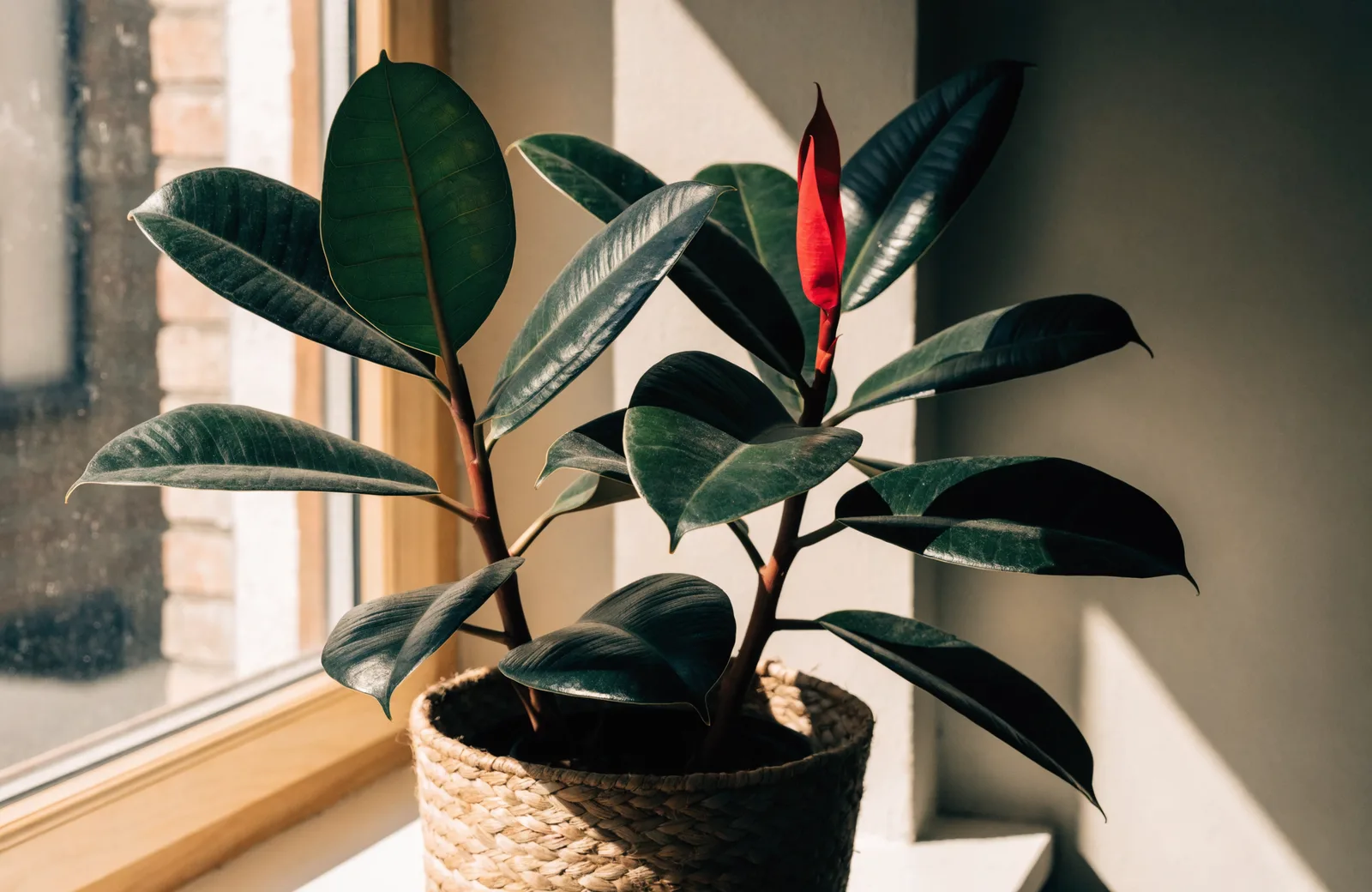
The rubber plant has quietly become one of the most searched-for houseplants in the world, and it deserves the attention. Ficus elastica grows fast, forgives the occasional missed watering, and its glossy, deep-green leaves make even a beginner's windowsill look styled. Give it a decade and decent light and it will happily become a small indoor tree. Here's everything it actually needs.
Light
Bright, indirect light is the sweet spot. An east-facing window is ideal; a spot a metre or two back from a south- or west-facing window works just as well. A rubber plant will tolerate lower light — it's one of the reasons it became an office classic — but it will grow slowly, stretch towards the window and produce smaller leaves. Harsh midday sun through glass can scorch leaves that aren't used to it, so acclimatise the plant gradually if you move it somewhere brighter.
Variegated cultivars such as 'Tineke' and 'Ruby' need noticeably more light than the plain green 'Robusta'. The cream and pink sections of their leaves contain no chlorophyll, so the plant has less working leaf area. In a dim corner a 'Tineke' loses its markings and sulks; near a bright window it glows.
Watering
Water when the top 2–3 cm of soil feels dry — stick a finger in rather than watching the calendar. In a warm, bright room that usually means about once a week in spring and summer and every 10–14 days in winter. Water thoroughly until it runs from the drainage holes, then empty the saucer. Rubber plants store some moisture in their thick leaves and stems, so they cope far better with slightly too dry than with constantly wet.
Warning: yellowing lower leaves combined with soil that stays wet for days is the classic sign of overwatering, and the first step towards root rot. Let the pot dry out properly, check that water can actually escape, and repot into a fresher, airier mix if the soil smells sour.
Temperature and humidity
Aim for 16–27°C. Rubber plants handle normal living-room conditions without complaint, but they hate cold: don't let them sit below about 13°C, and keep them away from draughty doorways, single-glazed winter windowsills and air-conditioning vents. Average household humidity is fine; if your air is very dry in winter, an occasional shower rinse or a humidifier nearby keeps the foliage supple.
Soil, feeding and repotting
Any good houseplant compost cut with about a quarter perlite or bark drains well enough. Feed with a balanced liquid fertiliser once a month through spring and summer, and not at all in winter. Young plants like to be repotted every one to two years in spring, one pot size up; a large, mature plant can simply have the top few centimetres of compost refreshed each year.
Leaf care, pruning and shaping
Those big leaves are dust magnets, and a dusty leaf photosynthesises measurably worse. Wipe them with a damp cloth once a month — you'll be surprised how much darker and glossier the plant looks afterwards.
Prune in spring if the plant gets leggy or too tall. Cut just above a node (the bump where a leaf joins the stem) and the plant will usually branch below the cut, giving you a fuller shape. Wear gloves: every cut bleeds a milky white latex sap that irritates skin and stains clothes. Press a damp paper towel on the cut for a minute to stop the flow.
Tip: rotate the pot a quarter turn every time you water. Rubber plants lean hard towards the light, and regular rotation is the difference between an even, upright tree and a permanent tilt.
Propagation
Take a stem cutting in spring or summer with at least one leaf and one node, let the sap stop bleeding, then root it in water or moist compost — roots take four to eight weeks. For a thick, established stem, air layering works even better: wound the stem, wrap the cut in damp sphagnum moss and cling film, and pot up the rooted section once roots fill the moss.
Common problems
- Sudden leaf drop: usually cold draughts, a recent move, or a big light change. Stabilise conditions and it will regrow.
- Yellow lower leaves: almost always overwatering — check the soil and roots first.
- Brown, crispy leaf edges: dry air or a root ball left bone-dry too long.
- Leggy growth with big gaps between leaves: not enough light.
- Sticky residue or fuzzy white blobs: mealybugs or scale — wipe off with alcohol on a cotton pad and re-check weekly.
Is a rubber plant safe for pets?
The latex sap is mildly toxic. Chewed leaves can cause drooling and stomach upset in cats and dogs, and the sap can irritate skin. It's nowhere near as dangerous as a lily, but it belongs out of reach of determined nibblers.
Not sure whether your ficus is a rubber plant, and whether that spot on the leaf is sunburn or something worse? Snap a photo in PlantMe — the app identifies the exact cultivar and cross-checks leaf symptoms against its disease library, then gives you a treatment plan.
Sources & further reading
Frequently asked questions
How big does a rubber plant get indoors?
With good light, 2–3 metres within a decade — in the wild Ficus elastica is a 30-metre tree. Prune the top in spring to keep it at the height you want; it responds by branching and thickening instead.
Why is my rubber plant dropping leaves?
Sudden leaf drop is a stress response, most often to cold draughts, a house move, repotting or a big drop in light. Fix the conditions and be patient — a healthy plant regrows from the top within a season.
Can I put my rubber plant outside in summer?
Yes, once nights stay above about 15°C. Acclimatise it over a week in bright shade first — leaves that lived indoors will scorch in immediate full sun. Bring it back in before autumn nights turn cold.
Why is my variegated rubber plant turning green?
Too little light. Variegated cultivars revert to plain green to survive in dim spots. Move it closer to a bright window and new leaves will show the cream and pink markings again.
About the author

Houseplants & Indoor Styling
Wren has killed enough houseplants to know exactly why yours is struggling — and kept hundreds more thriving in a small, bright flat that doubles as her test lab. She writes about reading plants instead of following rules, and believes every windowsill deserves at least one leaf.
Try it yourself
Diagnose it instantly with PlantMe
Snap a photo of any plant or leaf. Get the species, the diagnosis, and a care plan in seconds.
Download on theApp StoreKeep reading
See also