Journal/Plant Science & Curiosities · 6 min read
Mycorrhizal Fungi: The Underground Trade Deal Your Plants Already Signed
Most plants outsource part of their root system to fungi, paying in sugar for phosphorus and water. What mycorrhizas are, which plants form them, and what the evidence says about shop-bought inoculants.
Quick answer
Mycorrhizal fungi are soil fungi that colonise plant roots and trade phosphorus and water for the plant's sugars, effectively extending the root system. Most established garden soils already contain them. Evidence for shop-bought inoculants is weak, so the better investment is to dig less, fertilise less and keep living roots in the soil.
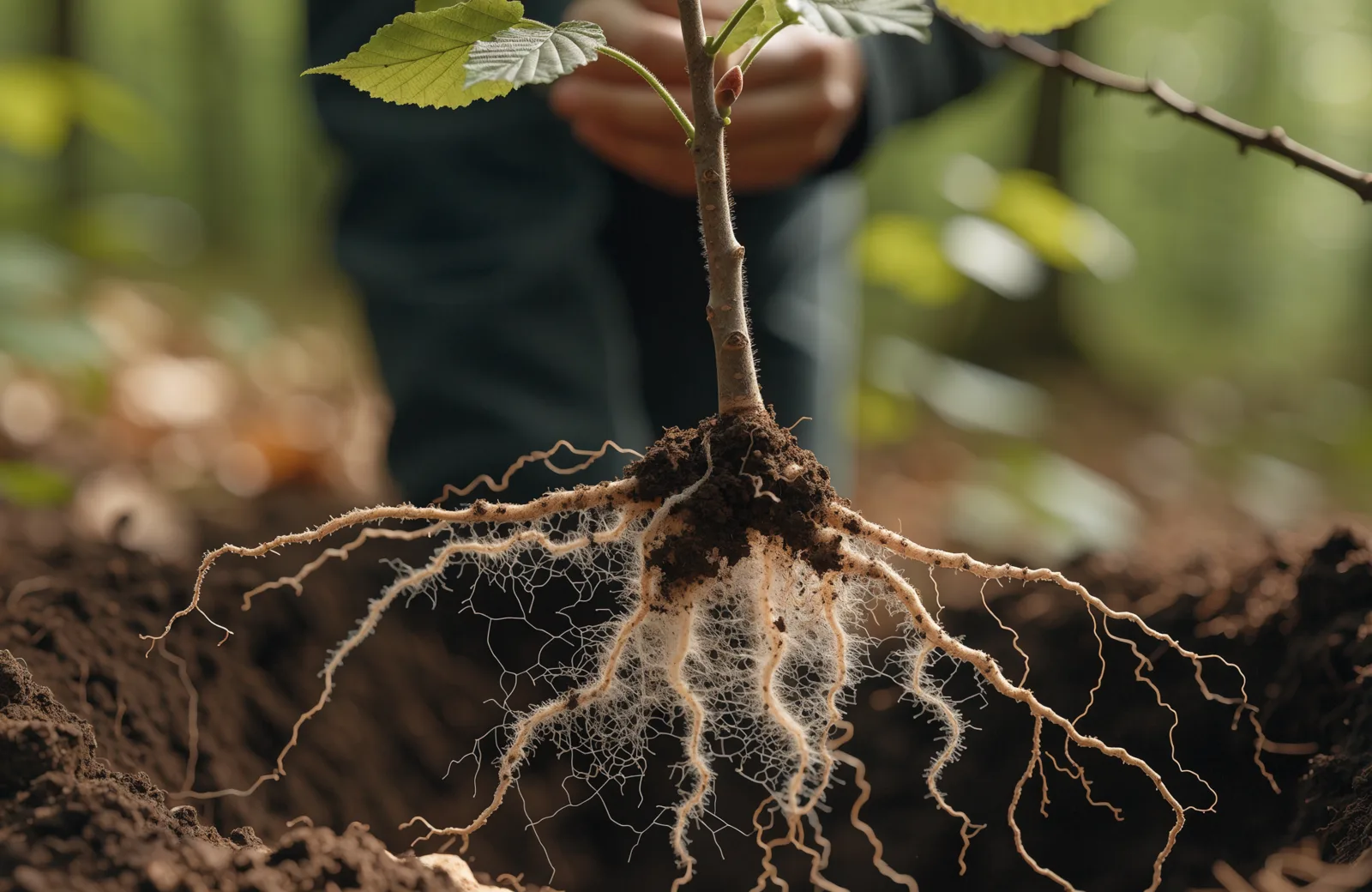
Dig up almost any healthy plant and you are not looking at one organism. Wrapped around — and in most cases growing inside — its roots is a fungus, threading outward into the soil in filaments far finer than any root could manage. This partnership is called a mycorrhiza, literally "fungus-root", and it is not a curiosity at the margins of botany: the large majority of land plants form one, and the arrangement is hundreds of millions of years old, predating roots as we know them.
Three terms are worth fixing before anything else. A mycorrhiza is the partnership itself, the compound organ of root plus fungus. Hyphae are the fungal filaments that do the work — threads a few thousandths of a millimetre across that push between soil particles and into pores that roots are simply too fat to enter. An inoculant is the thing sold in garden centres: a packet of fungal spores intended to start the partnership at planting time. The first two are settled biology. The third, as we will see, is where the evidence gets thin.
The deal, in plain terms
The exchange runs on a simple economy. The fungus is far better than the plant at foraging — its hyphae extend the effective root system enormously and are particularly good at retrieving phosphorus, an element that barely moves through soil and is often locked up just beyond a root's reach — and it delivers that phosphorus, along with water and other nutrients, into the root. The fungus, in return, cannot photosynthesise. It is paid in sugars that the plant makes in its leaves and ships down to its roots. Think of it as a courier network the plant hires rather than owning its own fleet: the couriers reach addresses the plant never could, and they are paid in the one currency the plant can print — carbon. The same fungal network, incidentally, is one of the channels by which plants pass signals to their neighbours.
One word, three different partnerships
"Mycorrhizal" covers several distinct arrangements, and which one a plant forms is fixed by its ancestry, not by anything you do with a watering can.
| Type | How it grows | Typical partners |
|---|---|---|
| Arbuscular (AMF) | Hyphae penetrate the root's cells and branch inside them | Most garden plants: vegetables such as tomatoes, peppers, squash and beans, most ornamentals, lawns |
| Ectomycorrhizal (ECM) | Hyphae sheathe the root and grow between cells, not into them | Trees: oak, beech, birch, pine, hazel, hickories and most conifers |
| Ericoid | Fine coils inside the very thin roots of heathland plants | Blueberries, rhododendrons, heathers and other ericaceous plants |
A minority of plants sit the whole thing out. The cabbage family — cabbage, broccoli, kale, radish — along with beets, chard and spinach do not form functional mycorrhizas at all. No product can change that, which is the first useful filter for any claim printed on a packet.
So do the bagged ones work?
Here the mechanism and the market part company. The symbiosis itself is as real as photosynthesis. Whether buying spores improves anything in an ordinary garden is a different question, and the research record is not kind. A meta-analysis summarised by the University of Connecticut's home-garden extension found that roughly 80% of commercial inoculant treatments produced minimal or no mycorrhizal colonisation of roots, and in a 2025 University of Zürich evaluation, none of the seven products marketed to home gardeners established the symbiosis under controlled conditions. Spores are living material; sitting in a warehouse, and then on a shelf, is not kind to them, and a product raised on one host plant may be a poor match for another.
The deeper problem is that the product is usually redundant. An established bed, a lawn, a border that has held plants for years — these already contain resident mycorrhizal fungi, arrived on their own and adapted to your soil. Adding bought spores to a functioning network has no evident benefit. The RHS, which takes a warmer view of inoculants than the extension literature does, still frames them for particular situations: genuinely impoverished soil — new builds, ground stripped in construction — and sterile growing media such as peat-free compost mixes, where microbial life has to start from zero. If you do use one, the practical points from both sources agree: apply it in direct contact with the roots of a young plant at planting time, choose products based on native fungal species, and do not feed at the same time.
What actually encourages the fungi you already have
The irony of the inoculant aisle is that the fungi respond far more reliably to what you stop doing than to what you add. Fertiliser is the clearest case: a plant with phosphorus delivered free to its roots has no reason to pay couriers, and generously fed plants scale back or abandon the partnership. Fungicides, unsurprisingly, harm fungi. And digging physically tears the hyphal network apart — one more argument for leaving soil structure alone except where planting genuinely requires it. Keeping living roots in the ground through winter helps too, which is one of the quieter arguments for sowing a green manure rather than leaving beds bare.
Autumn, as it happens, is when most of us disturb the most soil — it is tree, shrub and bare-root planting season. If you want your new plant to sign its underground contract quickly: improve the planting area with organic matter rather than enriching the hole with concentrated feed, firm the plant in, and then practise restraint with the fertiliser bag in its first seasons. The couriers are almost certainly already in the neighbourhood. Your job is to give the plant a reason to hire them.
Sources & further reading
About the author

Plant Science & Curiosities
Lena is a botanist who thinks the strangest thing about plants is how rarely we ask why they do what they do. She covers the science side of the Journal — photosynthesis, plant communication, disease biology — translating research into things you can actually use at the potting bench.
Try it yourself
Diagnose it instantly with PlantMe
Snap a photo of any plant or leaf. Get the species, the diagnosis, and a care plan in seconds.
Download on theApp Store