Journal/Plant Science & Curiosities · 6 min read
Photoperiodism: How Plants Count the Dark
Plants don't read calendars — they measure the night. What photoperiodism is, how phytochrome senses darkness, and why late September is the moment to start a Christmas cactus or poinsettia on long nights.
The autumn equinox slipped past a few days ago, and every plant on your windowsill registered it. Not the warmth — a mild September fools nobody in the plant kingdom — but the nights, which are now longer than the days and stretching a little further every evening. The mechanism plants use to read that change is called photoperiodism, and once you understand it, several of the season's small mysteries — why chrysanthemums flower in autumn, why a poinsettia refuses to colour up in a bright kitchen — resolve into one tidy piece of biology.
Photoperiodism is the ability of an organism to respond to the changing lengths of day and night. In plants it governs some of the biggest decisions in the calendar: when to flower, when an onion should stop making leaves and start making a bulb, when a deciduous tree should begin dismantling its chlorophyll for winter.
It's the night that does the counting
The vocabulary here is a historical accident. Botanists sorted plants into 'short-day' and 'long-day' categories before anyone knew what was actually being measured, and the names stuck. Later research showed that what matters most is the length of uninterrupted darkness, not the daylight. A 'short-day plant' is really a long-night plant: it flowers once the dark period stretches past a critical threshold — for many species, somewhere around the twelve-hour mark that we've just crossed.
Phytochrome, the pigment that runs the stopwatch
The measuring instrument is a pigment called phytochrome, present in the leaves. Phytochrome exists in two interconvertible forms: light flips it almost instantly into one form, and in darkness it slowly relaxes back into the other. Think of it as an hourglass that daylight keeps snapping back upright — only during a long enough stretch of unbroken darkness does the sand run all the way through, and that fully-run-through state is the chemical signal that the night was long. String enough of those long nights together and the plant commits to flowering.
The hourglass metaphor also explains the mechanism's famous fragility: light doesn't pause the countdown, it resets it. Commercial growers exploit this in both directions — blackout cloths pulled over greenhouse benches to guarantee long nights, or a deliberate burst of light in the middle of the night to keep a crop vegetative. It cuts the other way too: even stray light, a torch carried through a greenhouse at night, can set a crop back by weeks. In a living room, the equivalent saboteurs are a hallway lamp, a television, or a streetlight through thin curtains.
Short days, long days, or indifferent
The three photoperiod groups
| Group | What triggers flowering | Examples |
|---|---|---|
| Short-day (really long-night) | Nights lengthening past a critical threshold, as days drop below roughly 12 hours | Chrysanthemum, poinsettia, Christmas cactus |
| Long-day | Days running longer than about 12 hours | Asters, coneflowers, California poppies, lettuce, spinach |
| Day-neutral | Flower on their own schedule, whatever the calendar says | Tomatoes, sweetcorn, cucumbers, some strawberries |
The boundaries are softer than the table implies. Petunias will flower under any day length, but bloom earlier and more heavily when days are long. And flowering is only the best-known photoperiodic response: onion varieties are classed as long-day or short-day according to when they bulb, and the shortening days of autumn are one of the cues behind why leaves change colour in autumn. Day length is simply the most reliable calendar a plant has access to — temperature lies from year to year; the sun does not.
Why this matters in the last week of September
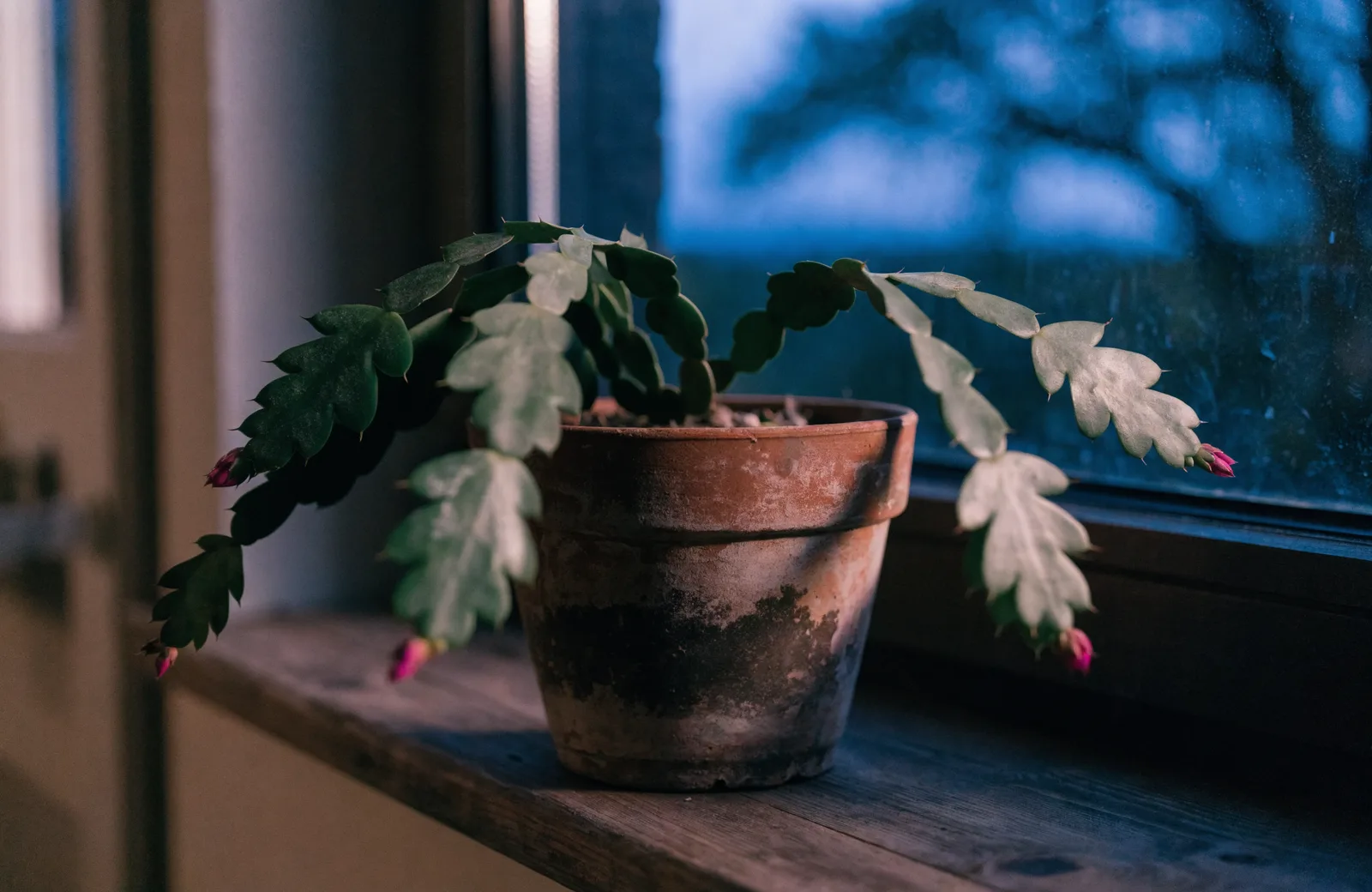
If you keep a Christmas cactus, the clock is already running. To set flower buds it needs fourteen hours or more of continuous darkness each night, starting around mid-September and kept up for at least six weeks, ideally somewhere cool — around 20°C (68°F). Buds usually become visible about four weeks in, and here is the forgiving part: once buds have formed, the photoperiod no longer matters, and your only job is keeping the compost evenly moist so they don't drop. The full routine, including what to do when it still sulks, is in our guide to making a Christmas cactus bloom.
A poinsettia is the same physiology with less margin for error — it is very strongly photoperiodic, and needs those long, uninterrupted dark periods to initiate flower buds and to colour its bracts red. As little as a couple of hours of light interruption in the night is enough to inhibit bud set in these short-day houseplants, which is why the kitchen ones so often stay stubbornly green. If you're overwintering one from last year, our poinsettia care guide covers the darkness regime alongside the everyday care.
Borrowing the growers' trick
None of this requires equipment. To simulate autumn for a short-day plant, cover it — a large box, or an unused cupboard — for at least twelve hours a day for several weeks; that is exactly how nurseries deliver chrysanthemums in flower for any date they choose. To run the trick in reverse and coax a long-day plant into bloom out of season, extend its day with an ordinary grow light. Either way you are not tricking the plant so much as forging its calendar.
This week's jobs, if you want December flowers:
- Choose the dark site now: a cupboard, spare-room corner or box that is genuinely light-tight from early evening until morning — fourteen hours for a Christmas cactus.
- Make it a fixed routine, in at dusk and out at breakfast, and defend it from hallway lamps; consistency over six weeks is the whole trick.
- Check for buds after about four weeks. The moment they appear, the darkness duty ends and even watering becomes the only rule that matters.
Photoperiodism is easy to admire once you notice it. A plant with no eyes and no brain is nonetheless keeping better track of the season than most of us — measuring each night with a pigment, comparing it to a threshold written in its genes, and waiting for the dark to say: now.
Sources & further reading
About the author
Plant Science & Curiosities
Lena is a botanist who thinks the strangest thing about plants is how rarely we ask why they do what they do. She covers the science side of the Journal — photosynthesis, plant communication, disease biology — translating research into things you can actually use at the potting bench.
Try it yourself
Diagnose it instantly with PlantMe
Snap a photo of any plant or leaf. Get the species, the diagnosis, and a care plan in seconds.
Download on theApp Store