Journal/Plant Science & Curiosities · 6 min read
What Is Seed Stratification? Why Some Seeds Refuse to Grow Until Winter Has Happened
Some seeds are built to ignore warmth until they have sat through a winter. What dormancy is, what cold and moisture actually do inside the seed, which plants need stratifying, and three ways to do it — starting this month.
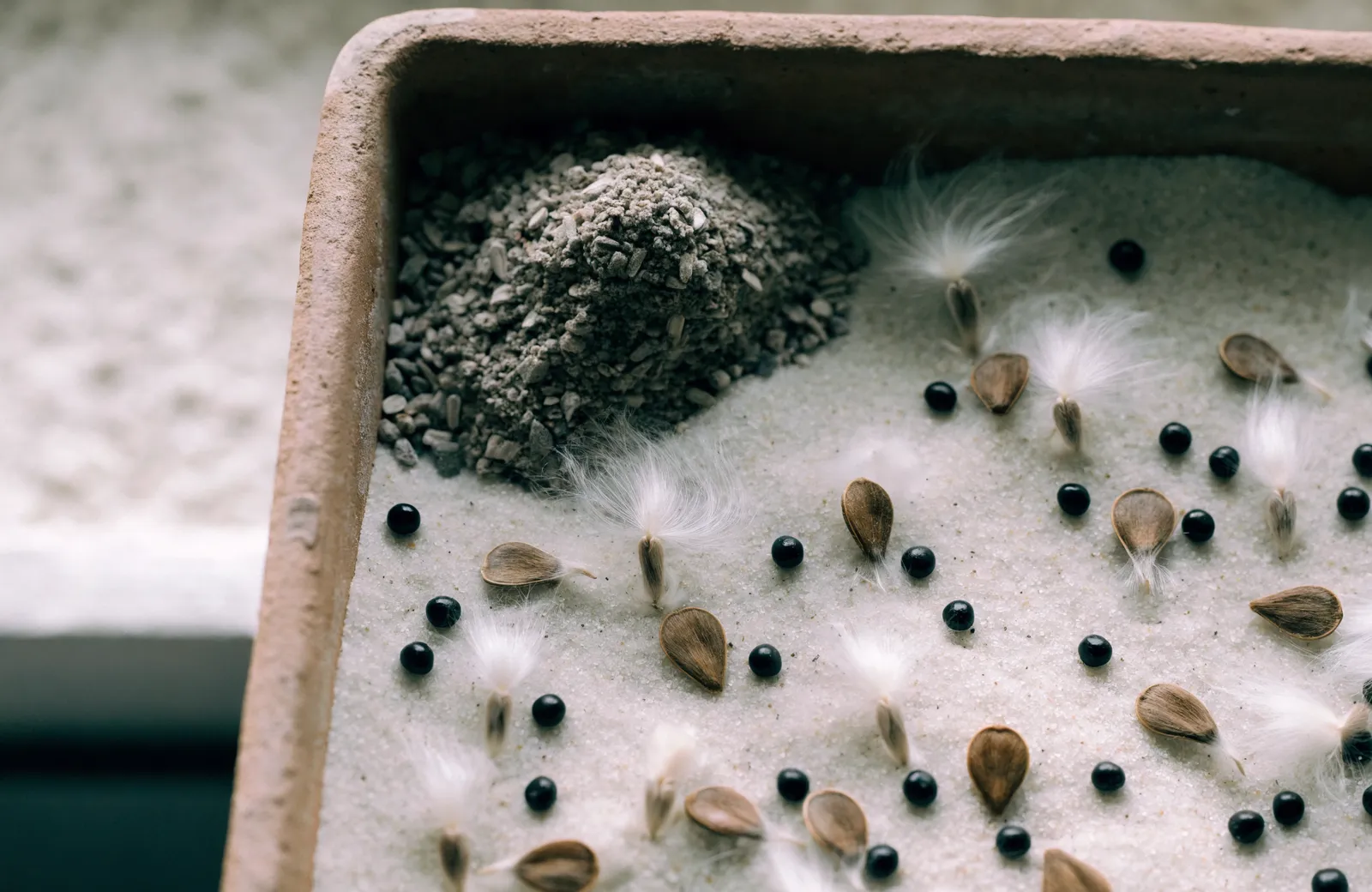
Sow a tomato seed on a warm windowsill and it germinates inside a week. Sow a columbine seed from the garden in the same pot, with the same compost and the same warmth, and — nothing. Not because the seed is dead, but because it is refusing. That refusal has a name, dormancy, and the cold, damp treatment that ends it is called stratification. If a packet of perennial or wildflower seed has ever quietly defeated you, this is the explanation — and October is exactly the right month to be reading it.
Dormancy: the seed's veto
A dormant seed is not asleep in any passive sense. It is alive, provisioned, and chemically held shut: its own internal inhibitors block germination even when water, warmth and oxygen are all on offer. The logic is brutal and sound. A seed that ripens in September and germinates in October produces a seedling that meets its first frost at two weeks old. So plants from climates with real winters evolved a veto — do not germinate until winter has verifiably happened — and they verify it the only way a seed can, by chemistry. Day length is another way plants read the calendar (photoperiodism covers that one), but a buried seed sees no light; it keeps time with temperature instead.
What cold actually does
Stratification is the treatment that satisfies the veto: a sustained spell of cold and moisture together, mimicking the winter the seed is waiting for. During those weeks the germination inhibitors inside the seed gradually break down, so that when temperatures rise the brake is simply no longer there. The useful numbers: the work happens at roughly 1–7°C (35–45°F) — refrigerator-cold, not freezer-cold — and for most herbaceous perennials it takes somewhere between 30 and 60 days. Both conditions have to hold at once. A stratified seed is best imagined as a time-lock safe: cold is the key, but turning the key once achieves nothing — it has to be held in the lock while the clock runs, and the clock only runs while the seed is moist. This is why the packet that spent all winter in a paper envelope in a cold shed germinates no better in March than it would have in October. Dry cold does not count.
One definition worth separating out: scarification. Some seeds are locked mechanically rather than chemically, behind a seed coat too hard for water to penetrate, and those need the coat breached — a nick with a knife, a rub with sandpaper, a soak in hot water — before anything else can happen. A few species need both treatments, in that order. If a seed packet mentions either word, it is telling you the species' unlock sequence.
Who needs it
The usual suspects are plants that evolved where winter is a fact: hardy perennials, natives and wildflowers, and a long list of trees and shrubs. Seed packets flag it with phrases like 'needs pre-chilling', 'requires stratification', or sometimes just 'hardy — reseeds readily'. Seed you collected yourself follows the same rule of thumb — if the parent plant shrugs off frost and drops its seed in autumn, assume the seed expects a winter before it performs. (If you saved seed this summer, our guide to collecting and saving flower seeds covers the storage half of the story.)
Who needs the cold, roughly
| Group | Examples | What to expect |
|---|---|---|
| Hardy herbaceous perennials & natives | Columbine, milkweed, garden phlox, bleeding heart, masterwort, rattlesnake master | Typically 30–60 days of cold, moist conditions |
| Trees & shrubs | Dogwoods, lilacs, species roses, viburnums, barberries | Often longer; some seedlings take a year or more to appear |
| Tender annuals & most vegetables | Tomatoes, basil, courgettes, most bedding annuals | No chilling needed — sow in warmth and they go |
That third row matters: stratification is a specific tool, not a general virtue. Chilling a tomato seed does nothing for it — saved tomato seeds want warmth, full stop. And the same winter-verification logic runs elsewhere in the garden: spring bulbs demand a cold count before they will flower, for reasons that rhyme with everything above — see why spring bulbs need cold.
Three ways to run the program
- Let winter do it — sow directly outdoors in autumn. For seed that needs chilling, this is the method closest to the natural process, and extension trials are blunt that it works beautifully: seed goes where you want it to grow, and the season supplies the cold, the moisture and the timing.
- Pots outside — sow in late autumn or winter into a well-drained mix (equal parts sharp sand and a peat-free seed compost works), top with a thin layer of grit, and stand the pots somewhere cold but sheltered: an unheated porch, a cold frame, the foot of a north wall. Keep them just moist. The milk-jug 'winter sowing' variant — a lidded, vented container sown between December and March — is the same idea with built-in slug armour.
- The refrigerator — mix seed with slightly damp vermiculite or sand in a labelled bag or box, and give it its 30–60 days of fridge time. This is the controlled option when you want to start seedlings indoors on your own schedule, or when the packet arrives in February and winter is nearly spent.
Where it goes wrong
Four failure modes account for almost every disappointment. Too wet: saturated medium invites fungal rot — the target is damp, never sodden. Not cold for long enough: an interrupted or abbreviated chill leaves the inhibitors partly intact, and germination stays patchy. Too much sun too soon: seedlings that germinate in a shaded cold corner scorch if marched straight into full light — acclimatise them in stages. And predation: outdoor pots are a winter buffet for rodents, birds and slugs unless covered. To these I would add a fifth, the most common of all: impatience. Some perfectly viable seed simply sits out the first spring and appears the following year. Keep the pot, keep it weeded, and wait.
If you sowed outdoors, spring will present you with a tray of anonymous green and a philosophical question: seedling or weed? A photo in PlantMe — trained on 35,000+ plant classes — will shortlist the candidates, though give any seedling the courtesy of a pair of true leaves first; cotyledons keep their secrets. The deeper satisfaction of stratification, I find, is that it reverses the usual direction of gardening. You are not coaxing a plant to do something. You are finally saying the one password it has been waiting to hear.
Sources & further reading
Frequently asked questions
Do all seeds need stratification?
No — most vegetables and tender annuals germinate on warmth and water alone, and chilling them gains nothing. Stratification is specifically for species from cold-winter climates whose seeds are built to wait winter out: many hardy perennials, natives, trees and shrubs.
How do I know whether a particular seed needs it?
Check the packet first: 'needs pre-chilling', 'requires stratification' or 'cold-hardy, reseeds' are the giveaway phrases. For collected seed, go by the parent: a frost-hardy plant that sheds seed in autumn very likely builds dormancy into that seed. When in doubt, split the batch — sow half warm, stratify half — and let the seeds answer.
Can I just put the seed packet in the fridge as it is?
Cold alone isn't the treatment — the seed has to be cold and moist at the same time for the inhibitors to break down. A dry packet in the fridge (or a cold shed) is just storage. Mix the seed into damp sand or vermiculite first, then refrigerate it for the 30–60 days.
About the author

Plant Science & Curiosities
Lena is a botanist who thinks the strangest thing about plants is how rarely we ask why they do what they do. She covers the science side of the Journal — photosynthesis, plant communication, disease biology — translating research into things you can actually use at the potting bench.
Try it yourself
Diagnose it instantly with PlantMe
Snap a photo of any plant or leaf. Get the species, the diagnosis, and a care plan in seconds.
Download on theApp Store