Journal/Seasonal · 7 min read
When to Prune Hydrangeas: The Right Time for Every Type
Mophead, lacecap, paniculata or Annabelle? When to prune each hydrangea type, why timing decides next year's flowers, and the one season to avoid.
Quick answer
It depends on the type. Mophead, lacecap, oakleaf and climbing hydrangeas flower on old wood: prune them lightly straight after flowering in summer, never in autumn or spring. Paniculata and smooth (Annabelle) hydrangeas flower on new wood: cut them back hard in late winter or early spring. Prune the wrong group at the wrong time and you trade a year of flowers for tidiness.
"When should I prune my hydrangea?" has a frustrating but honest answer: it depends entirely on which hydrangea you own. Prune a mophead at the wrong moment and you will spend a whole summer staring at a leafy green bush with not a single bloom. The good news is that there are really only two groups to keep straight — and one simple question sorts every hydrangea into the right one.
The one question that decides everything: old wood or new wood?
Old-wood hydrangeas form next summer's flower buds on this year's stems, in late summer and autumn. Those buds then sit on the bare branches all winter, waiting. Cut those stems back in autumn, winter or spring and you are snipping off next year's flowers — the plant stays perfectly healthy, it just cannot bloom. New-wood hydrangeas do the opposite: they flower on stems grown in the same season, so you can cut them back hard while dormant and they will still flower on the regrowth.
- Old wood — prune just after flowering, in summer: mophead and lacecap (Hydrangea macrophylla), mountain (H. serrata), oakleaf (H. quercifolia), climbing hydrangea (H. petiolaris).
- New wood — prune in late winter or early spring: panicle types (H. paniculata, like 'Limelight' and 'Vanille Fraise') and smooth hydrangeas (H. arborescens, most famously 'Annabelle').
- Both — repeat-flowering cultivars such as the Endless Summer series bloom on old and new wood, so they forgive almost any timing.
Mopheads and lacecaps: a light touch, straight after flowering
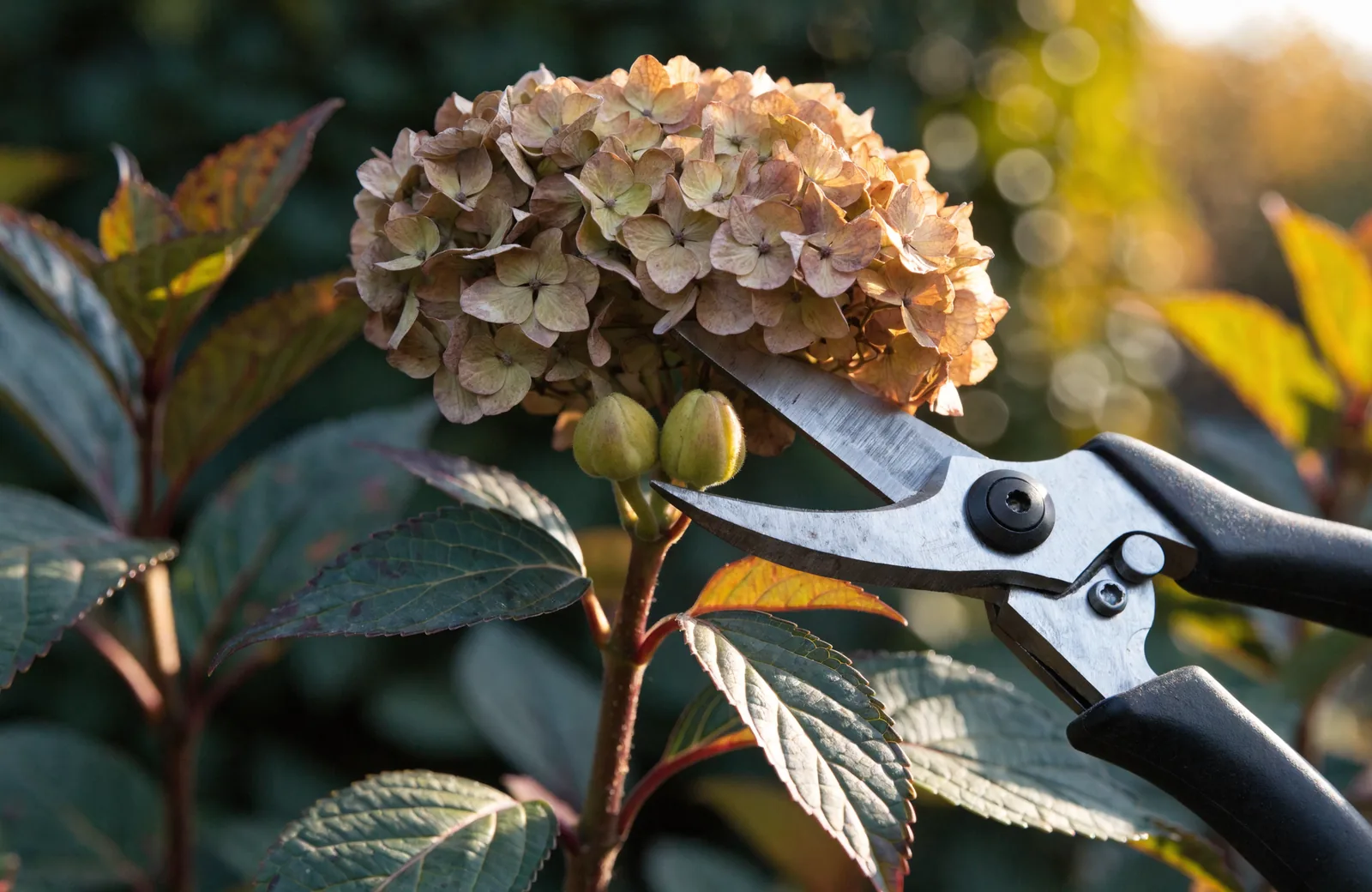
Once the flowerheads fade, cut each flowered stem back to the first strong pair of buds beneath the old head, remove any dead or spindly stems, and stop there. Done by late summer, this gives the plant time to set buds on what remains. Macrophyllas do not need — or want — hard annual cutting; constant heavy pruning just produces lush foliage and no flowers.
In colder regions, many gardeners skip even this and simply deadhead in mid-spring, cutting back to the first fat pair of buds below each old flowerhead. Leaving the spent heads on over winter is not laziness — they shield the buds beneath from frost.
Paniculata and 'Annabelle': cut hard while dormant
New-wood types are wonderfully unfussy. In late winter or early spring, just as the buds begin to swell, cut all of last year's stems back — paniculatas to a framework 30–60 cm tall, cutting each stem to just above a fat pair of buds; 'Annabelle' and other smooth hydrangeas as low as 20–30 cm from the ground. The harder you cut, the fewer but larger the flowerheads; a lighter trim gives more, smaller heads on sturdier stems. Either way, flowers are guaranteed, because they form on the new season's growth.
Oakleaf and climbing hydrangeas: barely at all
Oakleaf hydrangeas need only the dead, damaged or badly placed stems removed straight after flowering — their peeling bark and autumn colour are half the point of growing them. Climbing hydrangeas flower on short side shoots from old wood; trim overlong or outward-growing shoots right after flowering and otherwise leave the framework alone.
The season to avoid
If you take one rule from this guide: do not prune old-wood hydrangeas from late summer onwards. From August (or from late summer, wherever you garden) those stems carry next year's buds. Autumn tidying, winter cut-backs and enthusiastic spring pruning are the top three reasons a healthy hydrangea refuses to flower. When in doubt, wait — a hydrangea left unpruned for a year always flowers; one pruned at the wrong time never does.
Tip: gardening in the southern hemisphere, or advising someone who is? Shift everything by six months. Old-wood types get their light prune straight after the summer flowering (roughly February–March), and new-wood types are cut hard at the end of winter, in August–September, just before spring growth begins.
Renovating an old, overgrown hydrangea
An ancient, congested macrophylla that flowers poorly can be rejuvenated gradually: each summer, straight after flowering, remove a third of the oldest, thickest stems right at the base. Over three years the shrub rebuilds itself from fresh growth without ever losing a whole season of flowers. Only cut the entire shrub to the ground as a last resort — it will respond with vigorous new stems but usually skip a year of bloom.
Warning: a hydrangea that fails to flower is not always a pruning casualty. Late spring frosts can kill the buds on old-wood types after they start to swell, and deer are notorious bud thieves in winter. If your pruning timing is right and flowers still fail, frost pockets and browsing damage are the next suspects to rule out.
Not sure which hydrangea you have?
Leaf shape gives it away: huge, rounded, glossy leaves mean macrophylla; cone-shaped flowerheads on a shrub with matt, pointed leaves mean paniculata; deeply lobed, oak-like leaves mean quercifolia; heart-shaped leaves on clinging aerial roots mean a climber. Or skip the botany — photograph the plant in PlantMe and the app identifies which of 35,000+ plants you are looking at, then files it in your garden with care and pruning reminders matched to the type.
Sources & further reading
Frequently asked questions
Can I prune my hydrangea in the autumn?
Only the new-wood types (paniculata and 'Annabelle'), and even those are better left until late winter so the dried heads can protect the stems and feed winter interest. Never cut mophead, lacecap, oakleaf or climbing hydrangeas in autumn — you will remove next summer's flower buds.
Why didn't my hydrangea flower this year?
The usual culprit is pruning an old-wood type in autumn, winter or spring, which removes the flower buds. Other causes: a late frost killed the swelling buds, deer ate them over winter, or the plant sits in too much shade. The shrub itself usually looks perfectly healthy either way.
Should I deadhead hydrangeas, and when?
Yes — deadheading (removing only the spent flowerhead) is safe on every type at any time. In mild gardens, snip heads off as they fade; in colder areas, leave them on over winter to protect the buds below and cut back to the first strong pair of buds in mid-spring.
How hard can I cut back a 'Limelight' or 'Annabelle' hydrangea?
Very hard. Both flower on new wood, so you can take 'Annabelle' down to 20–30 cm and a paniculata like 'Limelight' back to a low framework in late winter and still get a full display. Harder pruning means fewer but bigger heads; lighter pruning means more, smaller ones on stronger stems.
About the author

Vegetable Garden & Seasons
Arthur has worked the same allotment for thirty years and measures the calendar in sowings, not months. He writes practical, no-nonsense guides to growing food and keeping a garden honest through the seasons — and has little patience for folklore that doesn't survive contact with a real plot.
Try it yourself
Diagnose it instantly with PlantMe
Snap a photo of any plant or leaf. Get the species, the diagnosis, and a care plan in seconds.
Download on theApp Store