Journal/Plant Science & Curiosities · 6 min read
Evergreens Aren't Really Evergreen
Every needle has a lifespan. Dr. Lena Okafor on why conifers shed their oldest needles each autumn, how the rest survive winter, and how to tell normal needle drop from real trouble.
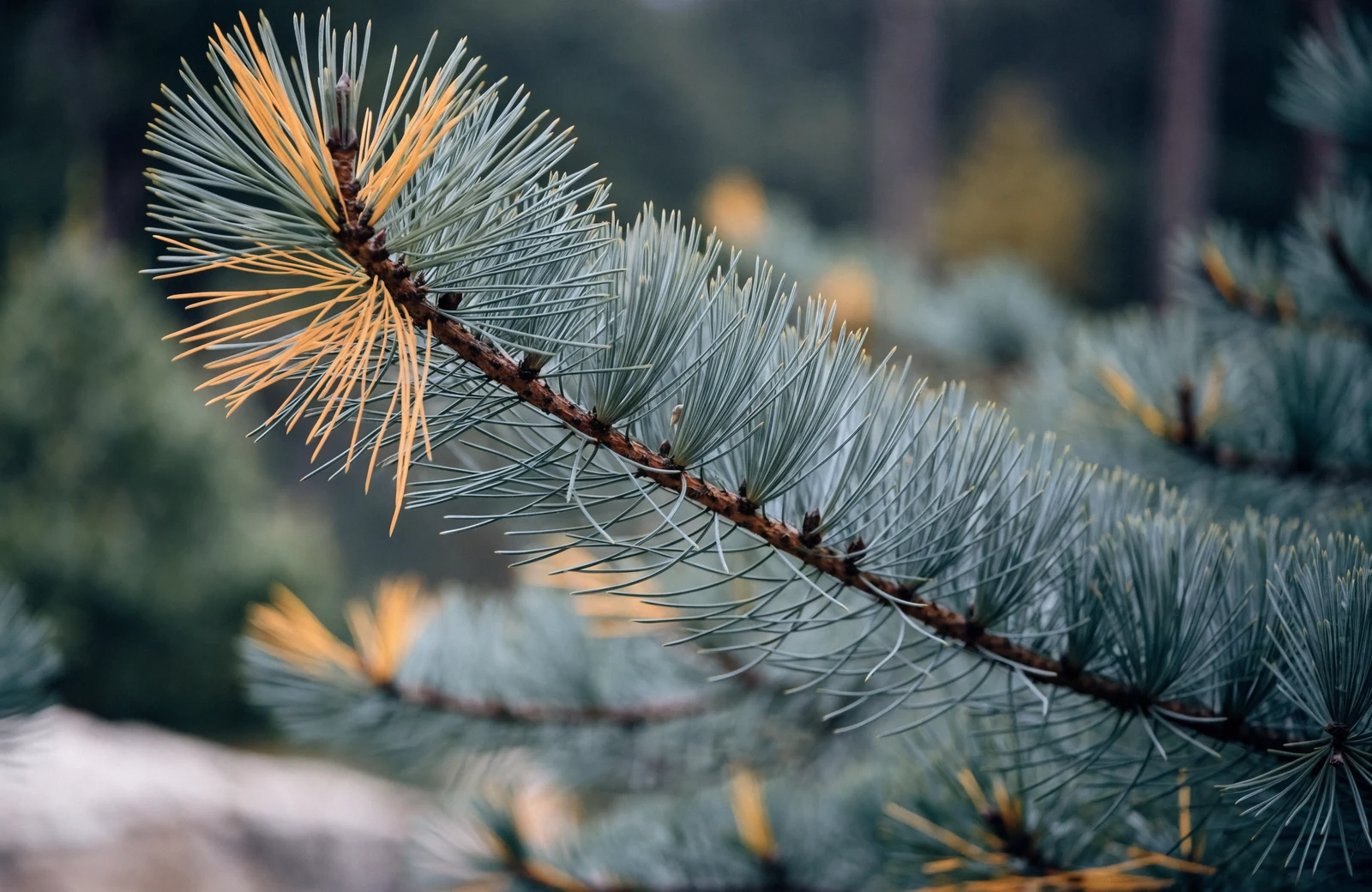
Every October, a white pine somewhere makes its owner panic. The inner third of the tree turns gold almost overnight, needles rain down with every gust, and it looks for all the world like the tree is dying. It almost never is. What it is doing has a name — seasonal needle drop — and it reveals something most of us get wrong about conifers: "evergreen" doesn't mean a tree keeps its leaves forever. It means it never stands bare. The individual needles are quietly replaced on a schedule, just like the leaves that turn colour and fall from a maple — only staggered over years instead of synchronised into one show.
Every needle has a lifespan
A needle is simply a leaf — a narrow, hard-wearing one. And like any leaf, it ages. As a needle gets older it photosynthesises less efficiently, gets shaded by newer growth further out on the branch, and eventually the tree cuts it loose through abscission: a layer of specialised cells at the base of the needle that seals off the connection, so the needle dries, yellows and falls. Because new needles grow at the branch tips, the needles being retired are always the oldest ones, deepest inside the canopy. That interior-first pattern is the signature of normal drop.
How long a needle lives depends on the species, which is why some conifers shed almost invisibly while others stage a dramatic autumn moult. Horticulturists at the University of Wisconsin–Madison and Iowa State University put typical figures on it:
Typical needle lifespans (University of Wisconsin–Madison Extension; Iowa State University Extension)
| Conifer | Needles typically kept for | What normal drop looks like |
|---|---|---|
| Eastern white pine | 2–3 years | Striking: the whole inner tree yellows at once in early autumn |
| Austrian & Scots pine | About 3 years | Noticeable but less dramatic |
| Red pine | About 4 years | Gradual interior thinning |
| Spruce & fir | Several years (often 5+) | Barely visible, inner branches only |
| Yew | About 3 years | Oldest needles drop in late spring, not autumn |
| Arborvitae | Longer than most pines | Old foliage browns rather than yellows before falling |
A handful of conifers opt out of the evergreen strategy entirely. Larch, bald cypress and dawn redwood are deciduous conifers: every autumn they turn amber and drop every needle they own. People regularly cut down perfectly healthy bald cypresses in winter believing they've died. They haven't — they're just doing what maples do.
The economics of keeping a leaf
Why would one tree pay to rebuild its entire canopy every spring while its neighbour keeps the same needles for five years? It comes down to leaf economics. Think of a deciduous leaf as a paper umbrella: cheap to make, brilliant in season, discarded without regret when the weather turns. A needle is a waxed canvas raincoat — far more expensive to produce, but built to be used year after year. A broad, thin maple leaf is a low-cost investment that pays for itself in a single generous summer. A needle has to earn back its higher build cost over several years, which is exactly what its design allows.
That design is all about endurance. A needle carries a thick cuticle — a waxy, waterproof outer coating — over a small surface area, with its breathing pores (stomata) sunk into grooves where drying winds can't reach them. Winter's real threat to foliage isn't cold alone but desiccation: when the ground is frozen, roots can't replace the water that leaves lose, so a thirsty broad leaf becomes a liability. The raincoat build lets a needle sit tight through months of frozen drought. It also explains where each strategy wins. Where summers are long and soils are rich, the disposable leaf's higher output during the growing season beats the needle's durability. Where the growing season is short and nutrients are scarce — think boreal forest — a leaf that's ready to work the moment conditions allow, with no spring rebuild, is the better bargain. That's why the far north belongs to conifers.
How a needle survives winter
Keeping leaves through winter creates a problem that deciduous trees never face: sunlight keeps arriving, but photosynthesis can't run. Light striking chlorophyll delivers energy that normally flows into sugar production; at freezing temperatures that assembly line stalls, and the stranded energy can wreck the leaf's own machinery. Researchers at the Umeå Plant Science Centre in Sweden have shown how conifers defuse it: in winter, the needle's two photosystems — the light-collecting complexes that usually work separately — physically move together and shunt excess energy between them, releasing it harmlessly as heat, a state scientists long called sustained quenching. In parallel, special proteins give stranded electrons safe alternative routes so nothing overloads. The needle effectively idles its engine all winter without ever turning it off — one more reason conifers dominate the coldest forests on Earth.
Normal drop or something wrong?
Once you know the pattern, a quick look tells you whether a shedding conifer is on schedule or in trouble.
- Normal: the yellowing needles are the oldest, innermost ones; the colour change is uniform; this year's growth at the branch tips stays green and unblemished; it's late summer or autumn.
- Worth investigating: browning starts on the newest, outermost needles; whole branches die back; current-season needles show spots or bands (a sign of fungal disease); or heavy drop arrives outside the usual season.
- Stress amplifies it: after a hot, dry summer, even healthy trees drop more needles than usual. Water evergreens deeply before the ground freezes — the same end-of-season habit that protects the rest of the garden from frost damage helps needles survive winter desiccation.
And resist the urge to fix it. There is no treatment for seasonal needle drop, because nothing is broken — Wisconsin's extension horticulturists put it plainly: control is neither possible nor beneficial. The gold carpet under a white pine in October isn't a symptom. It's a schedule.
Sources & further reading
Frequently asked questions
My white pine looks half-bare every November. Is that normal?
Usually, yes. White pines hold only two to three years of needles, and vigorous shoots may carry just the current year's needles by late autumn. As long as the branch tips are green and the yellowing is confined to older, inner needles, the tree is on schedule.
Can fertiliser or extra watering stop needle drop?
No. Seasonal needle drop is ageing, not deficiency, and extension horticulturists advise that control is neither possible nor beneficial. Deep watering before the ground freezes is still worthwhile — not to keep old needles on, but to help the retained ones survive winter drying.
About the author

Plant Science & Curiosities
Lena is a botanist who thinks the strangest thing about plants is how rarely we ask why they do what they do. She covers the science side of the Journal — photosynthesis, plant communication, disease biology — translating research into things you can actually use at the potting bench.
Try it yourself
Diagnose it instantly with PlantMe
Snap a photo of any plant or leaf. Get the species, the diagnosis, and a care plan in seconds.
Download on theApp Store