Journal/Care Basics · 8 min read
Boston Fern Care: How to Keep Those Fronds Green
How to care for a Boston fern indoors: light, watering, humidity, feeding — and why fronds turn brown and crispy, with fixes that actually work.
Quick answer
Give a Boston fern bright, indirect light (a north- or east-facing window is ideal), keep the soil consistently moist but never soggy, and aim for 50%+ humidity — dry air is the number-one cause of brown, crispy fronds. Keep it between 16–26°C, feed lightly every couple of months in spring and summer, and relax about pets: it's non-toxic to cats and dogs.
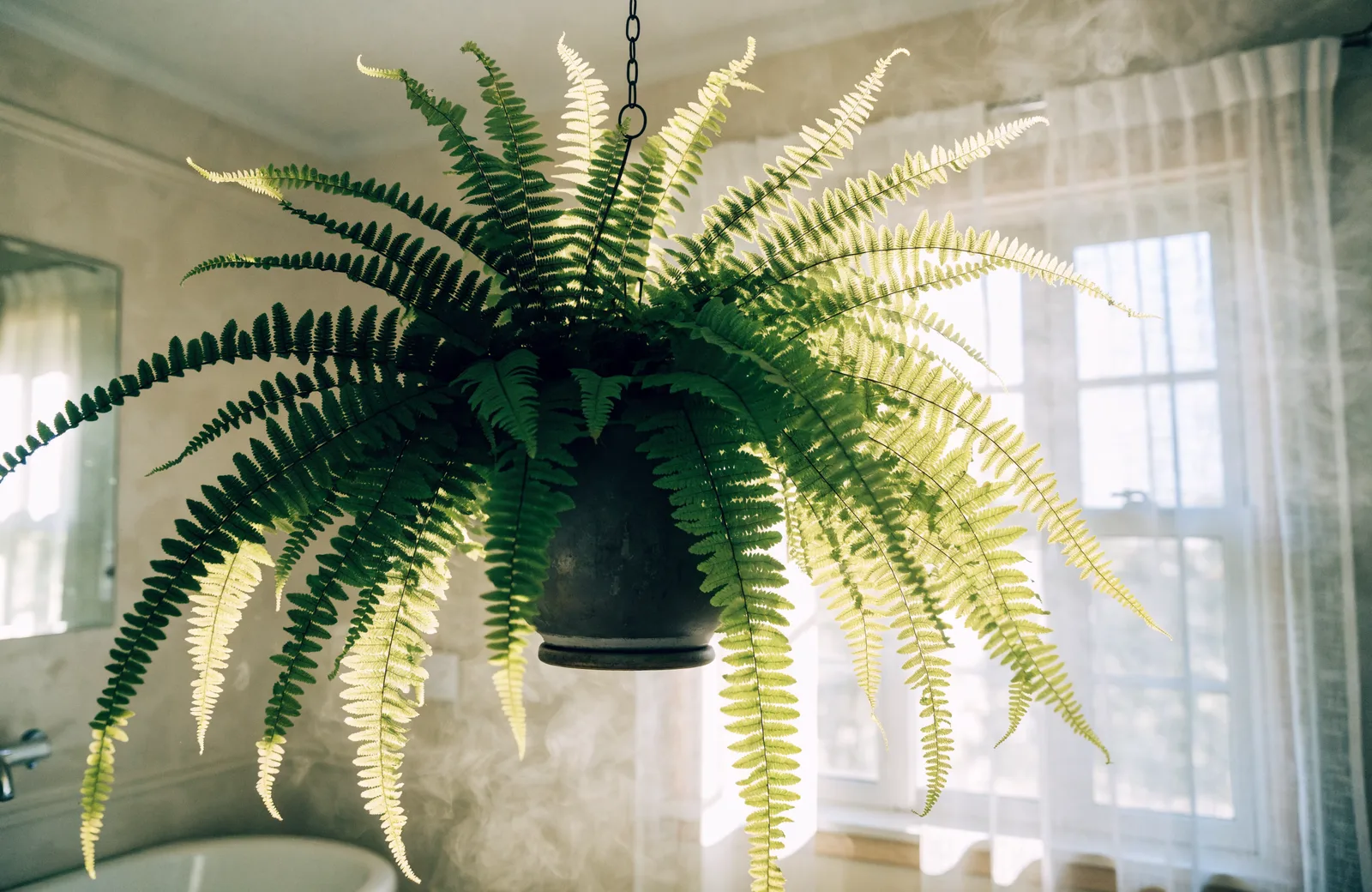
The Boston fern (Nephrolepis exaltata 'Bostoniensis') has been swinging from porch ceilings and parlour stands since the Victorians fell for it in the 1890s, and it has never really gone out of style. There's a reason: given two things — steady moisture and humid air — it produces fountains of arching green fronds like almost nothing else. Denied those two things, it becomes the world's most efficient producer of crispy brown confetti. This guide is about staying on the right side of that line.
Light: bright but never harsh
In the wild, Nephrolepis grows in the dappled shade of forests and swamps, and your living room should imitate that. Bright, indirect light is the target — a north- or east-facing windowsill is close to perfect, and a spot a metre or two back from a brighter window works too. Direct midday sun scorches the delicate leaflets surprisingly fast; deep shade won't kill the plant quickly, but it will thin it out until it looks sparse and defeated. If fronds are pale and dry despite good watering, suspect too much sun. If growth is slow and the plant is thinning, it's too dark.
Watering: consistently moist, never swampy
The Boston fern is not a plant for the forgetful waterer. The root ball should stay lightly moist at all times — in a warm summer room that can mean watering two or three times a week, dropping to weekly or less in winter. The finger test still beats any schedule: water when the top centimetre of compost is just starting to dry, and always let excess drain away. A fern left standing in a saucer of water gets root rot like any other houseplant; a fern allowed to dry out completely responds with a dramatic shower of leaflets, sometimes weeks later.
- Water thoroughly until it runs from the drainage holes, then empty the saucer.
- In hot weather, check the pot's weight every couple of days — light pot means water now.
- Every few weeks, give the whole pot a long soak in a basin for 15 minutes, then drain well — hanging baskets especially dry out from the sides.
- Use room-temperature water; cold tap water straight onto warm roots is an avoidable shock.
Humidity: the make-or-break factor
If you remember one thing about Boston ferns, make it this: dry air is what kills the look of the plant. Below roughly 40% relative humidity, frond tips start to brown and the oldest leaflets drop; central heating and air conditioning both pull indoor air well below that. Aim for 50% or more. A bright bathroom or kitchen is a classic Boston fern home for good reason. Elsewhere, group plants together, stand the pot on a tray of damp pebbles, or run a small humidifier nearby — the humidifier is the only one of these that moves the number dramatically. Misting looks caring, and the fern does enjoy it, but the effect lasts minutes; treat it as a supplement, not a strategy.
Temperature, feeding and repotting
Comfortable for you is comfortable for the fern: 16–26°C suits it, it sulks below about 10°C, and it hates sitting in the blast of a radiator, fan heater or AC vent. Feed with a general houseplant fertiliser at half strength every four to six weeks through spring and summer, and not at all in winter. Repot in spring only when roots fill the pot — Boston ferns don't mind being slightly snug — moving up one pot size into a peat-free, moisture-retentive mix.
Propagation: free ferns
Mature plants are easy to multiply. The simplest route is division: at repotting time, slice the root ball into halves or quarters with a sharp knife, each with a share of fronds, and pot each piece up separately. The fern also sends out fuzzy leafless runners (stolons) over the pot edge; pin one down onto a neighbouring pot of damp compost, wait for it to root, then cut the umbilical cord. Water new divisions well and keep them out of bright light for a fortnight while they recover.
Brown fronds: reading the symptoms
- Brown, crispy tips across the plant — air too dry. Raise humidity; trim spoiled tips with scissors, cutting at an angle just inside the dead zone.
- Whole fronds yellowing then browning from the base — usually underwatering or heat stress; occasionally the opposite, a waterlogged pot. Check the compost before deciding.
- Raining leaflets — a missed watering, a cold draught, or a house move. The fern sheds old growth when stressed; correct the cause and new fronds will replace the loss.
- Neat rows of brown dots on the underside of fronds — not a disease. Those are spores, and they mean the plant is thriving.
- Grey webbing and stippled leaflets — spider mites, which adore exactly the dry air the fern hates. Fixing humidity fights both problems at once.
Pro tip: every month or so, give the whole plant a lukewarm shower — literally, in the shower. It rinses dust from thousands of leaflets, raises humidity, waters the root ball evenly, and dislodges pests before they settle in. Let it drain completely before it goes back on display.
Warning: an old-school tonic that still circulates online recommends watering ferns with leftover tea. Don't. Tannins acidify the compost unpredictably, and sweetened tea invites fungus gnats. A correctly diluted houseplant feed is cheaper than the resulting problems.
Is it really a Boston fern?
Plenty of look-alikes hang in the same shop display — Kimberly queen ferns, maidenhairs, asparagus 'ferns' that aren't ferns at all — and their care differs just enough to matter. If you're not sure what came home with you, photograph it in PlantMe: the app recognises plants across 35,000+ classes with 93% top-3 accuracy, and its care plans then tell you exactly how to water and feed the fern you actually own, in any of 28 languages.
Sources & further reading
Frequently asked questions
Why is my Boston fern turning brown and crispy?
Dry air is the most common cause by far — below about 40% humidity the frond tips brown and old leaflets drop. Dry compost, direct sun and hot draughts produce similar damage. Raise humidity to 50%+, keep the soil consistently moist, and trim off the crispy parts; they don't recover, but new fronds will be fine.
Should I mist my Boston fern?
You can — the fern likes it and it helps rinse dust — but misting raises humidity for only a few minutes, so it can't fix a dry room on its own. A pebble tray, grouping plants, a bathroom spot or a small humidifier gives a lasting result; think of misting as a bonus.
Are Boston ferns toxic to cats or dogs?
No — the Boston fern is non-toxic to cats, dogs and humans, which makes it one of the best lush, dramatic houseplants for households with curious pets. The main risk is to the fern, since dangling fronds are irresistible toys.
Why is my Boston fern dropping leaves everywhere?
Shedding leaflets is the fern's general-purpose stress signal: a dried-out root ball, a cold draught, a spell of very dry air or a recent move can all trigger it. Some shedding of old growth in winter is normal. Restore steady moisture and humidity and the plant almost always regrows.
Can I put my Boston fern outside in summer?
Yes — a shaded, sheltered porch or balcony suits it well once nights stay above about 10°C, which is exactly how the Victorians used them. Keep it out of direct sun and bring it back in before autumn chill, checking for hitch-hiking pests first.
About the author

Houseplants & Indoor Styling
Wren has killed enough houseplants to know exactly why yours is struggling — and kept hundreds more thriving in a small, bright flat that doubles as her test lab. She writes about reading plants instead of following rules, and believes every windowsill deserves at least one leaf.
Try it yourself
Diagnose it instantly with PlantMe
Snap a photo of any plant or leaf. Get the species, the diagnosis, and a care plan in seconds.
Download on theApp Store