Journal/Care Basics · 5 min read
Do Plant Pots Need Drainage Holes?
Why drainage holes matter, how to use a beautiful pot that has none, and the truth about putting gravel in the bottom of the pot.
Quick answer
Yes — given the choice, always choose a pot with a drainage hole. Excess water needs an exit; without one it pools around the roots, pushes the air out of the soil, and quietly sets up root rot. A holeless pot isn't useless, though. Use it as a decorative outer pot, with the plant in a plastic nursery pot inside, lifted on a layer of pebbles so it never sits in run-off.
Sooner or later it happens to everyone. You find the pot — the glazed one, the perfect colour, the one that would sit just right on the bookshelf — and you turn it over in the shop and the bottom is smooth. No hole. Whether that matters, and what to do about it, is one of those small decisions that ends up deciding whether the plant inside thrives for years or sulks for six months and dies. So let's take it slowly.
What the hole is actually for
Roots need air almost as much as they need water. In a healthy pot, water soaks the soil, the roots drink, and the excess drains out of the bottom, pulling fresh air back into the gaps between soil particles as it goes. Take the hole away and the excess has nowhere to go. It sits at the bottom of the pot, fills those air gaps, and the lowest roots are left standing in a puddle in the dark. Starved of oxygen, they begin to die, and dying roots are exactly what root rot is waiting for. The cruel part is that the plant above responds by wilting — so it looks thirsty, and the watering can comes out again. If you've ever wondered why overwatering and underwatering look so alike, that's the mechanism.
The cachepot trick: keep the pretty pot
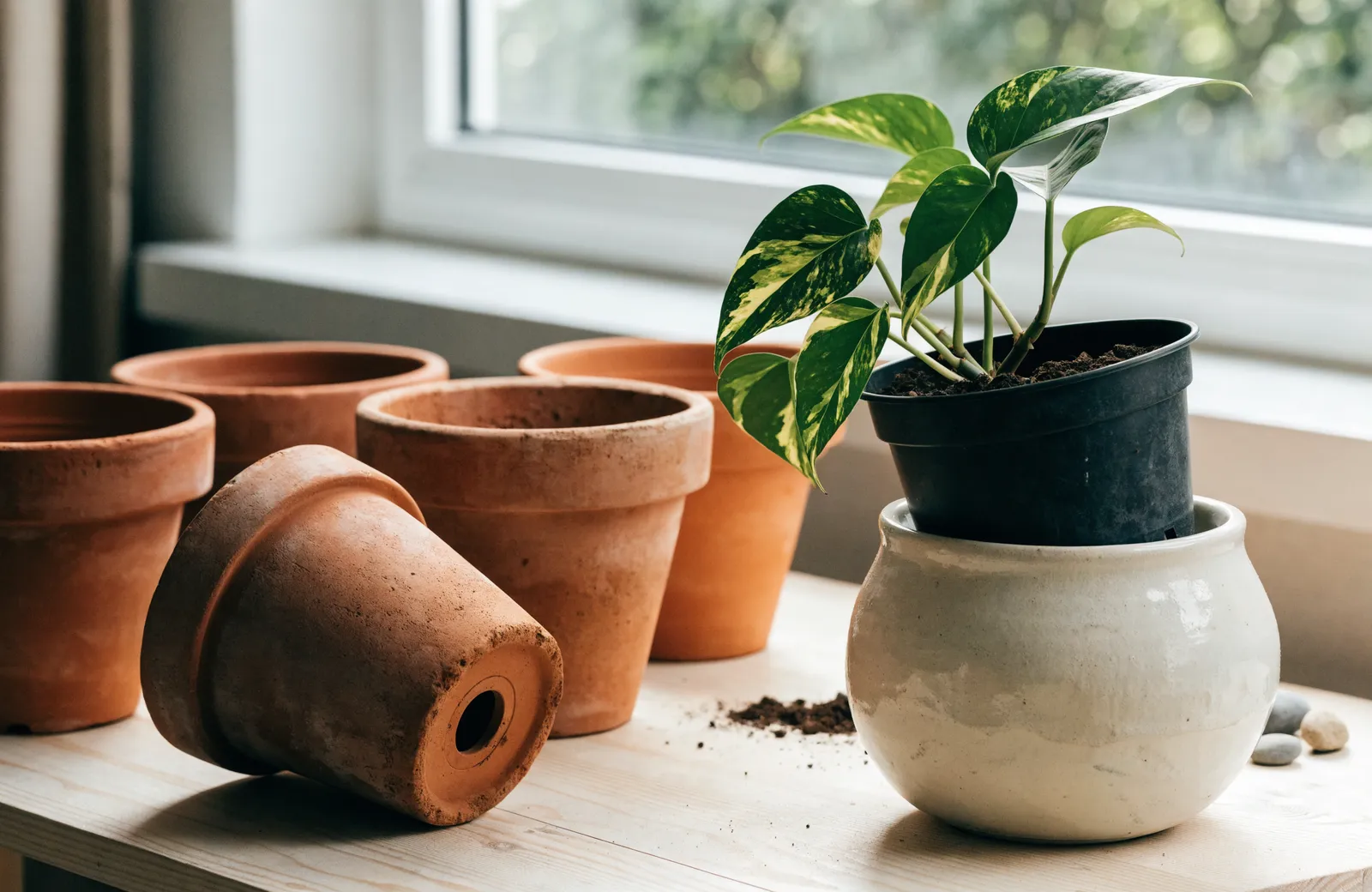
Here's the good news: you can have the beautiful pot and the drainage too. Leave your plant in the plain plastic nursery pot it came in — the one with holes — and stand that inside the decorative pot. Garden centres call the outer one a cachepot, which is just French for 'hides the pot'. Put a layer of pebbles or a few flat stones in the bottom of the outer pot first, so the inner pot sits raised above any water that collects. This is the arrangement university extension services recommend for exactly this situation, and it has a second advantage: at watering time you can lift the inner pot out, water it at the sink, let it finish dripping, and put it back. The bookshelf never knows.
If you're determined to plant straight in
It can be done — people grow lovely plants in holeless pots — but be honest with yourself about what you're signing up for. With no exit for excess water, every watering has to be measured rather than generous: enough to moisten the soil, never enough to pool at the bottom, which you can't see. It suits plants that like to dry out and forgiving owners with a light hand. A drill with the right bit will put a hole in many materials, and with terracotta or untreated wood it's genuinely easy. Otherwise, the honest answer is that the cachepot arrangement above gives you the same look with none of the risk.
About that layer of gravel at the bottom
You've probably heard the classic advice: no hole, no problem — just put gravel in the bottom for drainage. It feels right, and it doesn't work. Water moves reluctantly from a fine material into a coarse one, so instead of draining into the gravel, water clings to the potting mix and hangs there, saturated, just above the gravel line — which is to say, closer to the roots than before. The University of Maryland Extension's repotting guidance puts it flatly: don't fill the bottom of your pot with gravel. The pebbles earn their keep in the bottom of a cachepot, under a nursery pot — not inside the pot the roots live in.
Terracotta, plastic or glazed?
Once the hole question is settled, the material decides the watering rhythm. Unglazed terracotta is porous — it breathes through its walls, so soil in it dries noticeably faster. That's a feature if you're growing succulents or cacti, or if you know you're a bit free with the watering can: the pot forgives you. Plastic and glazed ceramic hold water in, which suits ferns, calatheas and other moisture-lovers, but leaves much less margin for error. Neither is wrong. A terracotta pot on a radiator-side windowsill and a glazed pot in the same spot are, in practice, two different watering schedules.
Size is part of the drainage story
One more thing while you're in the pot aisle: resist the enormous pot. A pot only a few centimetres wider than the root ball is the right call, because roots need to reach the soil for it to dry at a sensible pace. In a pot that's far too big, the plant drinks from a small corner of a large wet mass, and the rest stays soggy for weeks — a drainage problem wearing a different hat. When a plant genuinely outgrows its home, move it up one size, not three.
As ever, the pot is only half the conversation — the other half is listening to the plant standing in it. Check the soil with a finger before you water, water by need rather than by calendar, and if a plant starts looking sorry for itself despite your best intentions, photograph it with PlantMe. The app can't see inside the pot, but it reads the symptoms the plant shows above the soil and points you toward the likeliest cause — often before the roots have paid the full price.
Sources & further reading
About the author

Houseplants & Indoor Styling
Wren has killed enough houseplants to know exactly why yours is struggling — and kept hundreds more thriving in a small, bright flat that doubles as her test lab. She writes about reading plants instead of following rules, and believes every windowsill deserves at least one leaf.
Try it yourself
Diagnose it instantly with PlantMe
Snap a photo of any plant or leaf. Get the species, the diagnosis, and a care plan in seconds.
Download on theApp Store