Journal/Troubleshooting · 6 min read
Grey Mould on Plants (Botrytis): How to Stop the Fuzz Spreading
Fuzzy grey patches on leaves, stems or old flowers are usually Botrytis cinerea — grey mould. How to tell it apart from powdery mildew, why it flares up in autumn, and the five-step fix that actually works.
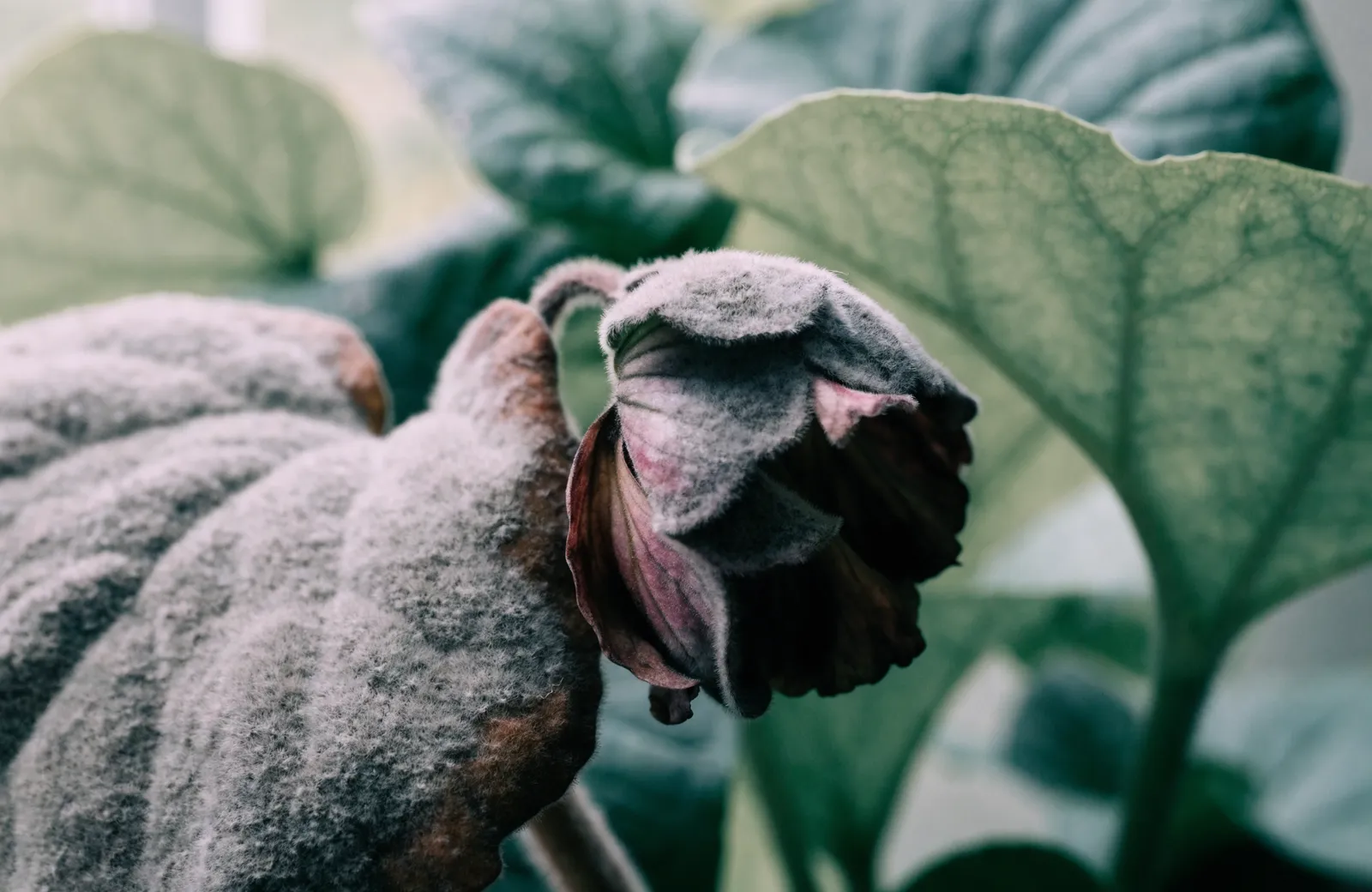
A patch of ash-grey fuzz on a leaf, a stem, or — most often — a flower that was already going over. Touch the plant or breathe near it and the patch releases a little puff of grey dust. That is grey mould, Botrytis cinerea, and the puff is the diagnostic: those are spores, in their thousands, leaving to find the next piece of soft tissue. No guilt required. Botrytis is one of the most widespread plant diseases there is, it attacks almost everything herbaceous — begonias, geraniums, peonies, dahlias, strawberries, tomatoes, cyclamen on the kitchen windowsill — and its arrival says more about the weather than about your care. The good news: it is also one of the most fixable problems on this site, because the cure is mostly subtraction.
First, confirm it's grey mould
Three lookalikes cause most of the confusion, and they're easy to separate. Powdery mildew is white-to-pale-grey, dry and dusty like icing sugar, and sits on top of otherwise firm leaves — if that's what you're seeing, you want our powdery mildew guide instead. White fluff sitting on the compost surface rather than on the plant is a harmless saprophytic mould — covered in our guide to mould on soil. Grey mould is different in both texture and context: it is genuinely fuzzy, grey to grey-brown, and it grows out of tissue that is dying under it — the patch beneath the fuzz is soft, brown and water-soaked, and it enlarges. It usually starts on something that was already weak or wounded: a spent bloom, a yellowing lower leaf, a stub left by a rough cut, fruit that's past its best. On roses and other soft-stemmed plants it can sink into the stem itself as a canker; in stored bulbs and corms it can rot the whole thing.
Why it shows up in October
Botrytis has precise requirements, and autumn meets all of them at once. The spores are around more or less permanently — they ride in on the air from dead leaves, plant debris and weeds — but they can only germinate when the surface they land on stays wet, or the air around it stays near-saturated, for roughly six hours at a stretch. Mild-but-cool temperatures suit it perfectly. So: shorter days, cold nights, condensation, the last soft growth of the season, closed windows, plants crowded back indoors or packed into a greenhouse — October is effectively a Botrytis welcome committee. There's a second rule that matters just as much: healthy, actively growing tissue resists direct infection. The fungus needs a foothold of weak or dead material first, and only then spreads into the healthy parts next door. Every step of the fix follows from those two facts — deny it six wet hours, and deny it a foothold.
The fix, in order
- Isolate an infected houseplant if you can — the spores travel on air and splashed water, and a shelf of plants packed together is a chain of dominoes.
- Remove every fuzzy, mushy or spotted part, cutting back to clean, firm tissue with clean tools. Do it with a steady hand, not a flick — shaking the plant is how the spores get their free ride. Ideally bag the debris as you cut.
- Clear the surroundings: fallen leaves on the compost surface, spent flowers, dead stems, anything soft and dying nearby. This is the fungus's food and its launchpad, indoors and out.
- Dry the scene out. Water in the morning, at the base of the plant rather than over the leaves, and empty saucers. Outdoors and in the greenhouse, that means no evening overhead watering from now until spring.
- Open up the airflow: space plants so leaves don't touch, thin congested growth, crack the greenhouse vents on mild days, and run rooms at normal humidity rather than tropical. Moving air is the cheapest fungicide there is.
That is genuinely the whole treatment for most cases. The University of Maryland's houseplant guidance makes the point plainly: anything that lowers humidity, shortens leaf wetness or improves air circulation reduces infection, and for indoor plants those adjustments are usually sufficient on their own. If your grey mould problem is a symptom of a generally sodden room, our houseplant humidity guide covers how to measure and manage it — humidity is a dial, not a blessing, and Botrytis is the argument for not turning it to maximum.
What about fungicide?
Honestly: it's the least useful tool in the box for a home grower. The fungicides available to gardeners are preventative rather than curative — they protect clean tissue but rescue nothing that's already infected — and the extension literature is frank that they often disappoint when conditions still favour the disease. Spraying a crowded, damp bench is painting over a leak. Fix the conditions first; if you then still want a protective layer on something valuable and susceptible, use a product labelled for Botrytis on that plant, and treat it as backup, not as the plan.
The autumn blind spots
Two places Botrytis does its quietest damage this time of year. First, overwintering plants: the geraniums, fuchsias and chillies coming inside now will sit for months in cool, still air, which is exactly the Botrytis climate — pick them over for dead leaves before they come in and every few weeks after, as covered in our guide to overwintering geraniums. Second, storage: bulbs, corms and tubers going into boxes should be dry, undamaged and unwrapped from anything airtight, because one soft dahlia tuber in a sealed bag becomes a bag of grey fur by February. If you're ever unsure what you're looking at before you cut, a photo diagnosis with PlantMe's plant doctor — trained on 500+ diseases — is a faster second opinion than scrolling image search results.
Keep the dead stuff picked off, the leaves dry by nightfall, and the air moving. Grey mould is persistent, but it is not clever — it has two requirements, and you control both.
Sources & further reading
Frequently asked questions
Is grey mould dangerous to people or pets?
It's a plant pathogen, not an infection risk for you or your animals in normal amounts — though a big cloud of spores is worth not inhaling, especially for allergy sufferers. Bag mouldy debris rather than shaking it about, and wash your hands after handling it.
Can a plant recover from grey mould?
Yes, usually. Botrytis kills the tissue it colonises, not the whole plant, and it can't invade healthy growth directly. Cut out everything affected, fix the damp-and-still-air conditions, and the plant carries on — check it weekly for a while, since spores will still be around.
Should I throw away the compost from an infected plant?
No need. Botrytis spores are effectively everywhere already, so sterilising one pot of compost buys you nothing. What matters is removing the dead and dying material the fungus feeds on, and keeping conditions too dry and airy for new infections.
About the author

Plant Rescue & Troubleshooting
Camille spent years behind the counter of a plant shop where every customer arrived with the same question: what's wrong with it? She writes the Journal's rescue guides — calm, diagnosis-first, no guilt — because most 'dying' plants are one correct decision away from recovery.
Try it yourself
Diagnose it instantly with PlantMe
Snap a photo of any plant or leaf. Get the species, the diagnosis, and a care plan in seconds.
Download on theApp Store