Journal/Vegetable Garden · 7 min read
How to Grow Raspberries: Plant the Canes Now, Argue About Pruning Later
Raspberries are the best return on effort in the fruit garden: dormant canes planted between November and March, a fence of wires, and pruning done by the calendar rather than by nerve. Here is the whole system, folklore removed.
Quick answer
Plant bare-root raspberry canes any time between November and March when the soil isn't frozen, 40–60cm apart, with the roots no more than 5cm below the surface. Summer-fruiting types crop on last year's canes; autumn-fruiting types crop on this year's. Know which you have, and pruning stops being confusing.
Two things are true of raspberries. First, a short row of canes will outproduce almost anything else you can plant in the same space, year after year, for a decade or more. Second, nearly everyone who grows them is slightly unsure whether they are pruning them correctly. The first fact is why you should order canes this month — bare-root season opens in November — and the second is entirely fixable in about four paragraphs. We will get to it.
First, know which raspberry you're dealing with
Every raspberry decision — pruning above all — depends on one distinction. Summer-fruiting varieties carry their fruit on canes that grew the previous year: plant in winter, get canes in year one, fruit in year two. Autumn-fruiting varieties fruit on the current season's canes, which means they crop in their very first year and can be pruned with a single, satisfying, impossible-to-get-wrong cut. If you are starting out, plant autumn-fruiting. If you inherited a mystery row, watch when it fruits: June–July means summer type, August onwards means autumn type.
The two types at a glance
| Summer-fruiting | Autumn-fruiting | |
|---|---|---|
| Typical height | Around 1.8m | 1.2–1.5m |
| Fruits on | Last year's canes | This year's canes |
| First crop | The second summer | The first autumn |
| Pruning | Cut out fruited canes after harvest; tip-prune in February | Cut the whole lot to the ground in February |
| Reliable AGM varieties | 'Glen Ample', 'Malling Jewel', 'Octavia', 'Tulameen' | 'All Gold', 'Joan J', 'Polka' |
When to plant
Raspberries are sold two ways. Bare-root canes — dormant sticks with roots, no pot, no soil — are available from autumn into spring, are noticeably cheaper, and travel well by mail order. Containerised plants cost more and are available for longer. Either way, the planting window for dormant canes runs from November to March, any time the soil isn't frozen or waterlogged. October is the ordering month: the good varieties sell through, and the same dormant-season logic applies to planting strawberries, so one order can cover both.
Where to put them
Raspberries want a slightly acidic soil, ideally pH 6 to 6.7, and they are not diplomatic about the alternatives: shallow chalky soil leaves them chlorotic and sulking, and waterlogged ground rots them. If your drainage is suspect, a raised bed solves it. They also resent following their own kind — avoid planting where raspberries grew before, as soil-borne problems accumulate. Dig in plenty of organic matter before planting; if you started a compost heap this autumn, this row is where next year's batch should go.
Planting, step by step
- 1. Clear the ground of perennial weeds now, while the soil is still warm enough to make the work tolerable.
- 2. Set canes 40–60cm apart. If you are planting more than one row, leave 1.5–2m between rows — you will want to walk between them at picking time.
- 3. Plant shallow. The topmost roots should sit no more than 5cm below the surface; a raspberry planted deep is a raspberry that struggles.
- 4. Firm the soil, water in, and label the row with the variety and type — February-you will need to know which pruning regime applies.
Give them a fence
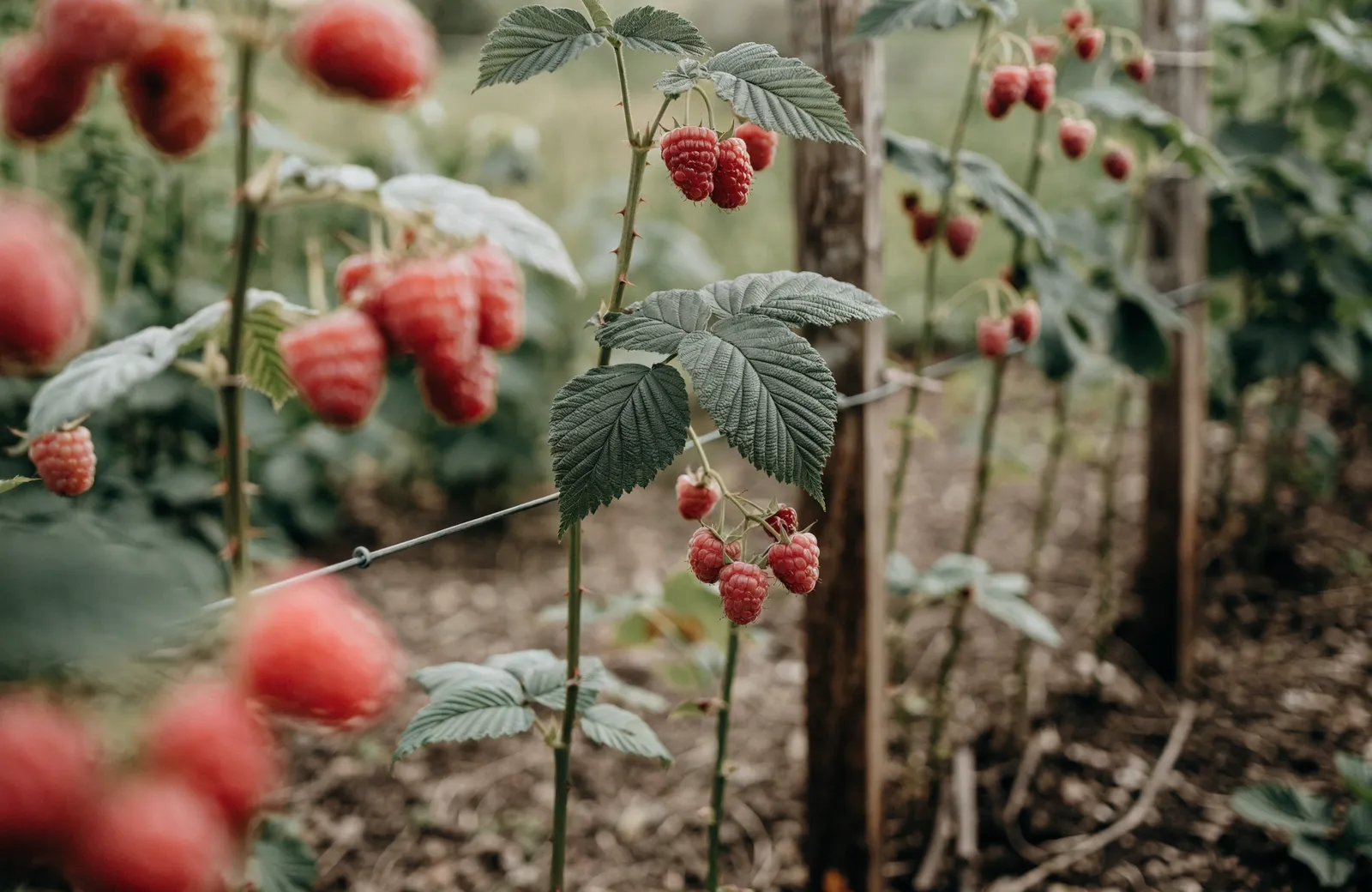
Freestanding raspberries flop, and floppy canes mean shaded fruit and broken stems. The standard arrangement is a post at each end of the row with horizontal wires strung between: a single flat fence of wires for summer types, whose canes are tied in individually, or a pair of parallel wires either side of the row for autumn types, which simply lean against them. A single stout post does the job for a small clump. Summer-fruiting canes get tied along the wires about 10cm apart, which sounds fussy and takes ten minutes a year.
Watering, feeding, mulch
Water new canes through their first growing season and during dry spells; after that, established rows in open ground only need help in a genuine drought. Each late winter or spring, lay a 5–7.5cm mulch of organic matter along the row — it feeds the plants, holds moisture, and suppresses the weeds you cleared in step one. Raspberries in containers are a different contract: they depend on you, and want a monthly liquid feed through the growing season.
Pruning, by the calendar
Summer-fruiting: once the last fruit is picked, cut every cane that fruited down to ground level — they are spent and will never fruit again. Keep the six to eight strongest new green canes per plant, tie them to the wires, and remove the rest. In February, trim any cane that has grown beyond the top wire back to about 10cm above it. Autumn-fruiting: in February, cut everything to the ground. All of it. New canes rise in spring and fruit the same year; if they come up crowded, thin them to roughly 10cm apart in early summer.
That is the entire mystery. The reason raspberry pruning has a reputation is that the two regimes are opposites, and advice that doesn't name the type reads as contradiction. It isn't folklore and it isn't feel — it's a label on a stick and two dates in the calendar.
What goes wrong
Raspberry beetle grubs turn up in summer fruit; birds will take the crop unless netted; and in a wet spell ripe berries can collapse into grey mould — pick promptly and keep air moving through the row. Cane diseases and viruses exist, which is the practical argument for buying certified stock rather than accepting a neighbour's mystery suckers; virus-stunted rows don't recover and should come out. If leaves or fruit look wrong and you can't name it, a photo in PlantMe's plant doctor will shortlist the likely culprits — though for viruses, confirmation is about the pattern across the row, not one leaf.
Jobs for this month
- 1. Order bare-root canes — decide summer, autumn, or one row of each.
- 2. Clear and weed the planting site; dig in organic matter.
- 3. Set posts and wires while the ground still digs easily.
- 4. Nothing else. The planting itself is a November job.
Sources & further reading
About the author

Vegetable Garden & Seasons
Arthur has worked the same allotment for thirty years and measures the calendar in sowings, not months. He writes practical, no-nonsense guides to growing food and keeping a garden honest through the seasons — and has little patience for folklore that doesn't survive contact with a real plot.
Try it yourself
Diagnose it instantly with PlantMe
Snap a photo of any plant or leaf. Get the species, the diagnosis, and a care plan in seconds.
Download on theApp Store