Journal/Care Basics · 6 min read
How to Raise Humidity for Houseplants (and What Actually Works)
Wren Hollis on dry winter air: what low humidity does to calatheas and ferns, the fixes that genuinely help — a humidifier, grouping, glass — and the honest truth about misting and pebble trays.
Quick answer
Most houseplants are happiest at roughly 40–50% relative humidity, while a heated winter home can sit far below that — sometimes 10–20%. The fixes that reliably work: a small humidifier near your plants, grouping plants together, and growing the fussiest ones under glass. Misting barely moves the needle — the boost evaporates within minutes — so buy a cheap hygrometer before you buy anything else.
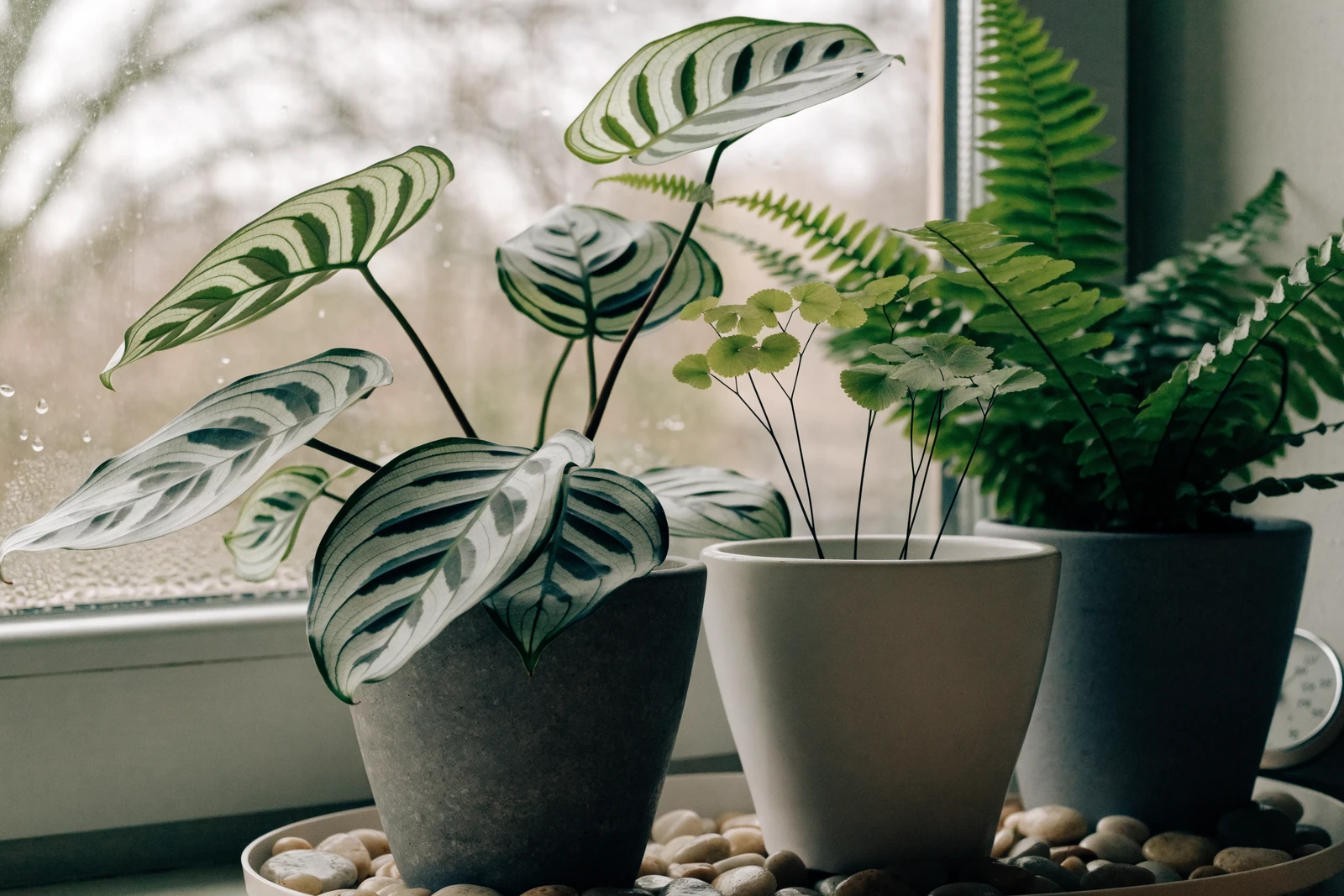
The radiators have been on for a few weeks now, and your calathea has noticed. The leaf edges have gone papery, the newest leaf never quite unfurled, and the maidenhair fern by the window is shedding like it's making a point. None of this means you've done anything wrong. It means the air in your home has changed, and nobody told the plants. The good news: of all the winter problems a plant can have, dry air is one of the more fixable ones — as long as you spend your effort on the things that actually work.
What dry air actually does
Relative humidity is just a measure of how much moisture the air is holding compared with how much it could hold. Heated indoor air holds very little: Iowa State University Extension notes that the humidity in many homes drops to around 10 to 20 percent in winter, while many houseplants do best at 40 to 50 percent. For context, the comfort standard for people (ASHRAE's) is 30 to 60 percent — so if your skin feels tight and your lips are chapped, your plants are feeling it too. Dry air pulls water out of leaves faster than roots can replace it, and the plant sacrifices its leaf edges and tips first. That's why low-humidity damage shows up as crisp brown margins rather than an all-over collapse — and why it hits thin-leaved plants like a calathea or a maidenhair fern long before it troubles a rubber plant.
Before you buy anything: measure
A small digital hygrometer costs about as much as a coffee and ends every argument about whether your flat is 'probably fine'. Rooms differ more than you'd think — the spot above a radiator, the draughty hall, the kitchen on a soup day. This is also the honest answer to the old advice about moving plants to the bathroom: it can work, but only if the shower runs often enough, and many bathrooms are short on the one thing winter plants can't spare — light. Penn State Extension's suggestion is the sensible one: measure first, then decide.
The three fixes that earn their keep
- A humidifier. The one method both extension services rate without hedging. A small portable unit placed near your plant collection does more than anything else on this list; run it through the heating hours rather than around the clock, and refill it when you water.
- Grouping. Plants release moisture from their leaves and from the damp compost they sit in, so a huddle of plants makes its own slightly gentler microclimate. The effect scales with numbers — three pots is a gesture, a dozen is a neighbourhood.
- Glass. For the true humidity lovers — fittonias, small ferns, anything that sulks below 50 percent — a cloche, a lidded jar or a terrarium recycles the moisture the plant itself releases. It's the one approach that genuinely transforms the air around a plant rather than nudging it.
The two tricks that mostly don't
Misting is the ritual everyone loves and almost nobody benefits from. Iowa State Extension is blunt: it is not an effective way to raise humidity, because the film of water is gone within minutes, and you would need to re-mist several times a day to matter. (The exception is air plants, where misting is simply how you water them.) Pebble trays are more interesting, because the experts genuinely disagree: Iowa State suggests them, while Penn State points out that the evaporating moisture diffuses through the whole room and barely registers overall. The fair verdict: a pebble tray is cheap, harmless and might help a little in the still air right around the leaves — but your hygrometer, not the internet, will tell you whether it's doing anything in your room.
Which plants actually need the help
Not all of them, happily. Succulents and cacti would rather you didn't. Most of the sturdy favourites — pothos, snake plants, dracaenas — will tolerate an ordinary winter home without complaint; as Penn State puts it, if the humidity is comfortable for you, most plants will get through. Save the humidifier's reach for the thin-leaved tropicals, the ferns and the prayer plants, and remember that crisp edges have other causes too: a plant resting for the winter needs less water, and a watering rhythm that hasn't adjusted to the season can produce brown tips that no humidifier will fix.
So: one cheap hygrometer, one honest reading, and then the fix that fits. Your calathea isn't asking for a rainforest. It's asking for forty percent, which — once the radiators have had their say — turns out to be a surprisingly reasonable request.
Sources & further reading
About the author

Houseplants & Indoor Styling
Wren has killed enough houseplants to know exactly why yours is struggling — and kept hundreds more thriving in a small, bright flat that doubles as her test lab. She writes about reading plants instead of following rules, and believes every windowsill deserves at least one leaf.
Try it yourself
Diagnose it instantly with PlantMe
Snap a photo of any plant or leaf. Get the species, the diagnosis, and a care plan in seconds.
Download on theApp Store