Journal/Care Basics · 5 min read
Maidenhair Fern Care: A Peace Treaty with the Fussiest Fern
Maidenhair ferns have a reputation for dying in three weeks. What Adiantum actually needs — steady moisture, 60%+ humidity, soft light — and how to bring a crisped one back.
Quick answer
Maidenhair ferns need consistently moist compost, high humidity (above 60%), bright indirect light and steady temperatures of 16–21°C. Never let the root ball dry right through — but never leave it swimming either. A bright bathroom is the easiest home. And if yours has crisped up: cut it back and keep it barely moist. Fronds are naturally short-lived, and plants often regrow from the roots.
There's a moment in every plant shop where a maidenhair fern gets the better of somebody. All that green lace, those wiry black stems, the way the whole plant shivers when the door opens. It comes home, it sits on a shelf, and within three weeks it has crisped into a pot of brown confetti. If that story sounds familiar, you're in excellent company — the University of Minnesota's houseplant guidance politely files maidenhairs under ferns to avoid 'unless you are looking for a real challenge'. This guide is about taking the challenge anyway, and winning more often than not.
Know the plant you brought home
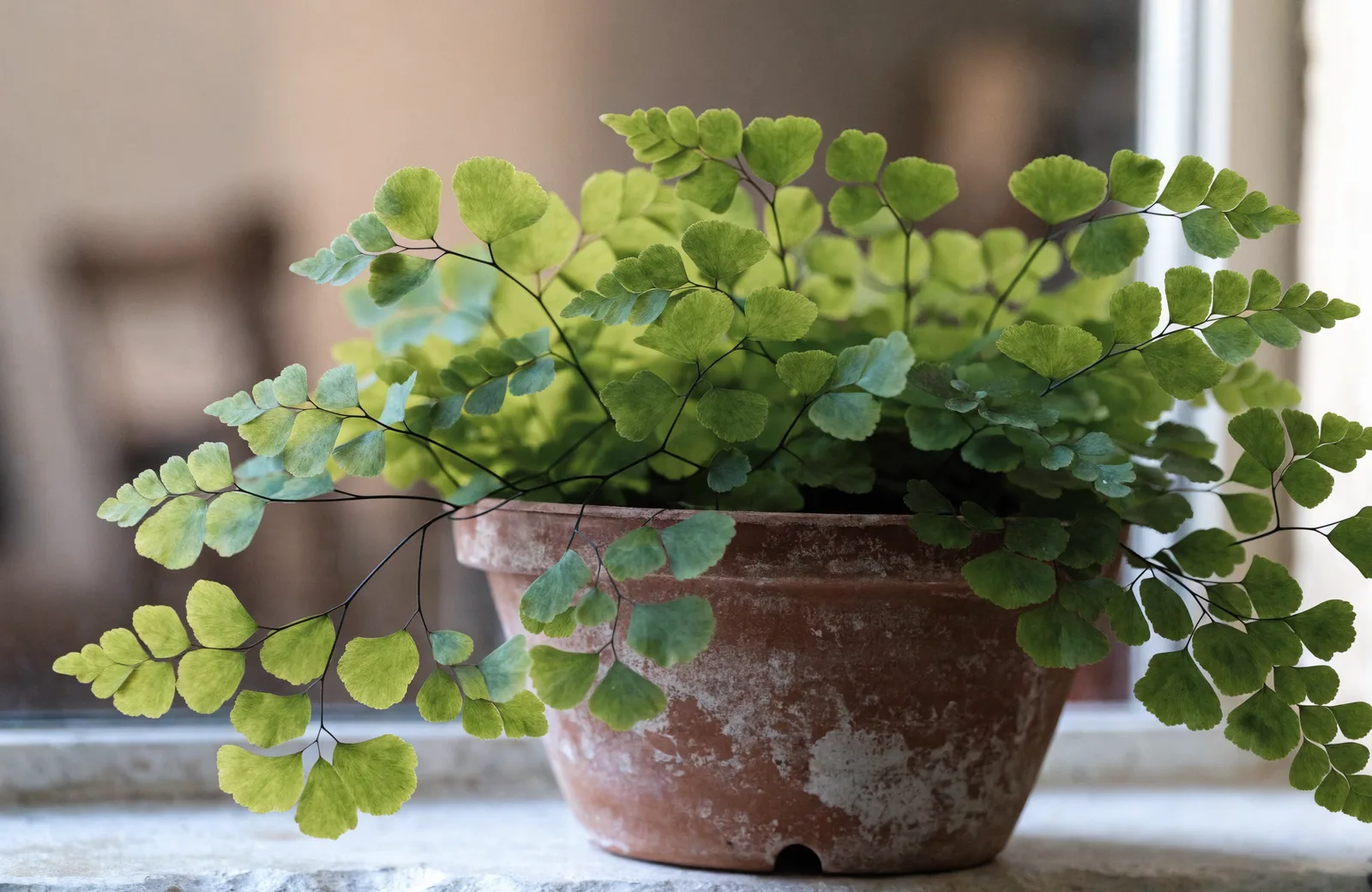
The maidenhair sold as a houseplant is usually Adiantum raddianum, the delta maidenhair — a small, clump-forming fern from tropical forests that tops out around half a metre. In the wild it lives where trees filter the sun and the air never really dries: shaded stream banks, damp walls, the splash zone of a waterfall. Every one of its demands makes sense once you hold that picture in mind. It isn't fussy, exactly. It's homesick.
Water is the whole relationship
A maidenhair holds no reserves. The leaflets are paper-thin, the stems are wire, and there is no thick, waxy anything to fall back on — so a root ball that dries right through is usually the beginning of the end. Keep the compost consistently moist: water freely while the plant is in growth, more sparingly in winter, and let only the top couple of centimetres dry out between waterings. The New York Botanical Garden's advice is usefully precise here: in active growth, let the soil dry about an inch down, then water thoroughly — and tip away anything left standing in the saucer within a quarter of an hour. Moist, never marshy.
Two refinements make this easier to live with. Use room-temperature water, because a cold shock to the roots is one more stress it doesn't need. And give it a pot with real drainage in a loam-based, peat-free mix that holds moisture without slumping into mud — the same 'moist but well-drained' balance the RHS recommends for this fern. If little-and-often watering isn't your strength, bottom watering is a forgiving method: the root ball takes up exactly what it wants and no more.
Humidity is the dealbreaker
Here is the honest part. The New York Botanical Garden names low humidity as the most common reason maidenhair ferns fail indoors, and puts the plant's comfort zone above 60 per cent — greenhouse air, not living-room air, and certainly not living-room air once the radiators come on. This is the requirement that separates the success stories from the brown confetti.
You have three workable answers, in ascending order of commitment. First, location: a bright bathroom or a kitchen windowsill is naturally the dampest air in the house, which is why the maidenhair earns a mention in our round-up of plants for bathrooms. Second, the RHS trick: stand the pot on a tray of moist gravel so the plant sits in its own gently humid microclimate — grouping it with other plants helps too, and our humidity guide covers the full toolkit. Third, glass: a large terrarium or a glass dome turns the most demanding houseplant fern into an easy one, because the air inside stays exactly as damp as it likes. Misting, for what it's worth, feels virtuous but changes the air only briefly — a garnish, not a strategy.
Light, warmth and moving air
Forest plants want forest light. Indoors, that means bright but indirect: a north-facing window suits it well, or a spot set back from an east- or west-facing one — the RHS lists exactly those aspects, in partial shade, for good reason. Direct midday sun scorches the leaflets faster than almost any other mistake you can make. Temperature is the easy part: ordinary rooms in the 16–21°C (60–70°F) range are ideal, with about 10°C as the floor. It appreciates gentle ventilation but not weather — keep it away from cold draughts and out of the hot updraught above a radiator, which is a desiccator aimed at the one plant in the house that can't take it.
Feeding is a light touch: the RHS suggests a half-strength liquid feed monthly from mid-spring to late summer, and none in winter. Fertilise only when the plant is actually pushing out new fronds.
When it crisps up anyway
It probably will, at least once, and this is the part most care guides skip: a crispy maidenhair is very often not a dead maidenhair. Individual fronds live only around six months before browning off naturally, and a stressed plant can drop everything, sulk, and re-emerge from the rhizome as if nothing had happened. So before the compost bin: trim off the dead growth, keep the root ball barely moist, park the pot somewhere bright, cool and humid, and give it a few weeks. New fronds unfurl from below, curled like tiny fiddleheads. If nothing stirs after a month or two, have a gentle look at the roots — firm and dark is alive, mushy is not. Our guide to reviving a dying plant walks through the same triage in full.
A happy clump, meanwhile, is easy to multiply: knock it out of its pot in early spring and pull the rhizome apart into two or three pieces, each with roots and fronds attached, and pot them up separately. The other route — sowing the dust-like spores at around 21°C — is a slow, satisfying science project rather than a way to fill a shelf.
The weekly rhythm, once it's settled
- Check the compost by touch every two or three days; water thoroughly with room-temperature water when the surface has dried a knuckle deep.
- Keep the humidity working for you — top up the gravel tray before it dries out, and keep the fern among its damp-loving friends rather than alone on a shelf.
- Turn the pot now and then, snip browned fronds off at the base, and glance along the stems for scale insects — the one pest the RHS specifically flags for this fern.
That's the treaty. You promise steady moisture and soft light; the maidenhair promises to look like green lace and make every other plant on the shelf seem slightly overbuilt. Read the plant, not the rulebook — and remember that this one, once its conditions are right, is nowhere near as delicate as its reputation.
Sources & further reading
About the author

Houseplants & Indoor Styling
Wren has killed enough houseplants to know exactly why yours is struggling — and kept hundreds more thriving in a small, bright flat that doubles as her test lab. She writes about reading plants instead of following rules, and believes every windowsill deserves at least one leaf.
Try it yourself
Diagnose it instantly with PlantMe
Snap a photo of any plant or leaf. Get the species, the diagnosis, and a care plan in seconds.
Download on theApp Store