Journal/Plant Science & Curiosities · 7 min read
Do Houseplants Go Dormant in Winter? What's Really Happening
Most houseplants don't truly go dormant in winter — they idle. What quiescence means, which plants rest deeply, and how to adjust water and fertilizer.
Quick answer
Most tropical houseplants never go truly dormant — in winter they enter quiescence, a reversible slowdown driven by short, weak daylight. A few, like alocasia and some cacti, rest more deeply and may drop leaves. Water only when the potting mix is fully dry, skip fertilizer for resting plants, and normal growth returns as days lengthen.
Every November, the same worried question: the monstera has stopped making leaves, the pothos hasn't moved in weeks — are they dormant? Dying? The honest answer is more interesting than either. Most houseplants are tropical species that never evolved a winter programme at all. What they do in your living room from November to February is something botanists distinguish from true dormancy, and the distinction changes how you should care for them.
Two words botanists actually use
True dormancy is an internally timed shutdown. A tulip bulb or an apple tree commits to it weeks in advance, triggered by shortening days and falling temperatures, and it will not resume growth until specific conditions — often a set period of cold — have been met. You cannot talk an apple tree out of dormancy by putting it in a warm room; the plant itself is holding the brakes on.
Quiescence is different: growth pauses only because something the plant needs is missing — usually light. Remove the limitation and growth resumes, no countdown required. This is what most tropical houseplants do in winter. Think of a car at a red light versus one parked with the engine off: the quiescent plant is idling, still burning fuel, ready to move the moment the light changes. University of Vermont Extension describes exactly this resting state in winter houseplants — growth slows considerably as daylight shortens and weakens, without the plant ever truly switching off.
What winter looks like from a leaf's point of view
The driver is light arithmetic. Between June and December, day length in northern mid-latitudes roughly halves, and the sun sits so low that each ray passes through more atmosphere and arrives at a shallower angle to your windows. A sill that delivered bright light in July may offer a fraction of it in January. Photosynthesis runs on that light, so the plant's energy income collapses even though your thermostat keeps it warm enough to spend. The rational response — the one plants make automatically — is to stop building expensive new tissue and tick over on reserves.
This is why a warm room doesn't restart growth but a grow light often does. If your plant sits under supplemental lighting or in a very bright south-facing window, it may never slow down at all — and it should then be watered and fed like a plant in active growth, because that is what it is.
Which of your plants rest, and how deeply
Typical winter behaviour by plant group
| Plant group | Winter state | What you'll see |
|---|---|---|
| Most tropical foliage plants (monstera, pothos, philodendron, ficus) | Quiescent | Little or no new growth; existing leaves held |
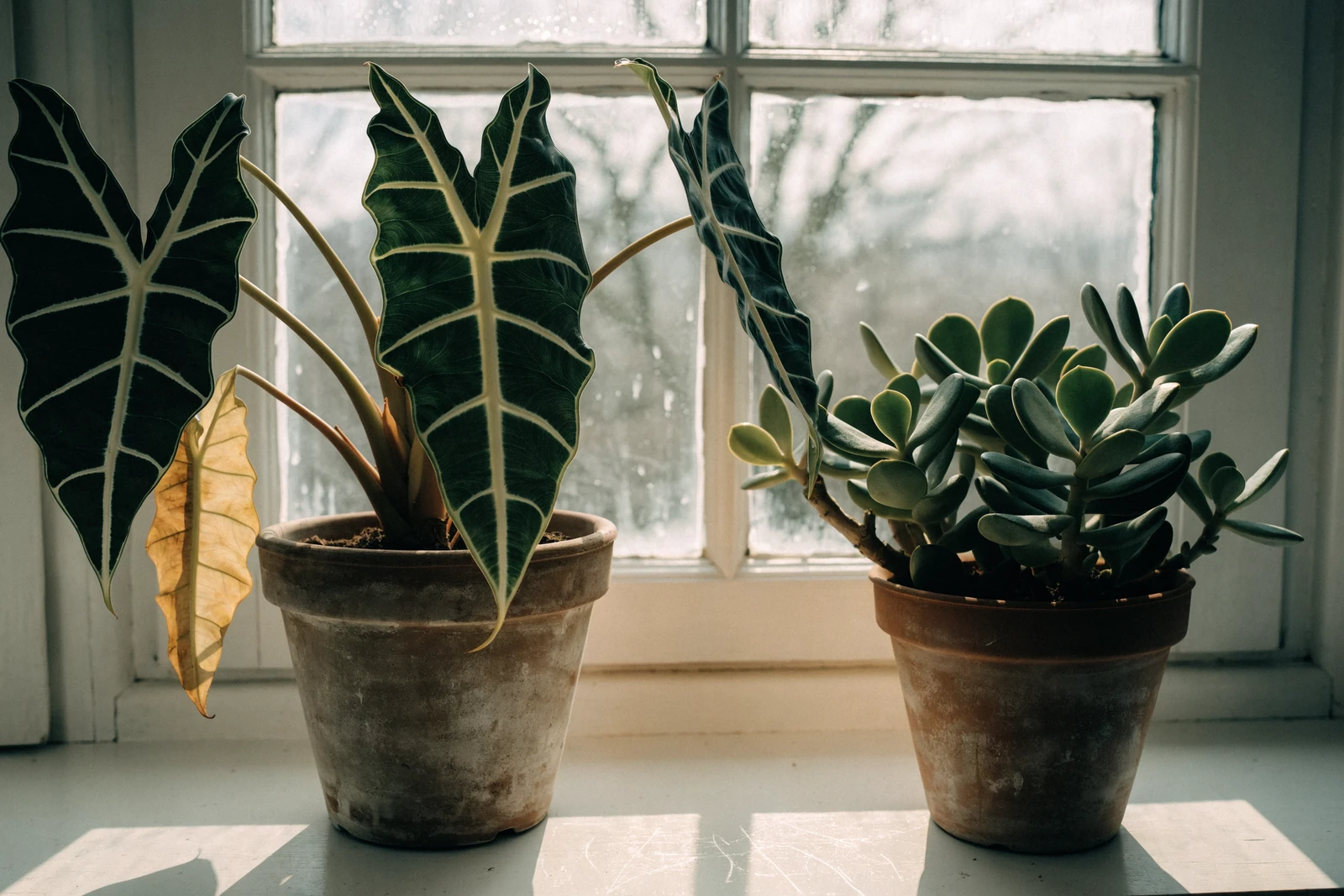
| Alocasia, caladium | Deep rest; may die back | Leaves yellow and collapse, sometimes to a bare pot — the corm or tuber is alive |
| Desert cacti and many succulents | True winter rest | No growth; some shrivel slightly; many need this cool rest to flower |
| Winter bloomers (Christmas cactus, cyclamen, moth orchids in spike) | Actively growing | Buds and flowers — treat as growing, not resting |
The last row matters. A plant in bud or bloom in December is not resting, whatever the calendar says, and starving it then is a common reason buds drop or flowering fizzles.
How to care for a plant that's idling
An idling plant uses less of everything, and winter care is mostly the discipline of giving it less. Water only when the potting mix is genuinely dry — push a wooden chopstick or your finger a few centimetres down; if mix clings, wait. A quiescent plant in cool, dim conditions might need water a third as often as it did in July, and the fastest way to kill one is to keep a summer watering schedule running through winter.
- Hold fertilizer for any plant that isn't visibly growing. Nebraska Extension's guidance is blunt: dormant and resting plants should not be fertilized, and unused fertilizer accumulates in the pot as soluble salts that scorch roots — the same salts that show up as a white crust on the soil.
- Postpone repotting until spring; disturbed roots regrow slowly without light to fund them.
- Keep what light there is: clean dusty leaves, move plants closer to windows, but away from cold glass, radiators and draughts.
- Watch humidity — heated winter air is dry air, and spider mites thrive in it. Grouping plants or running a humidifier helps.
If a deep rester like alocasia collapses entirely, don't bin it. Let the pot sit barely moist somewhere bright and wait; the storage organ below the soil typically resprouts in spring. The rest of a sensible seasonal routine is in our winter care guide.
The spring restart
Because quiescence is externally imposed, it ends externally too. Somewhere around late February in the northern hemisphere, day length and sun angle cross back over the threshold where income exceeds upkeep, and you'll see it: a new leaf spearing from the monstera, pale growth tips on the pothos. That first new leaf is the signal to resume feeding and normal watering — the engine has left the red light. Until then, patience is the most useful thing you can give a houseplant. The slowdown isn't a problem to fix; it's the plant doing its accounting correctly.
Sources & further reading
Frequently asked questions
Should I stop watering my houseplants completely in winter?
No — quiescent plants still lose water through their leaves and still have living roots to supply. Stretch the interval rather than stopping: let the mix dry fully, then water thoroughly. Only deeply dormant, leafless plants (a died-back alocasia, resting cacti) get by on barely-moist soil.
My alocasia dropped every leaf. Is it dead?
Probably not. Alocasia grows from a corm that routinely survives total leaf loss during its winter rest. Keep the pot barely moist in a bright spot, and new leaves typically emerge when light levels rise in spring.
Why is my Christmas cactus growing when everything else has stopped?
It's a short-day plant from Brazilian cloud forest, programmed to flower as days shorten — winter is its active season. A plant in bud or bloom is growing, so keep watering it normally and feed it lightly; rest comes after flowering.
About the author

Plant Science & Curiosities
Lena is a botanist who thinks the strangest thing about plants is how rarely we ask why they do what they do. She covers the science side of the Journal — photosynthesis, plant communication, disease biology — translating research into things you can actually use at the potting bench.
Try it yourself
Diagnose it instantly with PlantMe
Snap a photo of any plant or leaf. Get the species, the diagnosis, and a care plan in seconds.
Download on theApp Store