Journal/Troubleshooting · 6 min read
Mushrooms in Your Lawn: What They Mean and What to Do
Camille Fournier on the autumn flush of lawn mushrooms: what they are, what is actually feeding them, the fixes that work (and the ones that don't), and the special case of fairy rings.
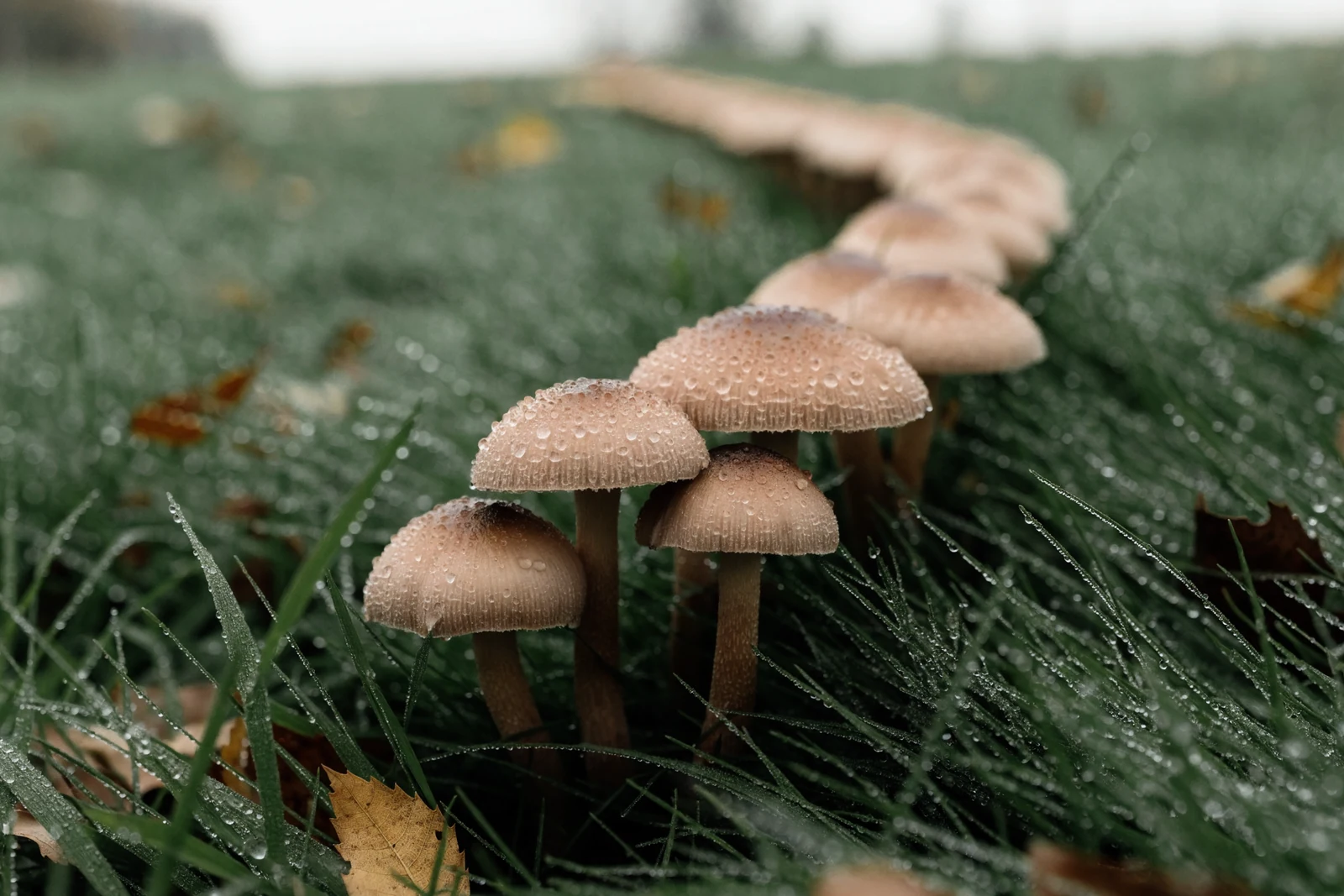
A week of proper autumn rain, and one morning the lawn has grown a crop you never sowed: a scatter of toadstools by the fence, a cluster near where the old cherry used to stand, perhaps a suspiciously neat arc of them across the back lawn. The usual reaction is somewhere between alarm and embarrassment. Neither is warranted. Mushrooms in a lawn are almost never a disease, almost never a threat to the grass, and almost always a sign that the soil underneath is doing exactly what soil is supposed to do. What they are is information — and once you read them correctly, the fix, where one is even needed, is usually straightforward.
What you are actually looking at
A mushroom is not the organism. It is the fruiting body — the reproductive structure — of a fungus whose real body is a network of fine threads running through the soil and thatch, where it has likely been living quietly for months or years before you saw anything at all. That network feeds on decaying organic matter: old grass clippings, thatch, buried roots, fallen leaves. The University of Minnesota Extension is reassuringly blunt on the key point — the vast majority of mushrooms in lawns are not related to disease. If anything, the fungus is paying rent: as it breaks that material down, it releases nutrients, including nitrogen, back to the grass. The same decomposers that turn a bin of autumn leaves into leaf mould are simply doing it under your lawn instead.
Why now
Fungi fruit when moisture allows, which is why the flush follows heavy rain, a stretch of damp overcast weather, or an irrigation system still running on a summer schedule. Autumn delivers all three plus a fresh fall of leaf litter to eat, so this is their season. A lawn that mushrooms every October is not deteriorating; it is on schedule.
The diagnosis: what is feeding them
Where the mushrooms come up tells you what they are eating. Work down this list — the first match is usually the answer.
- 1. Buried wood. Mushrooms clustered in one patch, year after year, very often mark an old stump or the roots of a long-removed tree rotting below. The mushrooms stop when the wood is used up — which can take years — or when you dig or grind it out.
- 2. Thatch and debris. A general scatter across the lawn points to the ordinary diet: thatch, dead grass, leaf litter worked into the sward. More raking, less food.
- 3. Standing moisture. Mushrooms concentrated in shady or low-lying corners point to ground that never dries — from shade, compaction, poor drainage or simple overwatering.
- 4. A ring. Mushrooms in an arc or circle, often with the grass behaving oddly along the same line, are a fairy ring — a special case with its own section below.
The fix, in order
- Knock the mushrooms over with a rake and remove them — into the bin, not the compost, if children or dogs use the lawn. This is cosmetic, but it also removes what the spores travel on.
- Rake out dead grass and fallen leaves, especially in damp, shaded corners, so there is less for the fungus to eat.
- Water deeply but less often, in the morning, so the surface dries during the day. If an irrigation timer is involved, turn it down now that summer is over.
- Aerate this autumn. Opening up compacted ground moves water through the profile instead of leaving it sitting at the surface.
- Let light in. Thinning an overhanging shrub or raising a tree canopy dries the ground below it more reliably than any treatment you can pour on.
- If one patch fruits stubbornly every year, assume buried wood and dig or grind it out; nothing short of that removes the food source.
- Skip the fungicide. For mushrooms feeding on debris it treats the symptom and not the food supply; university extensions rank it a last resort at best, and in the UK the RHS notes no fungicides are available to home gardeners for fairy rings at all.
The fairy ring, a special case
A ring of toadstools — sometimes with a band of dead grass, a band of unusually lush green grass, or both along the same curve — is a fungal colony advancing outward from a central starting point, dying out in the middle as it goes. The rings the RHS considers most damaging belong to Marasmius oreades, a light-brown toadstool with a domed cap and a thin but tough stalk. The colony creeps outward at roughly 30cm a year, and in large lawns a ring can keep going for a very long time indeed. The two bands have one cause each: the fungal mycelium is water-repellent, so in dry spells the grass above it dies of drought while the lawn around it stays green; and where old mycelium and dead grass break down, the released nutrients paint the neighbouring grass a deeper green.
Be realistic about the options. Picking the toadstools achieves nothing — spores drift in from elsewhere regardless. Digging the colony out means excavating turf and soil to at least 30cm across the whole ring, which the RHS itself calls impractical for most gardens. The workable approach is to manage the symptom: spike the dead zones, water them thoroughly — a wetting agent helps the water get past that repellent mycelium — and feed the lawn so the colour difference stops announcing itself. Most fairy rings are lived with, not cured, and a lawn can carry one for decades without anyone but its owner ever noticing.
A word on safety
Never eat a mushroom from your lawn. Edible and dangerous species can look remarkably alike, and lawn mushrooms are exactly where misidentification does real harm — South Dakota State University Extension puts it as a flat rule, and so do we. Our app identifies plants, not fungi, so do not ask any photo ID — ours included — to clear a mushroom for the table. If a dog that eats first and reflects later shares the lawn, knock mushrooms over and bin them as they appear, the same precaution you would take with the toxic plants already on the houseplant shelf.
And then let the lawn be. The fungus fruiting by your fence is part of the same underground workforce that includes the mycorrhizal fungi your plants actively recruit, and its indoor cousins turn up uninvited in houseplant pots for the same reasons: moisture plus organic matter equals fungus, everywhere on earth. A few toadstools after rain is not a lawn failing. It is a lawn with something alive underneath it.
Sources & further reading
Frequently asked questions
Are lawn mushrooms poisonous to dogs?
Some can be, and telling dangerous species from harmless ones is genuinely difficult even for experienced foragers. The safe routine is boring: knock mushrooms over and bin them as they appear in any lawn a dog uses, and call a vet promptly if you suspect one has been eaten.
Will a fungicide get rid of the mushrooms?
Usually not in any lasting way. The fungus is feeding on organic matter in the soil, and the mushrooms are only its fruiting bodies — remove the moisture and the food and the fruiting stops. Extensions treat fungicide as a last resort, and for fairy rings in the UK no products are available to home gardeners at all.
Do mushrooms mean my lawn is diseased?
Almost never. Lawn diseases are caused by different fungi that attack living grass and show up as patches, spots or threads on the turf itself, not as toadstools. A flush of mushrooms after rain is decomposition, not infection — the one case worth watching is a fairy ring with a band of dead grass, which is managed by spiking, watering and feeding.
About the author

Plant Rescue & Troubleshooting
Camille spent years behind the counter of a plant shop where every customer arrived with the same question: what's wrong with it? She writes the Journal's rescue guides — calm, diagnosis-first, no guilt — because most 'dying' plants are one correct decision away from recovery.
Try it yourself
Diagnose it instantly with PlantMe
Snap a photo of any plant or leaf. Get the species, the diagnosis, and a care plan in seconds.
Download on theApp Store