Journal/Care Basics · 7 min read
How to Care for a Philodendron
Philodendron care made simple: light, watering, soil, feeding, propagation, pet safety, and fixes for yellow or leggy growth.
Quick answer
Philodendrons want bright indirect light, watering when the top 2–3 cm of soil is dry (roughly weekly in summer, every 10–14 days in winter), and a chunky, airy aroid mix in a pot with drainage. Keep them between 18–27 °C, feed monthly in spring and summer, and take cuttings below a node to root in water in 2–4 weeks. All philodendrons are toxic to cats and dogs if chewed.
Philodendrons are the plants people keep once they have killed a few others. They tolerate imperfect light, forgive a missed watering, root from a cutting in a jam jar, and come in enough shapes that you can furnish a whole flat with the genus alone. This guide covers what actually matters: light, water, soil, feeding, propagation and the one safety point worth taking seriously.
Trailing types vs upright types
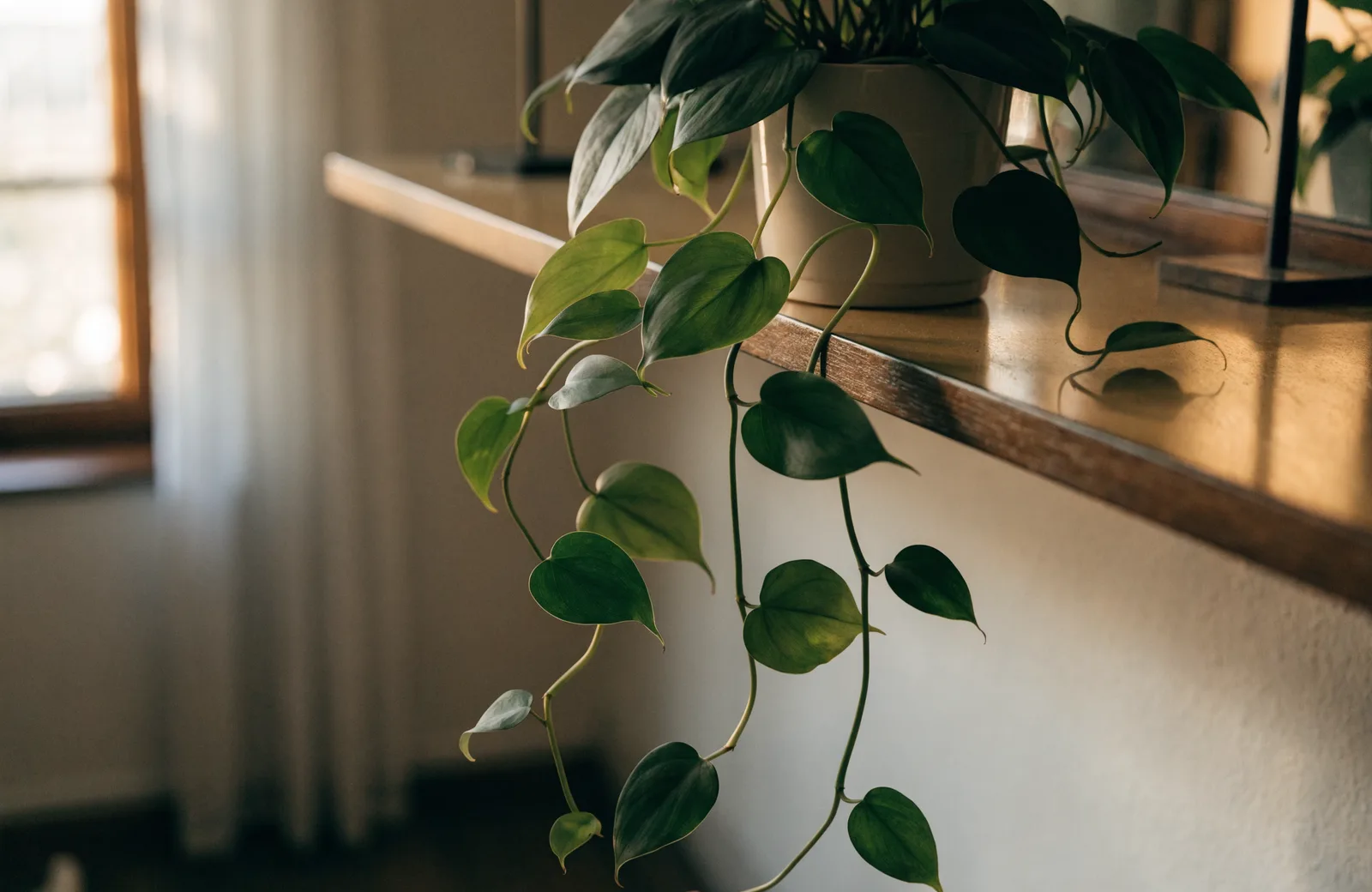
Philodendrons split roughly into two habits, and the good news is that care is broadly the same for both. Trailing and climbing types include the heartleaf philodendron (Philodendron hederaceum), the lime-green 'Brasil' with its painted stripe, and the velvety 'Micans'. These want something to climb or somewhere to hang from, and they run long fast.
Self-heading or upright types grow from a central crown instead of a vine: Philodendron bipinnatifidum (still widely sold as 'selloum'), the white-striped 'Birkin', and the collector's favourite 'Pink Princess'. They take up floor space rather than wall space and grow more slowly, but the watering, soil and feeding are identical. Only the light requirement shifts slightly, which we come to next.
How to tell a heartleaf philodendron from a pothos
These two get mixed up constantly in shops and in inherited plants, and although their care overlaps, it is satisfying to know what you own. A heartleaf philodendron has thinner, matte, genuinely heart-shaped leaves with a pronounced notch where the stem meets the blade, and it produces cataphylls — papery sheaths that protect a new leaf and then dry to a brown wisp on the stem. A pothos has thicker, waxier, slightly puckered leaves, often flecked with gold or cream, no cataphylls, and a fatter aerial root at each node. Philodendron new growth tends to emerge in a pinkish or bronze tone; pothos unfurls straight to green.
Light
Bright indirect light is the target — a spot within a metre or two of an east or north window, or set back from a bright south-facing one. Philodendrons tolerate medium light better than almost any other foliage plant, which is why they end up in offices and hallways, but tolerate is not the same as thrive. In deep shade they keep growing and simply do it badly: long bare stretches of stem between leaves, and each new leaf smaller than the last.
Variegated cultivars need noticeably more light. 'Birkin' and 'Pink Princess' produce their pale sections with less chlorophyll, so the plant will quietly revert to plain green in dim conditions to feed itself. If your Pink Princess is throwing all-green leaves, move it brighter before you blame the plant. What none of them want is harsh midday sun through unshaded glass, which bleaches and scorches the leaf surface within a few hot afternoons.
Watering
Water when the top 2–3 cm of soil is dry to the touch — push a finger in rather than guessing from the surface, which dries first and lies. In a warm bright room in summer that usually lands around once a week; in winter, with lower light and slower growth, every 10–14 days is more typical. Water thoroughly until it runs from the drainage holes, then empty the saucer. Small sips that only wet the top layer leave the deeper roots permanently dry.
The plant tells you which way you have erred. Yellowing lower leaves, often several at once and soft rather than crisp, means the roots are sitting wet — the classic overwatering signature. Crispy brown leaf edges with the rest of the leaf still firm points the other way: underwatering, or very dry air from a radiator.
Temperature and humidity
Anywhere between 18 °C and 27 °C suits them, which is to say normal indoor conditions. Nothing below about 13 °C: cold stalls growth and, sustained, blackens leaf tissue. Keep them away from draughty doors, single-glazed windows in winter, and the rising heat directly above a radiator — the daily temperature swing does more damage than the average temperature suggests.
Ordinary room humidity is fine; philodendrons are not divas. But at 50–60% humidity you get visibly larger leaves and fewer brown tips, so a pebble tray, grouping plants together, or a humidifier in a dry winter flat pays off in growth rather than mere survival.
Soil, pots and repotting
Philodendrons are aroids with thick roots that want air as much as water. Standard bagged compost on its own compacts and holds too much moisture. Mix your own: roughly two parts houseplant compost, one part perlite, one part orchid bark. The result should look chunky and drain fast, and it is the single change that fixes most chronic philodendron sulking.
Use a pot with drainage holes — a decorative cachepot is fine as long as the plant sits in a plastic liner you can lift out and drain. Repot every one to two years, or when roots circle the base and water runs straight through. Go up one pot size only; a large pot full of wet unrooted soil is how healthy plants get root rot.
Feeding
A balanced liquid houseplant feed at half the label strength, once a month through spring and summer, is enough. Stop entirely in autumn and winter, when low light means the plant cannot use the nutrients and unused salts accumulate in the soil. If you have not repotted in two years, flush the pot thoroughly with plain water a couple of times a year to wash those salts out.
Pruning and propagation
Philodendrons are among the easiest plants on earth to propagate, which makes them the right plant to learn on. Find a node — the slightly swollen point where a leaf and often a small aerial root emerge — and cut about a centimetre below it with clean scissors. Take a cutting with two or three leaves, drop it in a glass of water on a bright windowsill, and change the water weekly. Roots appear in two to four weeks. Pot up once they are 3–5 cm long, and keep the mix a little more evenly moist for the first fortnight while water roots adapt to soil.
Pruning serves the parent plant too: cutting a long bare vine back to a node forces branching lower down, and three cuttings tucked back into the original pot turn a straggly plant into a full one in a season.
Warning: all philodendrons contain insoluble calcium oxalate crystals in their sap and leaves, which makes them toxic to cats and dogs if chewed — expect mouth and throat irritation, drooling, pawing at the face and sometimes vomiting. It is rarely fatal, but it is genuinely painful. Keep trailing stems out of reach of a curious cat, and if you share your home with a determined chewer, read our guide to toxic plants for pets before you buy.
Common problems at a glance
- Yellow leaves, soft and starting from the bottom — almost always overwatering. Check the soil is drying between waterings and that the pot drains.
- Leggy, sparse growth with small leaves and long gaps between them — too little light. Move brighter before changing anything else.
- Droopy, limp leaves that perk up hours after watering — simply thirsty. If they stay limp in wet soil, suspect root rot instead.
- Brown crispy edges on otherwise healthy leaves — dry air or inconsistent watering.
- Sticky residue, fine webbing or white cottony specks in leaf joints — pests. Check leaf undersides for spider mites, mealybugs and scale, and treat before they spread.
- Variegated leaves reverting to plain green — insufficient light for the cultivar.
Tip: wipe the leaves with a damp cloth every few weeks. Dust on a large flat philodendron leaf measurably reduces the light reaching it, and the wipe doubles as your regular pest inspection.
If you inherited a plant and are not certain whether it is a philodendron, a pothos or a scindapsus — the care differs slightly and the pet-safety picture does not — photograph a leaf in PlantMe. The app recognises 35,000+ plant classes with 93% top-3 accuracy, so you can stop guessing from the label the shop stuck in the pot.
Sources & further reading
Frequently asked questions
How often should I water a philodendron?
When the top 2–3 cm of soil is dry — roughly weekly in summer and every 10–14 days in winter, depending on light, pot size and room temperature. Test with a finger rather than following a fixed schedule.
Why are my philodendron's leaves turning yellow?
Soft yellow leaves starting from the bottom of the plant are the classic sign of overwatering or a pot that drains poorly. Let the top few centimetres dry out fully between waterings, empty the saucer, and switch to a chunkier mix with perlite and bark if the soil stays soggy.
What's the difference between a philodendron and a pothos?
A heartleaf philodendron has thinner, matte, distinctly heart-shaped leaves and produces papery cataphylls on the stem. A pothos has thicker, waxier, slightly puckered leaves, no cataphylls, and a chunkier aerial root at each node. Both are toxic to pets and both like the same conditions.
Can philodendrons grow in low light?
They survive it better than most houseplants, but they do not grow well in it. Expect long bare stems, shrinking leaves and, on variegated cultivars, a slow reversion to plain green. Medium light is a reasonable compromise; deep shade is not.
Are philodendrons toxic to cats and dogs?
Yes. Every philodendron contains insoluble calcium oxalate crystals that cause mouth irritation, drooling and vomiting if chewed. Serious cases are rare but the reaction is painful, so hang trailing types out of reach and choose a pet-safe plant if your animal chews everything.
About the author

Houseplants & Indoor Styling
Wren has killed enough houseplants to know exactly why yours is struggling — and kept hundreds more thriving in a small, bright flat that doubles as her test lab. She writes about reading plants instead of following rules, and believes every windowsill deserves at least one leaf.
Try it yourself
Diagnose it instantly with PlantMe
Snap a photo of any plant or leaf. Get the species, the diagnosis, and a care plan in seconds.
Download on theApp Store