Journal/Care Basics · 5 min read
Pruning 101: Where to Cut and Why
Where to cut, when to cut, and what pruning actually does for a houseplant — plus how to make cuttings root every time.
Quick answer
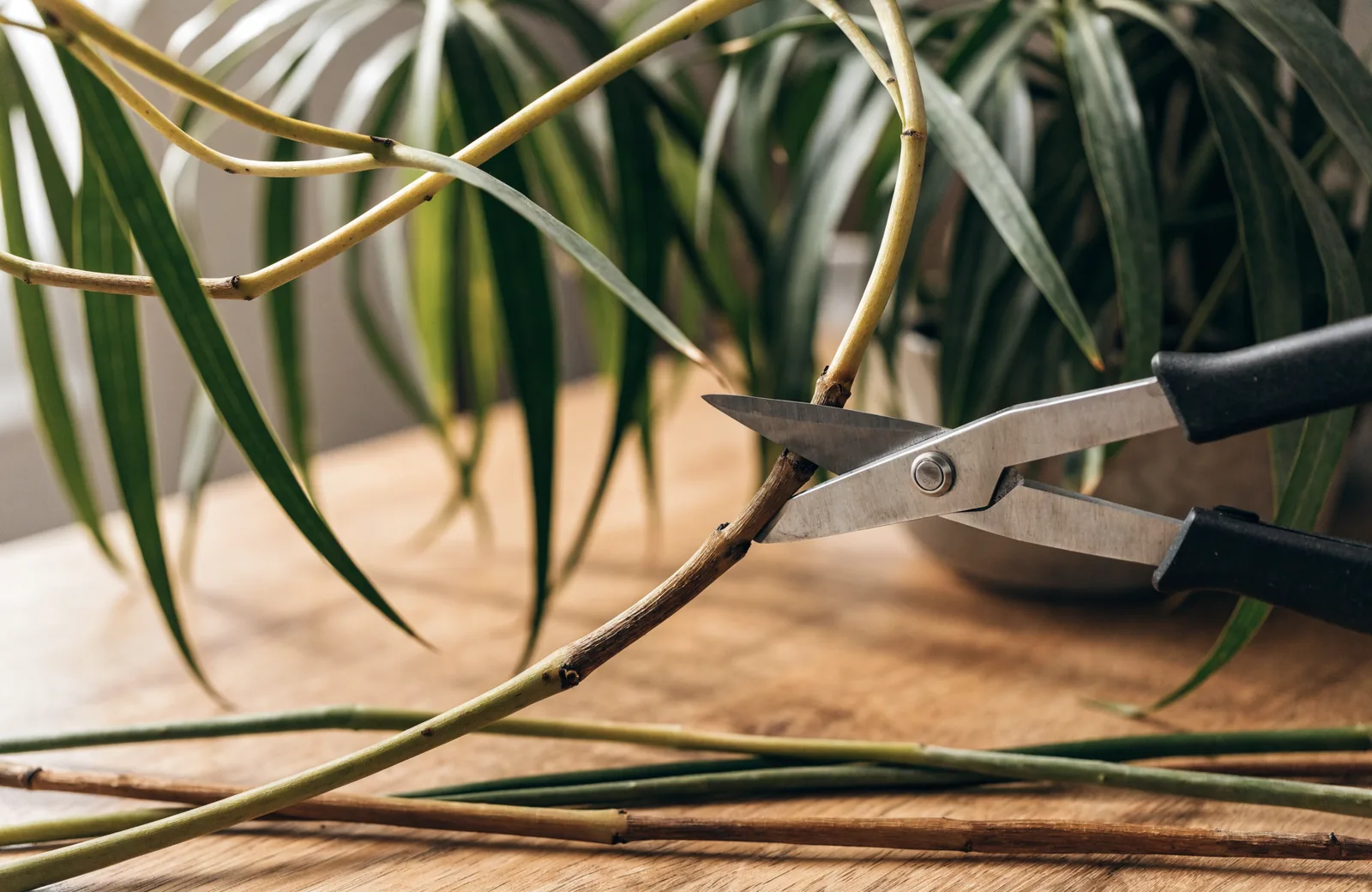
Prune most houseplants in spring, cutting just above a leaf node with clean, sharp scissors at a slight angle. Remove up to a third of the plant to encourage bushier growth. Every cutting with a node can be rooted in water or moist soil.
Pruning feels violent when you're doing it, but a well-timed cut is what turns a leggy vine into a full, bushy plant — and gives you free new plants in the process.
What is a node?
A node is the little bump on a stem where a leaf grows out. New branches, roots, and aerial roots all emerge from nodes. Everything below the node on a cutting is disposable; everything above is future plant. Cut just above a node and the plant will push new growth from that node — often two new stems instead of one.
When to prune
Early spring is best — the plant is entering active growth and heals quickly. Light shaping cuts can be made any time. Avoid heavy pruning in winter when growth is paused.
The three cuts to know
- Deadheading / clean-up — snip yellow, dead, or damaged leaves at the base of the stem. Do any time.
- Shaping cut — remove the top 10–20% of a stem just above a node to encourage branching.
- Rejuvenation — cut a leggy plant back by a third to a half. Drastic, but the regrowth is dense and healthy.
Tools and hygiene
Use sharp, clean scissors or pruners — dull blades crush stems and invite disease. Wipe blades with 70% alcohol between plants, especially if one has any disease.
Rooting cuttings
- Cut a stem with at least one node and 1–2 leaves.
- Remove any leaves that would sit in water.
- Place in a jar of water in bright indirect light. Change water every 3–4 days.
- Roots typically appear in 2–4 weeks. Pot up when they're 3–5 cm long.
Plants that love pruning
Pothos, philodendron, pilea, tradescantia, string of hearts — the more you prune, the bushier they get. Palms, orchids, and single-stem plants (fiddle leaf fig with one trunk) are more delicate — only remove damaged growth or one strategic top cut for branching.
If you're not sure where a node is, snap the plant in PlantMe and the app highlights ideal cutting points for that species.
Frequently asked questions
Can I use kitchen scissors?
As long as they're sharp and clean, yes. For thick woody stems (rubber plant, ficus) invest in proper bypass pruners.
Will my plant recover from a hard prune?
Almost always, if you cut above healthy nodes and the plant has energy stored. Water lightly and don't feed for 4–6 weeks after pruning.
Should I seal the cut?
No, houseplant stems heal fine on their own. Sealing traps moisture and can breed fungus. The one exception is milky-sap plants (rubber plant) — dab the cut with a paper towel to stop the sap.
About the author

Houseplants & Indoor Styling
Wren has killed enough houseplants to know exactly why yours is struggling — and kept hundreds more thriving in a small, bright flat that doubles as her test lab. She writes about reading plants instead of following rules, and believes every windowsill deserves at least one leaf.
Try it yourself
Diagnose it instantly with PlantMe
Snap a photo of any plant or leaf. Get the species, the diagnosis, and a care plan in seconds.
Download on theApp StoreKeep reading
See also