Journal/Troubleshooting · 6 min read
How to Get Rid of Scale Insects on Houseplants
Those little brown bumps on your plant's stems could be scale. How to spot scale insects, remove them, and stop the sticky mess they leave behind.
Quick answer
Scale insects look like small, immobile brown, tan or white bumps clustered on stems and leaf undersides, often with sticky honeydew and black sooty mould nearby. To get rid of them, isolate the plant, scrape or wipe the scale off, then treat every few days with horticultural oil, neem or dabs of rubbing alcohol until no new bumps appear — it usually takes several rounds.
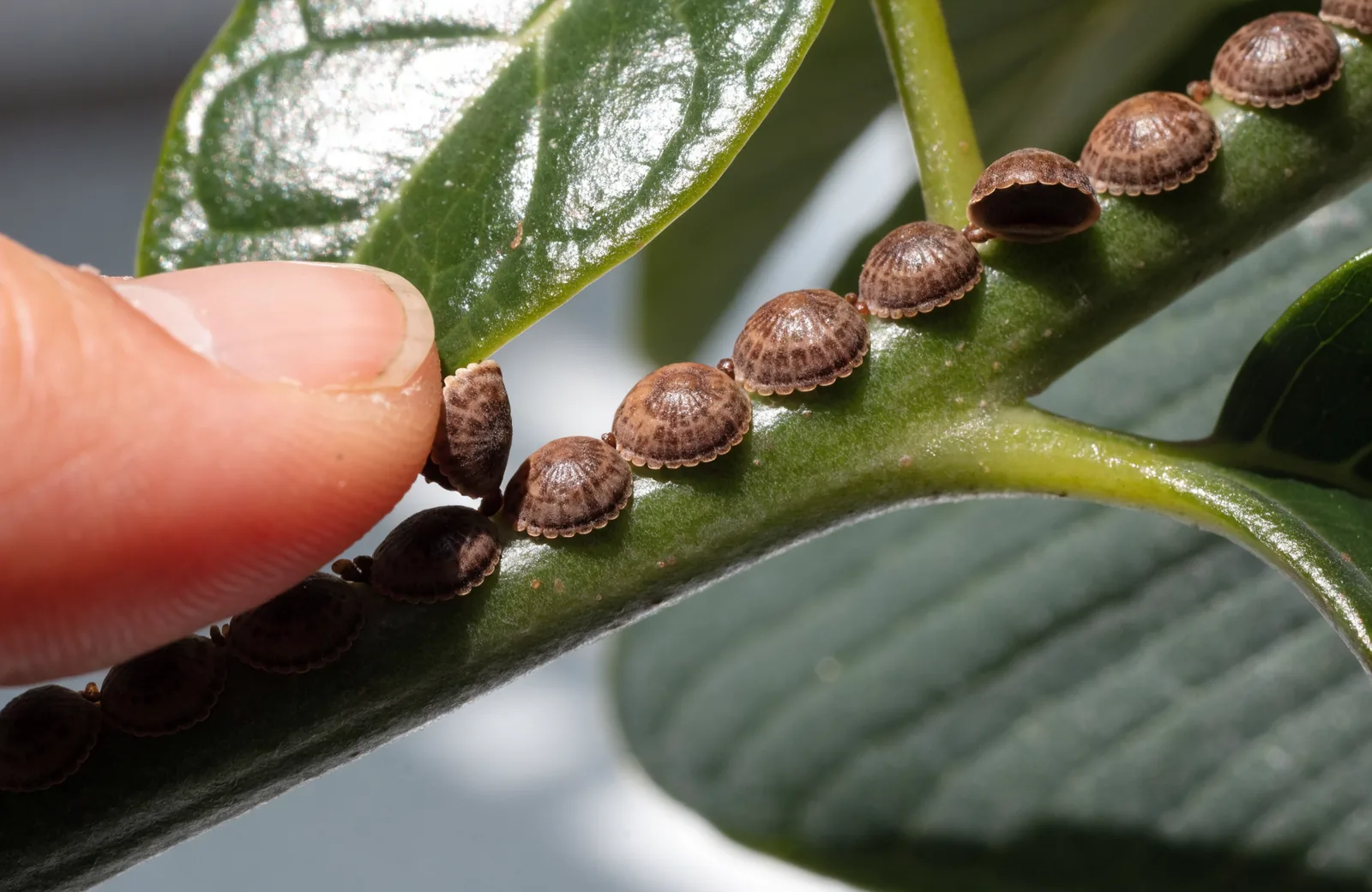
Scale is the houseplant pest most people fail to notice until it's well established, because it barely looks like an insect at all. The adults sit motionless under a protective shell, disguised as harmless brown bumps on a stem, quietly draining the plant's sap. Catch them early and they're straightforward to clear; leave them and a colony can weaken a plant, coat everything below in sticky residue, and spread to your whole collection. Here's how to recognise scale and deal with it properly.
How to recognise scale insects
Scale insects are small — usually 1–5 mm — and spend most of their lives fixed in one place, which is exactly what makes them easy to miss and easy to mistake for part of the plant. Look for these signs:
- Round, oval or teardrop-shaped bumps in brown, tan, grey or white, clustered along stems, leaf stalks, and the midribs and undersides of leaves.
- Bumps that don't brush off easily and that can be scraped away with a fingernail to reveal a soft insect underneath — a good confirmation test.
- Sticky, shiny 'honeydew' on the leaves, on lower leaves, or on the floor and furniture beneath the plant.
- Black sooty mould growing on that honeydew, giving leaves a dirty, sooty film.
- Yellowing leaves, poor or distorted new growth, and general decline in a plant that's otherwise cared for well.
There are two broad groups worth knowing about. Soft scale produce lots of honeydew and the sooty mould that follows — that's usually the sticky, messy kind. Armoured scale have a harder, separate shell and produce little or no honeydew, so they're spotted by the bumps and the plant's decline rather than by stickiness. The treatment is much the same for both.
Step 1: isolate and remove what you can see
The moment you confirm scale, move the plant well away from your others — scale crawls short distances and spreads between touching leaves, so isolation stops a single infested plant becoming an outbreak. Then physically remove as many as you can, which on its own dramatically knocks back the population:
- Scrape the bumps off with a fingernail, an old toothbrush, or a soft cloth, working along stems and leaf undersides.
- For heavily encrusted stems, prune them out entirely and bin the prunings.
- Dab individual scale with a cotton bud dipped in rubbing (isopropyl) alcohol — it dissolves their protective coating and kills them on contact. Wipe the residue away afterwards.
Step 2: treat with oil or neem, and repeat
Physical removal rarely gets every one, and it misses the tiny mobile young — called crawlers — that hatch and move to new spots. The key to beating scale is persistence: follow up with a spray and repeat it on a schedule. Horticultural oil (or a light insecticidal soap or neem-oil solution) works by smothering the insects and the crawlers, so coverage matters — spray until stems and both sides of the leaves are thoroughly wetted. Because a single treatment won't catch eggs and newly hatched crawlers, repeat every five to seven days for several weeks until no new bumps appear. Test any spray on one leaf first and avoid treating in strong direct sun, which can scorch oiled foliage.
Tip: after each treatment, wipe the honeydew and sooty mould off the leaves with a damp cloth. It isn't just cosmetic — clearing the sticky film lets the leaf breathe and photosynthesise properly, and gives you a clean surface so you can see any survivors at the next round.
Step 3: check, and keep checking
Scale is beaten by vigilance more than by any single product. Keep the plant isolated and inspect it closely every few days, paying attention to leaf undersides, stem joints and new growth where crawlers settle. Don't declare victory until you've gone two to three weeks with no fresh bumps. For a badly infested, much-loved plant, a systemic insecticide (taken up by the plant and eaten by the feeding insects) can be worth it, but for most houseplants the oil-and-patience approach clears the problem without stronger chemicals.
Stop scale coming back
- Quarantine every new plant for a couple of weeks and inspect it before it joins your collection — new arrivals are the most common source.
- Check your plants regularly, especially the undersides of leaves, so you catch scale while it's still a handful of bumps.
- Keep plants healthy and unstressed; vigorous plants shrug off small infestations far better than struggling ones.
- Wipe down leaves during routine care — it removes early scale and honeydew and keeps you familiar with what each plant should look like.
Not sure whether those bumps are scale, mealybugs, a bit of natural corky growth, or something else entirely? Photograph the affected stem in PlantMe. The app identifies your plant from 35,000+ species and cultivars and checks the symptoms against a library of over 500 diseases and pest disorders, so you can be sure it's scale — and treat the right problem first time — before it spreads.
Sources & further reading
Frequently asked questions
What causes scale insects on houseplants?
Scale almost always arrives on a new plant, a cutting, or fresh flowers brought indoors, then spreads to neighbouring plants. Warm, stable indoor conditions with no natural predators let a small number multiply unchecked, which is why quarantining new plants and inspecting regularly matters.
Does rubbing alcohol kill scale?
Yes. Dabbing scale with a cotton bud soaked in isopropyl alcohol dissolves their protective coating and kills them on contact. It's ideal for small infestations, but pair it with a horticultural-oil spray and repeat treatments to catch the crawlers you can't see.
How long does it take to get rid of scale?
Expect several weeks. Because eggs and crawlers keep hatching, a single treatment never clears it — repeat every five to seven days and only consider the plant clear once two to three weeks pass with no new bumps appearing.
About the author

Plant Rescue & Troubleshooting
Camille spent years behind the counter of a plant shop where every customer arrived with the same question: what's wrong with it? She writes the Journal's rescue guides — calm, diagnosis-first, no guilt — because most 'dying' plants are one correct decision away from recovery.
Try it yourself
Diagnose it instantly with PlantMe
Snap a photo of any plant or leaf. Get the species, the diagnosis, and a care plan in seconds.
Download on theApp Store