Journal/Troubleshooting · 7 min read
Mealybugs: How to Get Rid of the White Fluff on Your Plants
White fluff on your plant is probably mealybugs. How to identify them, get rid of them with alcohol, soap and patience, and stop them coming back.
Quick answer
That white, cottony fluff in the leaf joints of your plant is almost certainly mealybugs — sap-sucking insects hiding under a waxy coating. Get rid of them by dabbing each cluster with a cotton bud dipped in 70% isopropyl alcohol, then spraying the whole plant with insecticidal soap or neem oil every five to seven days for several weeks. Isolate the plant while you treat it, because mealybugs spread easily.
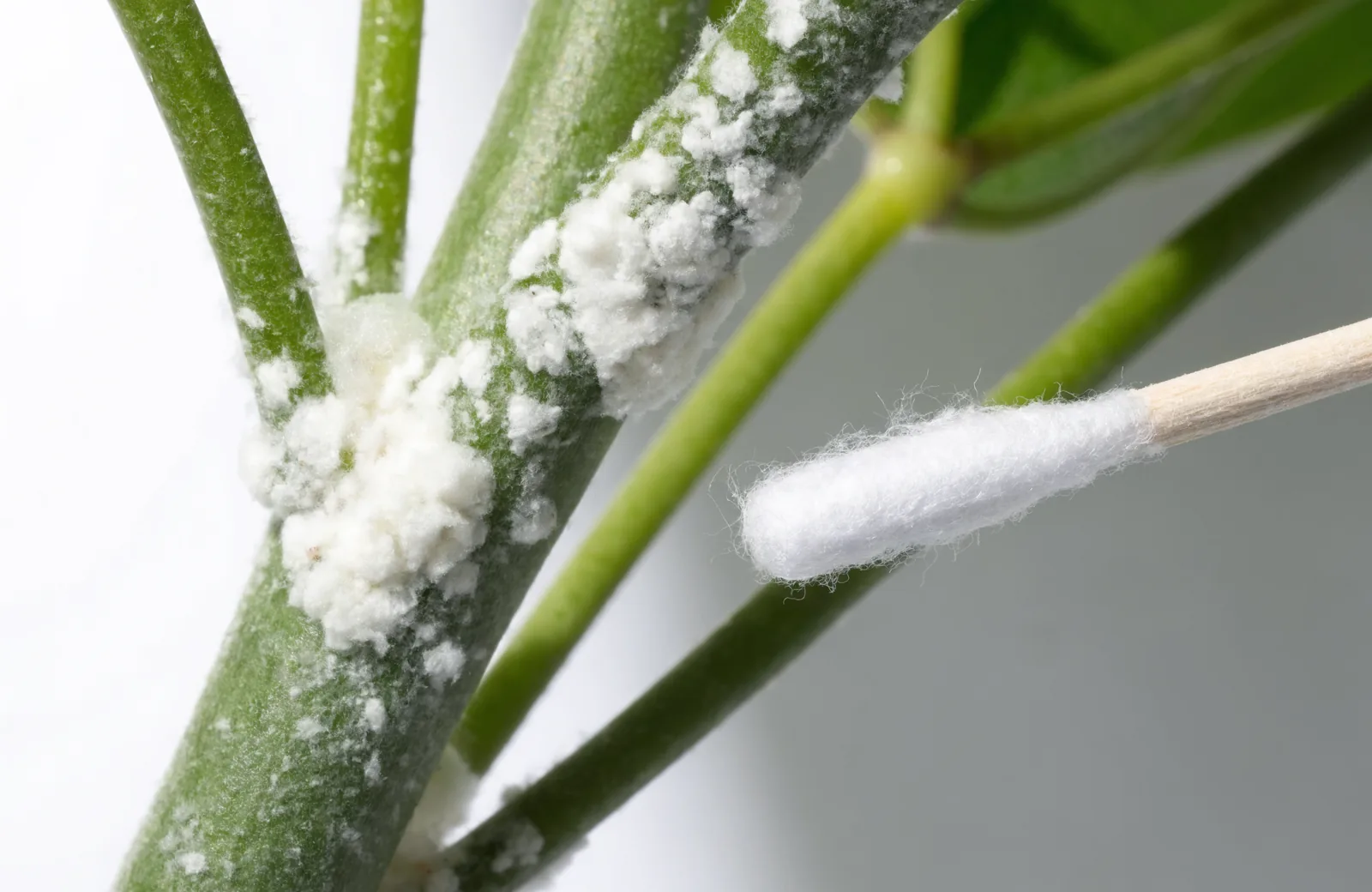
Few things are more deflating than spotting little tufts of white cotton wool tucked into the leaf joints of a plant you love. That fluff is not mould and it is not lint — it is mealybugs, one of the most stubborn houseplant pests there is. The good news: caught early, an infestation is very beatable. It just takes a method and a bit of persistence, and this guide gives you both.
What mealybugs actually are
Mealybugs are small, soft-bodied insects related to scale. The adult females — the ones you actually see — are oval, wingless and coated in a white, powdery wax that makes them look fuzzy, like tiny woodlice dusted in flour. They push their mouthparts into the plant and drink the sugary sap, weakening it leaf by leaf. As they feed they excrete sticky honeydew, which is why an infested plant often has shiny, tacky patches on its leaves and sometimes a coating of black sooty mould growing on the residue.
The wax coating is what makes them so difficult. It repels water — and water-based sprays — so a casual misting does almost nothing. They also deliberately wedge themselves into the most protected spots on the plant: leaf axils, the undersides of leaves along the veins, the bases of stems, under pot rims, and in some species down among the roots, out of sight entirely.
How to confirm it is mealybugs
- White, cottony clusters in leaf joints, on stems, or on the undersides of leaves — the classic sign.
- Sticky, shiny honeydew on leaves or on the surface beneath the plant, sometimes with black sooty mould.
- Yellowing, curling or dropping leaves and generally stalled, sad-looking growth.
- Slower-moving oval insects under the fluff when you tease it apart with a cocktail stick.
- A plant that keeps wilting despite reasonable watering — root mealybugs can be the hidden cause. Slide the plant out of its pot and look for white, waxy deposits on the roots and inner pot wall.
Mealybugs have favourite hosts: succulents and jade plants, orchids, hoyas, ferns, philodendrons, citrus and coleus are all high on their list. If one plant has them, inspect its neighbours closely — the young nymphs, called crawlers, are tiny and mobile, and they will happily walk to the next pot along the shelf.
Step one: isolate and prune
Move the plant well away from the rest of your collection before you do anything else. Then look it over methodically and cut off any stems or leaves that are heavily encrusted — there is no point nursing a leaf that is more insect than plant. Bag the trimmings and put them in the bin, not the compost.
Step two: the alcohol treatment
For every cluster you can see, dip a cotton bud in 70% isopropyl alcohol (rubbing alcohol) and dab it directly onto the insects. The alcohol dissolves the protective wax and kills them on contact — you will see the white fluff collapse into a translucent smear. Work through the whole plant: leaf joints, stem bases, under every leaf. For larger plants, a spray bottle with a mix of roughly one part alcohol to a few parts water plus a drop of washing-up liquid speeds things up.
Tip: test alcohol on a single leaf first and wait 24–48 hours before treating the whole plant. Most houseplants tolerate it well, but thin-leaved and waxy-bloomed plants (some ferns and succulents) can be marked by it. If the test leaf looks scorched, stick to insecticidal soap instead.
Step three: spray, wait, repeat
Alcohol kills the bugs you can see; the eggs and hidden crawlers are another matter. Females lay hundreds of eggs inside those cottony sacs, and a new generation can mature in a few weeks in a warm room. So after the initial clean-up, spray the entire plant — tops and undersides of leaves, stems, soil surface — with insecticidal soap or neem oil, and repeat every five to seven days for at least three to four weeks. These sprays work on contact by blocking the insects' breathing pores, and they are most effective on young nymphs that have not yet built up their wax. Missing a week is how infestations come back.
Root mealybugs and stubborn cases
If you found white deposits on the roots, treatment means repotting: knock off all the old compost, rinse the roots thoroughly under lukewarm water, discard the soil, scrub the pot with hot soapy water, and repot in fresh mix. For a highly valuable plant that keeps relapsing, a systemic insecticide watered into the compost is the option of last resort — it makes the sap itself poisonous to the bugs. And sometimes the honest answer is triage: a cheap plant that is completely overrun is often better binned than allowed to reinfect a whole collection.
Stopping them coming back
Nearly every mealybug outbreak arrives on a new plant. Quarantine anything new for a couple of weeks and inspect it — leaf joints especially — before it joins the shelf. Check your plants briefly whenever you water, because a colony of five is an evening's work while a colony of five hundred is a month's. Avoid overfeeding with nitrogen-rich fertiliser, which produces exactly the soft, sappy growth mealybugs love.
Not sure whether you are looking at mealybugs, scale, or something fungal? Photograph the affected spot in PlantMe — the app recognises over 500 plant diseases and pest problems from a photo and gives you a diagnosis and treatment plan in seconds, so you can start the right fight straight away.
Sources & further reading
Frequently asked questions
What causes mealybugs to appear?
They almost always arrive on a newly bought plant, on cut flowers, or occasionally in contaminated potting compost. They do not appear from nowhere — which is why quarantining new plants for a couple of weeks is the single best prevention.
Can a plant recover from mealybugs?
Yes, in most cases. If the plant still has plenty of healthy growth, consistent treatment — alcohol on visible clusters plus soap or neem sprays weekly for a month — clears the infestation and the plant regrows. Heavily encrusted plants are harder to save and can be a risk to the rest of your collection.
Do mealybugs live in the soil?
Some species do. Root mealybugs feed below the surface and show up as white, waxy deposits on the roots and inner pot wall. Treating them means repotting into fresh compost after rinsing the roots clean — sprays on the leaves will not reach them.
About the author

Plant Rescue & Troubleshooting
Camille spent years behind the counter of a plant shop where every customer arrived with the same question: what's wrong with it? She writes the Journal's rescue guides — calm, diagnosis-first, no guilt — because most 'dying' plants are one correct decision away from recovery.
Try it yourself
Diagnose it instantly with PlantMe
Snap a photo of any plant or leaf. Get the species, the diagnosis, and a care plan in seconds.
Download on theApp Store