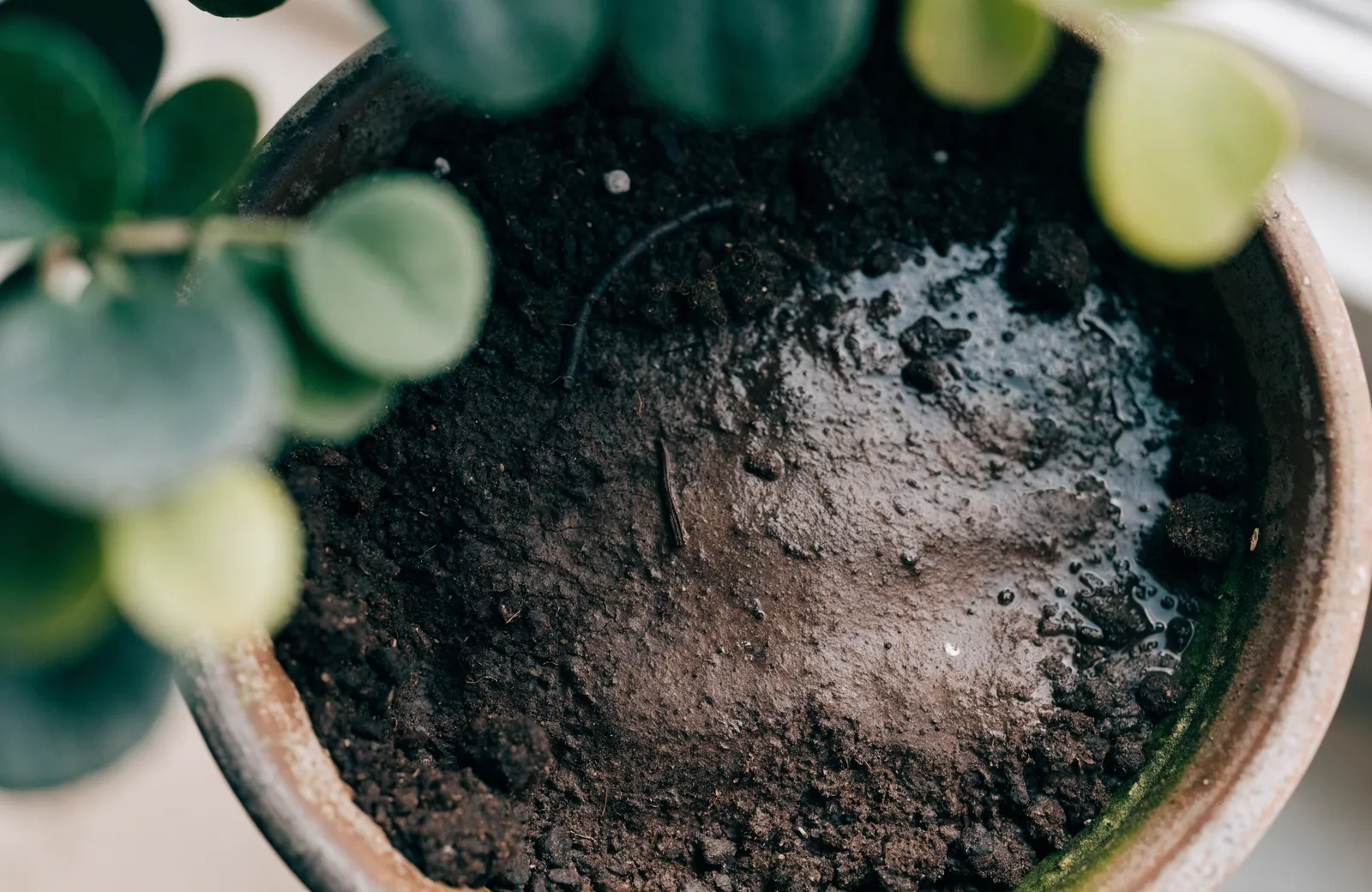
Journal/Troubleshooting · 5 min read
Springtails in Houseplant Soil: The Tiny Jumping Bugs That Aren't Attacking Your Plant
Tiny white or grey bugs jumping on the compost when you water? Those are springtails. How to confirm the diagnosis, why they've moved in, why they're harmless to plants and people — and the watering change that clears them out.
Quick answer
Tiny pale bugs that ping into the air when you disturb the soil are almost certainly springtails. They eat fungi, algae and decaying matter — not your plant — and they don't bite people or pets. They're there because the compost is staying wet. Let the soil dry properly between waterings and the population collapses on its own.
You water a pot, lean in to check on it, and the soil surface flickers — dozens of specks, smaller than a pinhead, vaulting in every direction. It is an unsettling thing to watch over your morning coffee, and the usual reaction is to reach for a spray. Put it down for a moment. Of all the creatures that turn up in houseplant compost, this one is the closest to a false alarm — but only once you've confirmed what you're looking at, so let's start there.
Start with the diagnosis
Springtails are wingless, soft-bodied creatures, most of them 1–2 mm long — white, grey or brownish, with short antennae. Their signature is a forked appendage called a furcula, held folded under the abdomen like a set mousetrap; released, it flings them many times their own body length. That jump is your diagnostic. Check the suspect against this list:
- They jump when disturbed — poke the soil and the specks scatter like popping candy. Fungus gnat larvae, mites and most other soil residents cannot do this.
- They cluster where it's wet: on the compost surface, under the pot, in the saucer, around the drainage holes after watering.
- They don't fly. If your problem is on the wing around your face, it isn't springtails.
- The plant itself looks untouched — no holes in mature leaves, no sticky residue, no webbing, no wilting you can't otherwise explain.
Springtails or fungus gnats?
These two share a pot so often they're worth separating deliberately, because the treatments overlap but the stakes don't. Fungus gnats are the small dark flies that drift up from the compost and hang in the air; their larvae live in the soil and can nibble fine roots, which makes them worth actual intervention — our fungus gnat guide covers that campaign. Springtails stay down on the surface and jump rather than fly, and the research consensus on them is unusually blunt: extension entomologists at Iowa State and Minnesota describe them as harmless to established plants, people and pets. No bites, no stings, no disease. The worst they do is startle you.
What they're actually doing in your pot
Springtails are decomposers. Outdoors they live in leaf litter and mulch in extraordinary numbers — Penn State Extension puts populations at up to 100,000 per cubic metre of surface soil — quietly eating fungi, algae, bacteria and decaying plant matter. A houseplant pot that never quite dries out is the same habitat in miniature: constantly damp compost, often high in peat, growing exactly the fungal film they feed on. If your pot also carries a whitish bloom on the surface, that's the buffet itself — our guide to mould on houseplant soil explains that layer — and green algae on the compost or the pot wall is the same signal in a different colour.
Which reframes the problem usefully: springtails are not an infestation so much as a symptom. They can only boom in a pot that stays wet, so a crowd of them is your compost filing a report. The condition they're reporting — soil that never dries, airless and slowly souring — is the one that actually damages houseplants, and it has its own warning signs long before root rot sets in. If the springtails arrived alongside yellowing lower leaves or a musty smell, read our guide to overwatering vs underwatering next, because the bugs are the least of what that pot is telling you.
The fix: make the pot boring
Every extension service lands on the same prescription: take away the moisture and the population collapses. Chemicals are the wrong tool — Minnesota Extension notes that pesticides are ineffective against springtails indoors precisely because they do nothing about the damp that sustains them. The campaign, such as it is:
- Let the top few centimetres of compost dry out fully before you water again — then water thoroughly, so you're watering deeply but less often. (Our guide to how often to water houseplants covers judging this by touch rather than calendar.)
- Empty the saucer after every watering. Standing water under the pot is a springtail reservoir and a root-rot risk in one.
- Scrape off any algae, moss or mouldy film on the compost surface, and clear fallen leaves off the soil — you're removing the food supply.
- Check the drainage. A pot that can't shed water can't dry; if the mix stays swampy for a week after watering, repot into a fresher, freer-draining mix.
- Improve airflow around the pot — a less stagnant surface dries faster and grows less fungus.
Expect the numbers to fall over two to three weeks rather than overnight; you are managing a habitat, not spraying a pest. A few stragglers in a healthy, well-drained pot are normal and can be ignored with a clear conscience.
When springtails are telling you something
Two honest caveats. In greenhouses and seed trays, very large populations can rasp at seedlings and the softest new growth — Penn State notes minor damage is possible — so damp propagation setups deserve the same drying discipline, applied more carefully. And indoors, a sudden springtail bloom in autumn, just as plants come back inside and light levels fall, is usually a sign your summer watering routine has outlived the season. If you're not sure whether the specks in your pot are springtails, fungus gnat larvae or something with worse intentions, a photo in the PlantMe app can help put a name to the problem — it recognises 500+ plant diseases and pest symptoms — and a named problem is a solvable one. But nine times out of ten, the tiny acrobats in your compost are just the clean-up crew, working a pot that's wetter than it should be. Dry the stage and the show closes.
Sources & further reading
About the author

Plant Rescue & Troubleshooting
Camille spent years behind the counter of a plant shop where every customer arrived with the same question: what's wrong with it? She writes the Journal's rescue guides — calm, diagnosis-first, no guilt — because most 'dying' plants are one correct decision away from recovery.
Try it yourself
Diagnose it instantly with PlantMe
Snap a photo of any plant or leaf. Get the species, the diagnosis, and a care plan in seconds.
Download on theApp Store