Journal/Troubleshooting · 6 min read
Vine Weevil: Spot the Grubs Before They Kill Your Plants
White C-shaped grubs in the compost and a plant that wilts for no reason: how to confirm vine weevil, why September is the month that matters, and the fix that actually works.
A container plant that wilts even though the compost is damp. A cyclamen that lifts clean out of its pot with almost no roots attached. Little C-shaped white grubs curled in the compost when you tip the plant out. If any of that sounds familiar, you are probably dealing with vine weevil — and you are not too late. Most plants can be saved if you act in the next few weeks.
Vine weevil is really two problems wearing one name: an adult beetle that nibbles leaf edges in summer, and a root-eating grub that does the actual killing from autumn to spring. The treatment is different for each, so the first job is working out which one you're looking at.
Two pests in one: which are you seeing?
Symptom checker
| What you see | Which stage | How serious |
|---|---|---|
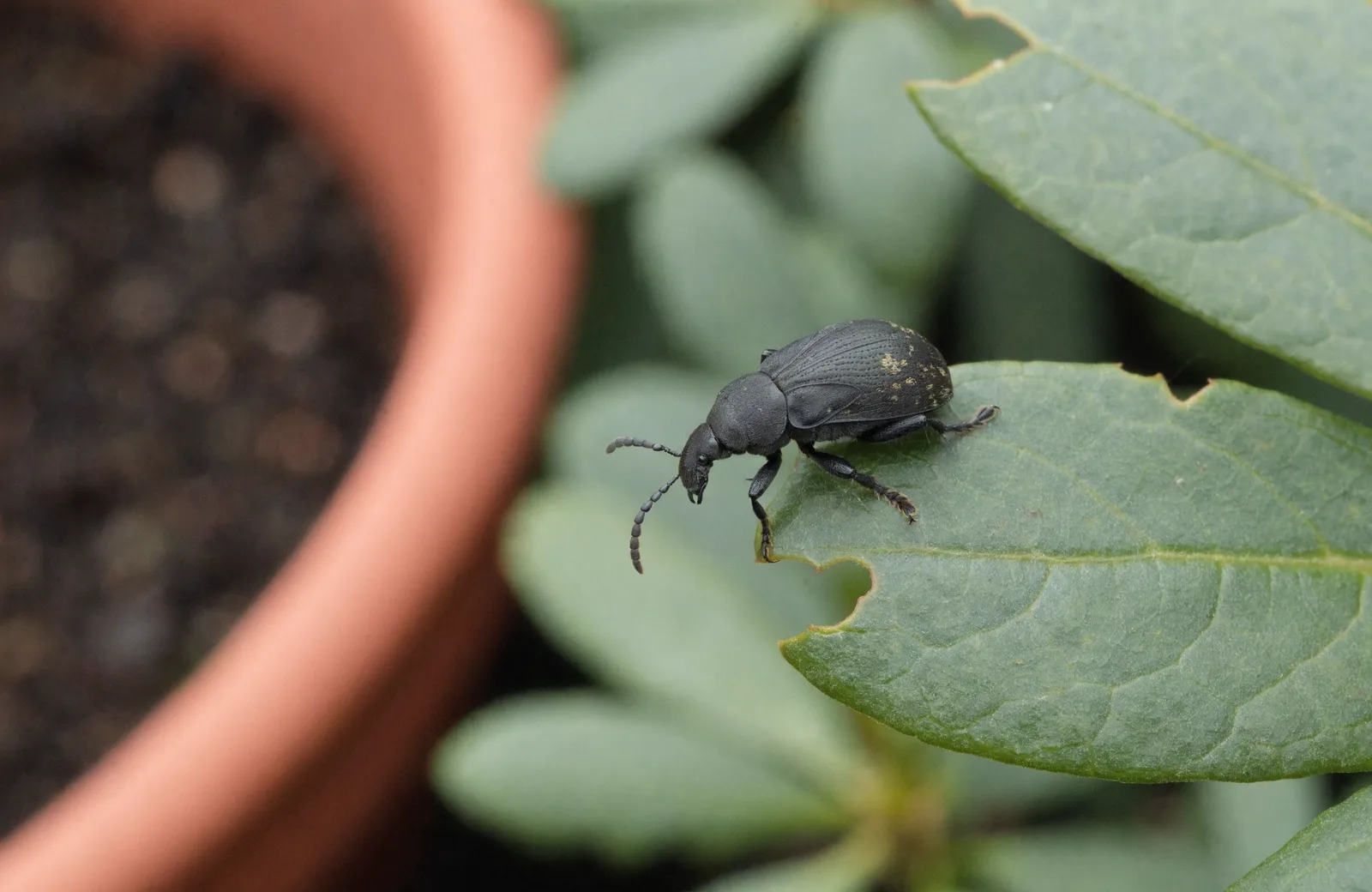
| Irregular U-shaped notches eaten from leaf edges | Adult beetle, feeding at night in summer | Cosmetic — plants shrug it off |
| Plant wilting despite damp compost, or growth stalling | Grubs eating the roots below | Serious — act now |
| Plump white C-shaped grubs, up to 10 mm, with pale brown heads, in the compost | Larvae — the damaging stage | Serious — treat the pot and check its neighbours |
| Matte-black beetle about 9 mm long, out after dark on pots and foliage | Adult — flightless, but an excellent climber | Each one can lay several hundred eggs |
The tip-out check
If a potted plant is wilting and water doesn't fix it, don't keep guessing — tip it out of the pot and look at the roots. Vine weevil grubs sit in the root zone, usually against the sides and bottom of the root ball, and they're unmistakable: fat, legless, white with a pale brown head, curled into a C. Don't confuse them with the larvae of fungus gnats, which are thin, thread-like and live in the top few centimetres of compost. Fungus gnat larvae are mostly a nuisance; vine weevil grubs eat entire root systems, and they will also gnaw the outer tissue from stem bases and bore into tubers.
Containers are where the damage concentrates. In the RHS's experience the plants that suffer worst in pots are cyclamen, begonias, primulas, succulents and strawberries; in open ground, rhododendrons, hydrangeas, evergreen euonymus and young yews are the classic victims. If you grow cyclamen in containers, treat a sudden collapse as vine weevil until proven otherwise.
Why late September matters
The vine weevil year has a rhythm. Adults emerge in late spring, feed for a few weeks, then spend the summer laying eggs — several hundred per beetle, all of them viable, because the entire population is female and reproduces without mating. Those eggs have now hatched, and the grubs are small, close to the surface and feeding hard before winter. This is exactly when they are easiest to kill — and it's also the RHS's window for biological control, which works while the compost is still warm. Most plant losses happen between September and March, when fully grown grubs finish off the root system. Treat now and you break the cycle before the expensive part.
Nematodes: the fix that actually works in pots
The standard non-chemical treatment is a drench of microscopic insect-parasitic nematodes, watered onto the compost. They hunt down the grubs and kill them within days, and they're harmless to people, pets, birds and earthworms. Timing and temperature are the whole game: Steinernema kraussei works in compost from 5–20°C, which makes it the right choice for autumn in a cool climate; Heterorhabditis species need 12–20°C, so they're better used in late summer or under glass. Water the compost before and after applying, and treat every pot in the group — grubs are rarely in just one. Nematodes work best in open, peat-free or coir-based composts and lighter soils.
Hand-picking adults
Adults can't fly — they walk everywhere — so physical controls do real work. Go out on a mild evening with a torch and pick the beetles off pots, walls and foliage; lay a sheet or upturned umbrella under a shrub and give it a shake. In a greenhouse, sticky barriers around staging legs stop them climbing. Every female you remove now is several hundred eggs that never get laid next summer.
Rescue repotting for a collapsing plant
If a plant is already wilting and you find grubs, nematodes alone may be too slow. Do a rescue repot instead:
- Tip the plant out and crumble away all the old compost over a sheet — every scrap goes in the bin or the middle of a hot compost heap, not back in a pot.
- Pick out and squash every grub you find, including the ones tucked against the pot walls.
- Rinse the remaining roots, trim anything gnawed or dead, and repot into fresh compost in a clean pot.
- Water in, keep the plant shaded and cool for a fortnight, and feed nothing until new growth appears.
- Check the plants that stood nearby — grubs travel in the compost, and adults will have laid eggs across the whole group.
Tuberous plants like begonias and cyclamen can look completely dead and still regrow from the tuber once the grubs are gone, so don't be too quick to throw them out. The same tip-out-and-clean routine is worth doing as part of overwintering fuchsias — fuchsias are a favourite target, and autumn repotting is your one guaranteed chance to inspect the roots.
Prevention
Buy carefully: check the root ball of new container-grown plants before they come home, especially rhododendrons, and quarantine anything suspicious. Encourage the things that eat vine weevils — birds, frogs, toads, hedgehogs and ground beetles all take adults and grubs. And put a repeat nematode drench in the calendar: one application in April and one in early September keeps pots clean through both halves of the grub season. If notched leaves appear next summer, that's your early warning to book the autumn treatment before the wilting starts.
Sources & further reading
Frequently asked questions
Can vine weevils fly in from the neighbours' garden?
No — vine weevils are flightless. They arrive on foot or, far more often, hidden as eggs or grubs in the compost of bought plants. That's why checking new root balls is the single best prevention.
Is it too late for nematodes in late September or October?
Not necessarily. Steinernema kraussei stays effective in compost as cool as 5°C, so it can be applied well into autumn in most temperate areas. The warmer-blooded Heterorhabditis species need 12°C or more, so save those for late summer.
I found one grub — do I need to treat everything?
Yes, treat the whole group of pots. A single female lays several hundred eggs around multiple plants, so one visible grub almost always means siblings nearby. Nematode drenches are applied per-pot, so do them all in one session.
About the author

Plant Rescue & Troubleshooting
Camille spent years behind the counter of a plant shop where every customer arrived with the same question: what's wrong with it? She writes the Journal's rescue guides — calm, diagnosis-first, no guilt — because most 'dying' plants are one correct decision away from recovery.
Try it yourself
Diagnose it instantly with PlantMe
Snap a photo of any plant or leaf. Get the species, the diagnosis, and a care plan in seconds.
Download on theApp Store