Journal/Plant Science & Curiosities · 5 min read
What Is a Mast Year? Why Some Autumns Bury You in Acorns
Some autumns the oaks bury the garden in acorns; most autumns they don't. The boom-and-bust rhythm is called masting — and it's one of the best tricks in the botanical playbook.
Quick answer
A mast year is a season in which oaks and other trees across a whole region produce a huge, synchronised seed crop — in oaks, roughly every two to five years. The glut is set by weather and the trees' internal boom-and-bust rhythm months in advance, and its best-supported purpose is to overwhelm seed-eaters so that some acorns survive to sprout.
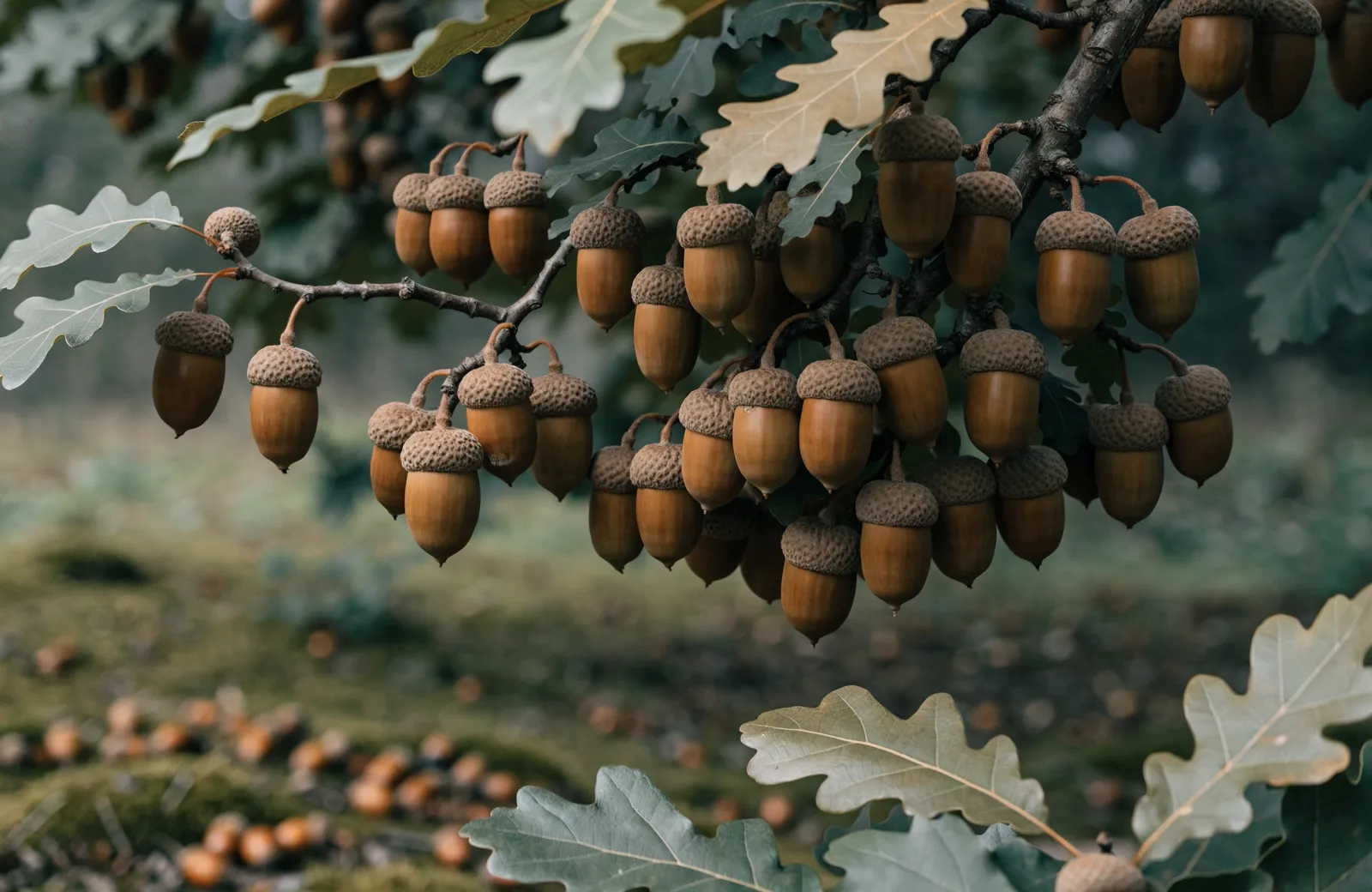
The first sign is usually sound: an irregular drumroll on the shed roof, a patter of something small and hard dropping through the branches. Then you look down and the lawn is gravelled with acorns — far more than last year, far more than the squirrels seem to know what to do with. A year when your oak buries the garden isn't a fluke, and it isn't an omen. It's a strategy, and botanists call it masting.
First, define the term
'Mast' is the old collective word for the fruit of forest trees — acorns, beechnuts, hickory nuts and their kin. Botanists split it into hard mast (nuts and acorns) and soft mast (berries and fleshy fruit). A mast year is a season in which a whole population of trees produces an enormous, synchronised seed crop — followed, as a rule, by several meagre ones. In oaks the boom returns roughly every two to five years, though the rhythm is irregular and no two regions keep quite the same calendar. A single mature oak can drop thousands of acorns in a mast autumn and next to none the year after.
The best-supported explanation: flood the market
Why would a tree spend so heavily in one season instead of producing a steady, sensible crop? The leading hypothesis is predator satiation. Acorns are among the most valuable food parcels in a temperate wood — squirrels, mice, jays, deer, turkeys, raccoons, foxes and wild boar all take them. If an oak offered the same comfortable crop every autumn, the animals that eat acorns would settle at a population exactly sized to eat all of it, every year, and almost nothing would be left to germinate.
Masting breaks that equilibrium. A run of lean years keeps seed-eater numbers low; then the glut arrives, and there are simply too many acorns for the reduced workforce to handle. Think of a bakery that stands nearly empty for three years and then, one morning, gives away ten thousand loaves: however hungry the town, most of the bread goes uneaten. The surplus acorns are the point — they are the ones that get buried, forgotten, and become oaks.
How do thousands of trees agree on a date?
Satiation only works if the trees act together — a lone oak holding a private mast year merely feeds its local squirrels better. And they do act together: trees many kilometres apart, in woods that have never 'met', boom in the same season. Exactly how they synchronise is still an open question, but researchers broadly agree that shared weather acts as the cue. Oaks are wind-pollinated, so every tree in a region lives through the same spring, and warm, wet growing seasons have been linked to heavy crops. The weather is the conductor — and plants are better at acting on shared signals than we tend to assume.
A crop on that scale is also a serious investment, which is why mast peaks arrive as spikes in a cycle rather than back-to-back: a tree that has just thrown a banquet typically produces little the following year.
The ripple through the food web
A mast year doesn't end when the acorns stop falling; it echoes for two or three years. Ecologists tracing oak masting have followed the chain from acorns to mice and chipmunks, from rodents to their predators, and onward to ground-nesting birds and ticks. It reads like a delayed-action timetable:
What a mast autumn sets in motion
| When | What typically happens |
|---|---|
| The mast autumn | Deer, turkeys, bears, squirrels and jays feast; jays and squirrels cache far more acorns than they will ever recover |
| The following year | Seed-eaters that entered winter well fed survive and breed strongly; rodent and deer numbers climb |
| One to two years on | Owls, hawks and foxes respond to the rodent boom; tick numbers can rise with their rodent and deer hosts |
| Meanwhile, underground | Cached, forgotten acorns germinate — the next generation of oaks |
That last row is the quiet payoff. A jay burying acorns it will never retrieve is, functionally, a forester.
Do lots of acorns mean a hard winter is coming?
The folklore is irresistible — surely the trees know something. But the crop under your feet was decided months to years before it fell: by the spring weather in which the flowers were pollinated, and by where each tree sat in its own boom-and-bust cycle. An acorn glut is a record of seasons already past, not a forecast of one that hasn't happened yet. Oaks are many things; meteorologists they are not.
What a mast year means for your garden
Practically, a mast autumn mostly asks for a rake. Acorns on a lawn are harmless, but the hundreds of oak seedlings that follow in spring are real; hoe or pull them young, because even a finger-high seedling is already building a taproot with opinions.
If you'd rather grow one on purpose, collect plump brown acorns early and sow them outdoors in autumn — like many temperate tree seeds, most acorns wait out a cold spell before sprouting, the same timer explained in what seed stratification is. Expect company either way: in a mast year, every squirrel in the parish is planting pots of its own. Masting isn't an oak eccentricity, either — hickories, beeches, sugar maples and many conifers run the same boom-and-bust strategy on their own calendars. A garden in October is anything but idle: the trees are making moves measured in decades, and that includes the colour changing overhead.
Sources & further reading
Frequently asked questions
How often do oaks have a mast year?
Roughly every two to five years, but the cycle is irregular and varies by species and region. Local weather can shift the rhythm, and an individual tree may run slightly out of step with its neighbours.
Do more acorns mean more squirrels next year?
Usually, yes. Seed-eaters that enter winter well fed survive and breed better, so rodent and deer numbers tend to climb the year after a mast autumn — and their predators often follow a year later.
Do all trees have mast years?
No, but many do. Hickories, beeches, sugar maples and many conifers show the same boom-and-bust pattern on their own calendars, and masting has even been recorded in some grasses.
About the author

Plant Science & Curiosities
Lena is a botanist who thinks the strangest thing about plants is how rarely we ask why they do what they do. She covers the science side of the Journal — photosynthesis, plant communication, disease biology — translating research into things you can actually use at the potting bench.
Try it yourself
Diagnose it instantly with PlantMe
Snap a photo of any plant or leaf. Get the species, the diagnosis, and a care plan in seconds.
Download on theApp StoreKeep reading
Plant Science & Curiosities
What Is Seed Stratification? Why Some Seeds Refuse to Grow Until Winter Has Happened
Plant Science & Curiosities
Do Plants Really Communicate? The Science
Plant Science & Curiosities
Photoperiodism: How Plants Count the Dark
Plant Science & Curiosities
Why Do Leaves Change Colour in Autumn?