Journal/Plant Science & Curiosities · 6 min
What Is Guttation? Why Your Plant Drips Water Overnight
Dr. Lena Okafor explains guttation — the root pressure that pushes xylem sap out through pores called hydathodes overnight — how to tell it from dew and pest honeydew, and when the droplets are worth your attention.
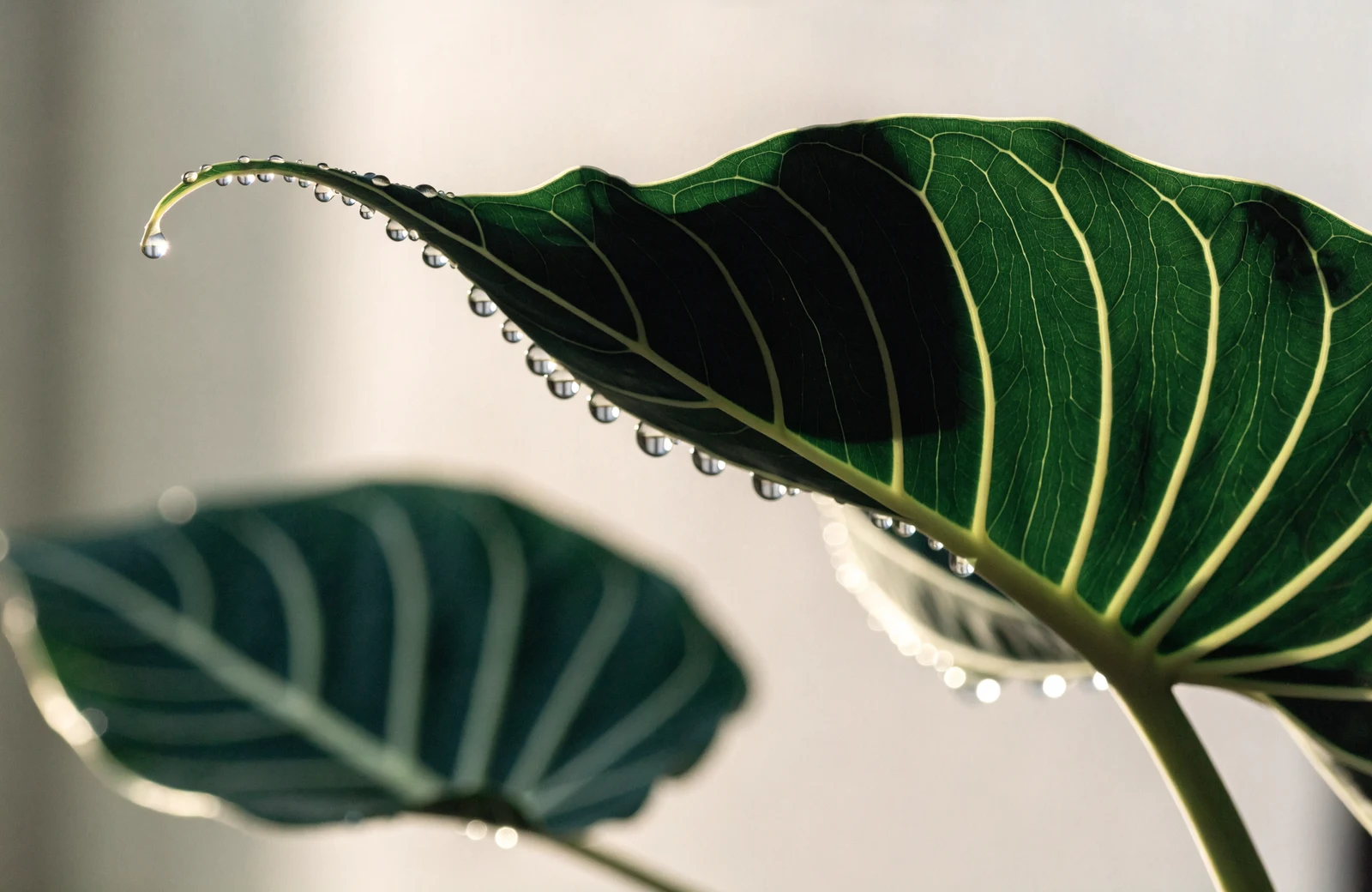
You water a monstera in the evening, and by breakfast there are clear beads hanging from the leaf tips — or a damp ring on the shelf below. The plant is not leaking, crying, or failing. It is doing something called guttation, and once you understand the plumbing behind it, the droplets stop being a worry and become a weather report: a short, readable bulletin about your soil, your air, and your watering habits.
First, the word
Guttation comes from the Latin gutta, a droplet. It names the slow release of liquid from the inside of an intact, healthy leaf — usually at the very tip, or spaced with odd precision along the margin. The liquid is not pure water. It is xylem sap: the dilute solution of minerals, with traces of sugars and other compounds, that the roots have been sending upward all night. That detail matters later, because what the droplets leave behind when they dry is part of the story.
The mechanism: pressure with nowhere to go
By day, a plant moves water in one overwhelming direction: in at the roots, up the xylem, and out as vapour through the stomata — the adjustable pores, mostly on the undersides of the leaves, that also take in carbon dioxide. That evaporative pull is transpiration, and it is the engine of the whole system. At night the engine switches off. In most species the stomata close, and evaporation all but stops.
The roots, though, do not clock off. While the soil is moist, root cells keep moving mineral ions into the xylem, and water follows by osmosis. With nothing drawing the water out above, the column of sap is pushed upward from below — botanists call this root pressure. Picture a building's plumbing with every tap shut while the pump in the basement keeps running: the pressure has to go somewhere. A plant's relief valves are hydathodes — tiny pores at the leaf tips and margins, sitting exactly where the fine veins end. Unlike stomata, hydathodes cannot close, so when root pressure builds overnight, sap is forced out through them, and you find the droplets at breakfast.
This is why guttation is a moist-soil, still-air, humid-night phenomenon. The New York Botanical Garden notes it shows up most often when the soil is very wet and cool temperatures, still air and high humidity have slowed evaporation to a crawl — which, in a home, is a fair description of a plant watered generously in the evening in a room where the air barely moves.
Guttation, dew, or something else?
Not every wet leaf is guttation. The usual suspects separate cleanly.
| What you see | Most likely | How to confirm |
|---|---|---|
| Distinct clear droplets at leaf tips or spaced along the margin, in the early morning | Guttation | Soil is moist; droplets sit where the veins end; they may dry to a faint pale film |
| A fine film of moisture across the whole leaf surface | Dew (condensation) | Forms on cold surfaces — outdoor foliage, or a plant pressed against a cold window — and wets leaf and pot alike |
| Sticky drops scattered on upper leaf surfaces or the furniture below | Honeydew from sap-sucking pests | Tackiness is the giveaway — check the undersides of the leaves directly above, and see why plant leaves get sticky |
| Water pooling under the pot hours after watering | Drainage, not the leaves | Lift the pot — a waterlogged root ball keeps weeping long after the excess should have run through |
Is it doing any harm?
To the plant, almost never. The droplets usually evaporate within a few hours of daylight, and guttation itself is a normal by-product of healthy root function — one suggestion, noted by the NYBG, is that it may even help some plants offload surplus mineral salts. Two caveats are worth filing. First, because the fluid carries dissolved minerals, it can dry to a whitish deposit along the leaf edge — chemically close kin to the white crust that forms on the soil surface — and in heavily fertilised pots those concentrated salts can occasionally scorch the leaf tip where they dry. Colorado State University's horticulturists add that the residue is regularly mistaken for scale insects or powdery mildew, and suggest looking closely before treating a problem that is not there.
Second, in the greenhouse and the vegetable garden, the droplets have a darker side: they can ferry pathogens from plant to plant — grey mould among them, and bacterial canker in tomatoes — which is one reason experienced growers avoid brushing through wet plants first thing in the morning. Indoors, with plants spaced on shelves, this is rarely a live concern, but if a plant is already fighting grey mould (botrytis), keep its mornings dry.
What the droplets say about your watering
Occasional guttation after a thorough watering means nothing except that the system works. Droplets every single morning are a different message: root pressure needs consistently wet soil, so daily guttation from a pot whose surface never dries is a polite early hint that you may be overwatering — the droplets do no damage, but soil that never dries starves roots of oxygen, and that does. The fix costs nothing: water in the morning rather than the evening, and let the top of the mix dry before the next round, as covered in how often to water houseplants.
As for who gutters: mostly plants shorter than about a metre, where root pressure can realistically push sap to the leaf ends. Lawn grasses are the classic case — those perfect pearls on grass blades at dawn — along with strawberries, tomatoes and hydrangeas outdoors, and a long roster of houseplants indoors: monstera, pothos and alocasia are famous for it. Conifers, by contrast, appear not to do it at all.
Sources & further reading
Frequently asked questions
Is guttation fluid safe for pets?
Droplets from a pet-safe plant are nothing to worry about. On a plant that is itself toxic to cats or dogs, treat the drips as part of the plant — the sap is the plant's own — and wipe any your pet could reach.
Why does my monstera only drip after I water it?
Root pressure only builds when the soil is thoroughly moist, so an evening watering followed by a still, humid night is the perfect recipe. Water in the morning and the daytime transpiration pull uses the water before pressure can build overnight.
Do I need to stop it?
No. If the drips bother your furniture, water earlier in the day, let the top few centimetres of mix dry between waterings, and give the room a little more air movement. Those three changes remove the conditions guttation needs.
About the author

Plant Science & Curiosities
Lena is a botanist who thinks the strangest thing about plants is how rarely we ask why they do what they do. She covers the science side of the Journal — photosynthesis, plant communication, disease biology — translating research into things you can actually use at the potting bench.
Try it yourself
Diagnose it instantly with PlantMe
Snap a photo of any plant or leaf. Get the species, the diagnosis, and a care plan in seconds.
Download on theApp Store