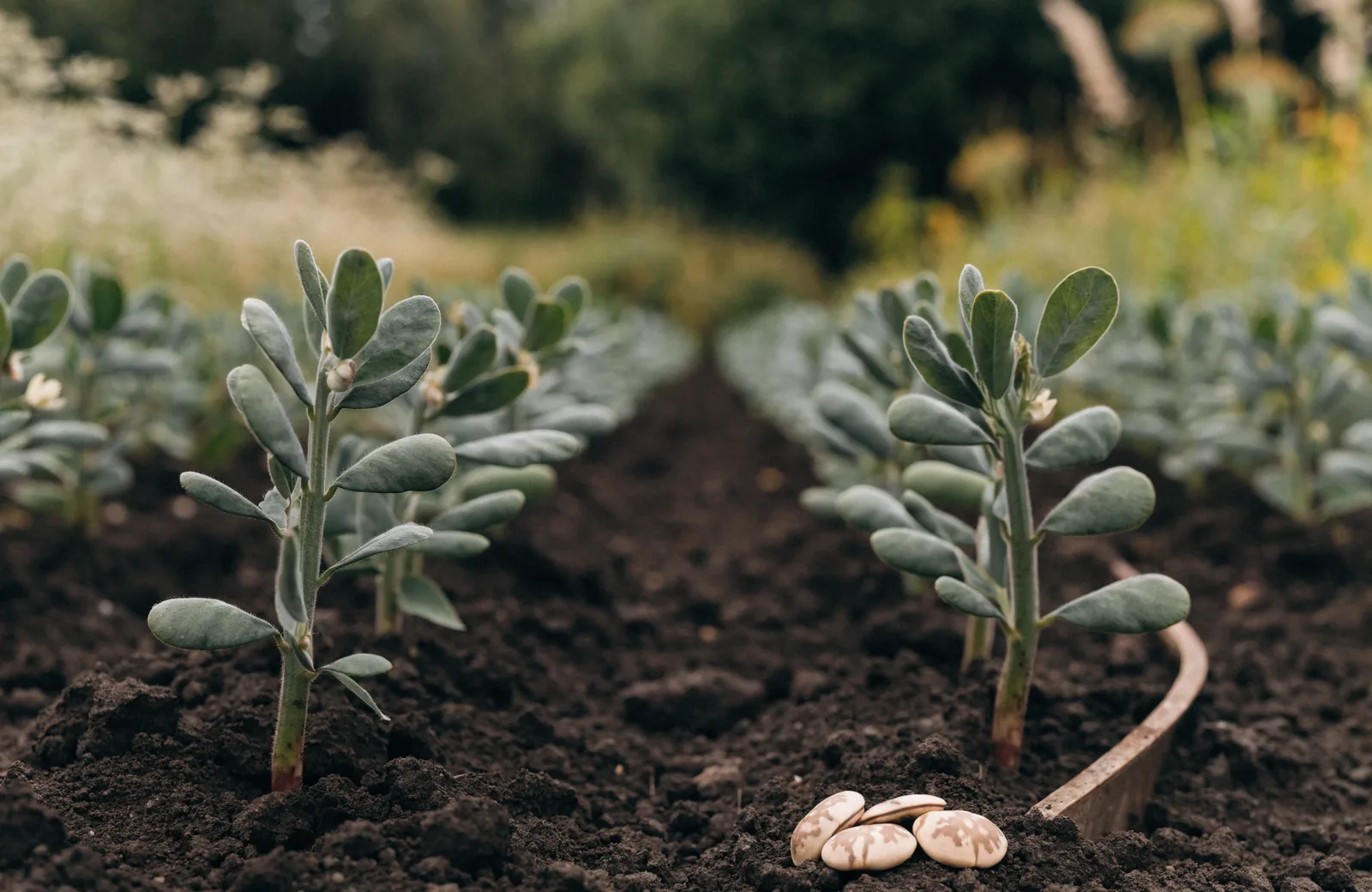
Journal/Vegetable Garden · 6 min read
When to Plant Broad Beans: Autumn or Spring?
When to plant broad beans: autumn sowing in October–November with hardy varieties, spring sowing from February to mid-April — plus depths, spacing, support and harvest.
Quick answer
Broad beans have two sowing windows: October–November with a hardy variety such as 'Aquadulce Claudia' for the earliest crop, or February to mid-April for summer picking. Sow 5–7.5 cm deep with the seed scar facing down, 15–23 cm apart. Don't sow after mid-April — late sowings produce fewer and fewer pods.
Broad beans are one of the few vegetables with two honest planting windows, which means every autumn the same question comes around: sow now, or wait for spring? The answer is less romantic than the seed catalogues suggest. Autumn sowing works, but it is a calendar decision with real trade-offs, and the right choice depends mostly on your soil. Here is the whole calculation, plus how to sow them properly whichever window you pick.
The two sowing windows
For an early crop, sow a hardy variety — 'Aquadulce Claudia' is the standard recommendation — direct in the ground in October or November. Otherwise sow from late winter onwards: in February in pots under cover, or outdoors from March to early May. One deadline matters more than any of the others: the RHS notes that broad beans sown after mid-April produce fewer and fewer pods, until by June they are no longer worth sowing. This is not a crop for procrastinators.
Broad bean sowing windows compared
| Window | How | Variety choice | First pickings |
|---|---|---|---|
| October–November | Direct in the ground; fleece or cloche in cold spells | Hardy types, e.g. 'Aquadulce Claudia' | Late spring — the earliest crop |
| February | In pots or modules under cover, planted out later | Quick-maturing types, e.g. 'Monica' | Barely later than autumn-sown |
| March to mid-April | Direct in the ground | Any variety | Through the summer |
The case for autumn sowing — and the catch
The case for sowing now: plants establish before winter, sit through the cold, and start into growth the moment spring arrives, giving you the first pickings of the bean year. The catch: seeds spend five months in cold, often sodden ground, where mice eat them and damp rots them. On a windy or wet site, the RHS's own advice is blunt — skip autumn sowing and start a quick cultivar such as 'Monica' in pots indoors in February instead, because there is hardly any difference in maturity between the two. Autumn sowing is a fair bet on free-draining soil in a reasonably sheltered spot, and a poor one on heavy clay that lies wet all winter.
How to sow broad beans, step by step
- 1. Pick a warm, sunny, sheltered spot with rich, free-draining soil. A few weeks before sowing, fork in around two bucketfuls of well-rotted manure or compost per square metre and let the ground settle.
- 2. Sow seeds 5–7.5 cm deep with the black scar facing downwards, 15–23 cm apart.
- 3. Space single rows 45 cm apart. For double rows, set the two lines 23 cm apart, with 60 cm between each pair.
- 4. If your soil is damp or mice are a known problem, sow in modules or small pots instead, 5 cm deep, and plant out the young plants — mice will happily clear a whole row of direct-sown seeds.
- 5. For autumn sowings, keep fleece or cloches to hand and cover young plants during cold spells.
Winter care is mostly leaving them alone
A hardy variety sown in October stands through frost as a short, tough plant — it does not need mollycoddling, just protection in the harshest spells. Cover with a cloche or plastic-free fleece when hard frost or biting wind is forecast, the same kit covered in our guide to protecting plants from frost. Beyond that, resist the urge to fuss: winter beans need no feeding and, in most winters, no watering.
Spring jobs: stake, water, pinch
Most broad beans need staking before they flop. Put sturdy stakes at each corner of the row and every 1.2 m along it, then run string around the stakes at 30 cm intervals from the ground up. Dwarf varieties largely hold each other up, especially grown in double rows. Water as flowering starts and again two weeks later — the RHS notes this does more for the harvest than routine watering ever will.
Then the one job that separates good broad bean growers from the rest: when the lowest flowers have formed small pods, pinch out the soft shoot tip at the top of each plant. It pushes the plant's energy into pods instead of more leaf — and it removes exactly the growth that blackfly colonise. If the black bean aphid finds your beans anyway, our guide to getting rid of aphids covers the fixes.
Harvest
Depending on sowing date and variety, broad beans crop from late spring to late summer. Pick pods while they are full but still on the small side; once the scar on the shelled bean has turned black, the beans have gone tough. Very young pods, around 5 cm long, can be picked and cooked whole. Keep picking — regular harvesting encourages more pods.
Jobs for this week
It is late September, so nothing needs sowing today — this is the ordering-and-preparing fortnight, alongside the other big autumn planting jobs in our October planting guide and the autumn garlic sowing that shares the same bed-preparation work.
- Order seed of a hardy autumn variety now, before the popular ones sell out.
- Decide honestly whether your soil drains well enough for autumn sowing — if not, plan a February sowing in modules instead and skip the gamble.
- Prepare the bed: two bucketfuls of well-rotted manure or compost per square metre, forked in a few weeks ahead of an October or November sowing.
- Set a reminder for your sowing date, and another for pinching out tips next spring.
And if something does go wrong next spring — blackfly, chocolate-coloured leaf spots, chewed seedlings — photograph the plant in PlantMe and let the diagnosis do the arguing for you.
Sources & further reading
About the author

Vegetable Garden & Seasons
Arthur has worked the same allotment for thirty years and measures the calendar in sowings, not months. He writes practical, no-nonsense guides to growing food and keeping a garden honest through the seasons — and has little patience for folklore that doesn't survive contact with a real plot.
Try it yourself
Diagnose it instantly with PlantMe
Snap a photo of any plant or leaf. Get the species, the diagnosis, and a care plan in seconds.
Download on theApp Store