Journal/Seasonal · 7 min read
When to Prune Apple Trees
Winter pruning keeps apple trees open, healthy and productive. When to do it (November to early March — later in cold climates), how much to take off, and what to leave alone.
Every autumn, as soon as the last fruit is picked and stored, the same question comes round: can I prune the apple tree now? Short answer: soon, but not quite yet — and with rather less vigour than most people are itching to apply.
Winter pruning is the one job that decides what a free-standing apple tree does for the next twelve months. Done well, it keeps the crown open, productive and a manageable size. Done to excess, it buys you a thicket of useless upright shoots and not much fruit. The rules below are the boring, reliable ones.
The window: leaf fall to bud burst
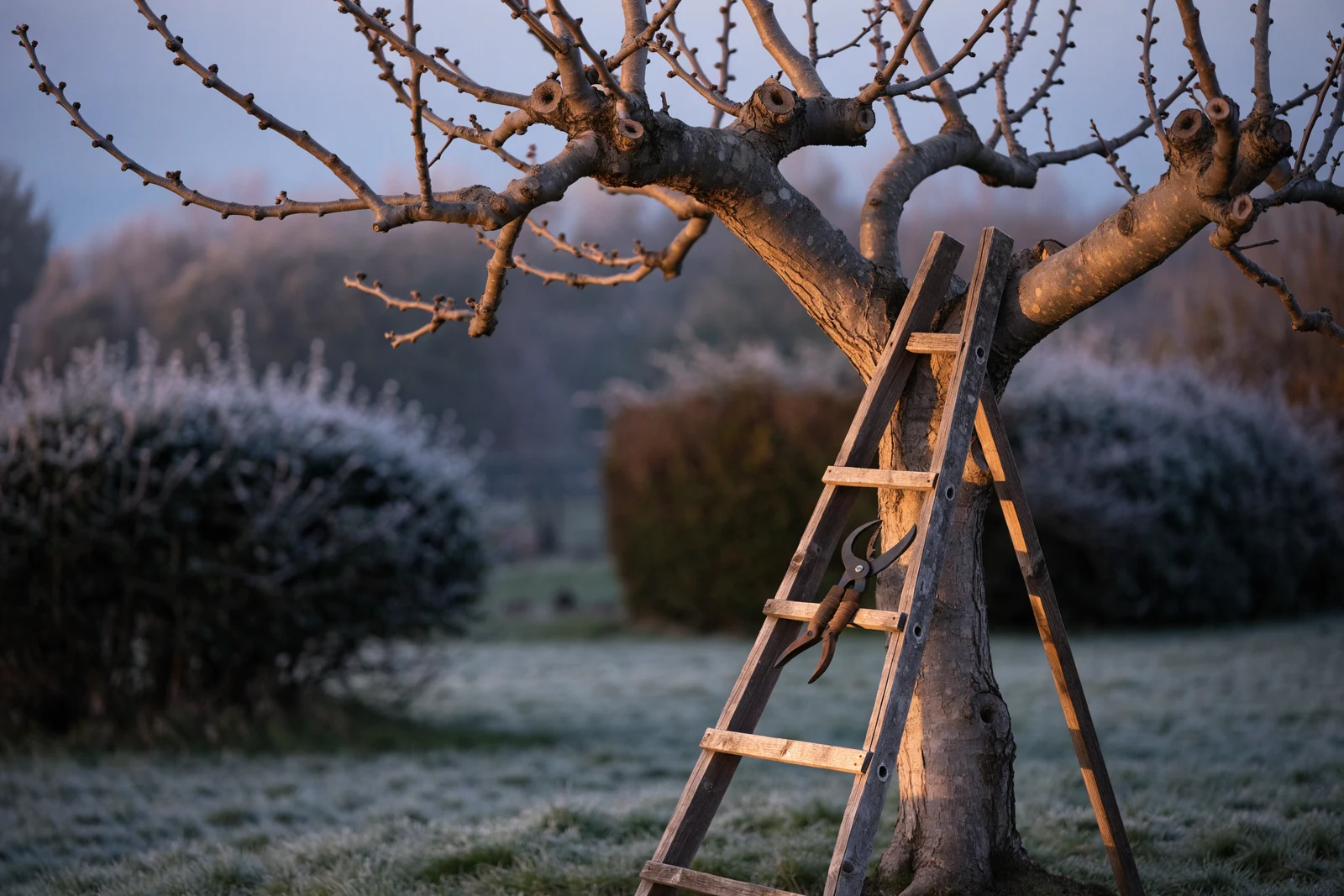
Free-standing apples and pears are winter pruned while fully dormant — any time between November and early March, once the tree is leafless. That is the Royal Horticultural Society's window, and it exists for a practical reason as much as a physiological one: a bare tree is easier to read. You can see the structure, the crossing branches and the congested middle without foliage flattering any of it.
One adjustment if your winters are properly cold, continental rather than maritime: wait. Iowa State University Extension recommends dormant pruning in late winter or early spring, because cuts made in early winter heal slowly and raise the risk of cold injury to the surrounding wood. In practice, November pruning is fine in a mild climate and a poor idea where January means minus twenty. February suits almost everyone.
Know your tree: spur bearers and tip bearers
Most apple varieties are spur bearers: they fruit on short, knobbly spurs carried on wood two years old and older. A minority are tip bearers, carrying next summer's fruit buds at and near the ends of last year's shoots. The distinction matters, because a confident all-over trim of a tip bearer removes most of its crop before the year has even started.
Spur bearers vs tip bearers at pruning time
| Spur bearers | Tip bearers | |
|---|---|---|
| Where fruit forms | Short spurs on older wood | At and near the tips of last year's shoots |
| Typical varieties | Most apples and pears | 'Bramley's Seedling', 'Blenheim Orange', 'Discovery', 'Worcester Pearmain' |
| Winter approach | Shorten main branches, thin congested spurs | Leave shoot tips; cut a share of older fruited branches back to a younger shoot |
Not sure which you have? Look at where this year's apples actually sat. Fruit clustered on stubby side growths means spurs; fruit hanging off the ends of long young shoots means tips. An identification app — ours included — will name the species for you, but not the variety, so on this point the tree itself is the only witness worth consulting.
The job, in order
- 1. Sharpen and clean your tools. Sterilise secateurs and the pruning saw between trees — rubbing alcohol does the job. Blunt blades tear, and torn wood is an open door for disease.
- 2. Take out the three Ds: dead, diseased and damaged wood, cut back to clean, healthy growth.
- 3. Remove crossing or rubbing branches and anything growing into the centre. You are aiming for an open, goblet-shaped crown with outward-facing main branches.
- 4. Shorten last year's growth on each main branch by about a third, cutting just above an outward-facing bud. This stiffens the framework without provoking the tree.
- 5. Leave most side shoots alone — on spur bearers they carry the next few years of fruit buds. Thin them only where they are genuinely congested.
- 6. On older trees, thin crowded spur systems, starting with spurs on the shaded undersides of branches, where fruit ripens poorly anyway.
The whole visit should feel undramatic. Step back between cuts, and keep the prunings in one pile so you can see how much you have taken. If the pile is starting to look like a second tree, stop.
How much is too much
The RHS puts a usable number on it: remove more than about a fifth of the canopy in one winter and the tree usually responds with water shoots — those whippy, vertical growths that crowd the crown, fruit poorly and give the tree the look of a startled hedgehog. Hard pruning does not calm a vigorous tree. It provokes one.
There is a simple health check at the other end of the season, courtesy of Iowa State Extension: a mature apple tree in good balance puts on roughly 10 to 15 inches — 25 to 40 centimetres — of new shoot growth a year. Much less suggests it could take more feeding and lighter pruning; much more means you, or the nitrogen, overdid it. A neglected giant gets renovated over two or three winters, never in one heroic afternoon.
Trained forms play by a different calendar
Espaliers, cordons and fans are mainly summer-pruned, in August or thereabouts, to keep them flat and fruiting; winter is only for light tidying. Everything above is for free-standing trees. And if you are still at the planting stage rather than the pruning stage, bare-root season opens now — the same dormant window, and the trees cost about half as much.
Jobs list before the hard frosts
- Rake up fallen apple leaves and compost them or turn them into leaf mould — codling moth larvae overwinter in leaf litter and under loose bark.
- Remove any mummified fruit still hanging in the branches; it carries rot straight into spring.
- Order bare-root trees now — nurseries run out of the good varieties by December.
- Book the pruning itself for a dry, frost-free day between November and late February. Later in cold regions.
None of this is complicated. The discipline is in what you leave on the tree: a few well-chosen cuts beat an afternoon of enthusiasm every time. If in doubt, leave the branch. It will still be there next winter, and so will you.
Sources & further reading
Frequently asked questions
Can I prune apple trees in October?
If the tree still has leaves on it, wait. Winter pruning starts once the tree is dormant and bare — from November in mild climates. In cold-winter regions hold off until late winter, since early cuts heal slowly and the wood around them is more prone to cold injury.
My tree threw up dozens of vertical shoots after last year's pruning. What went wrong?
Those are water shoots, the classic response to removing too much in one winter — more than about a fifth of the canopy. Thin out the worst of them this year, keep one or two well-placed ones to fill genuine gaps, and prune more lightly from now on.
About the author

Vegetable Garden & Seasons
Arthur has worked the same allotment for thirty years and measures the calendar in sowings, not months. He writes practical, no-nonsense guides to growing food and keeping a garden honest through the seasons — and has little patience for folklore that doesn't survive contact with a real plot.
Try it yourself
Diagnose it instantly with PlantMe
Snap a photo of any plant or leaf. Get the species, the diagnosis, and a care plan in seconds.
Download on theApp Store