Journal/Seasonal · 7 min read
When (and How) to Prune Lavender
Late summer is the moment to prune lavender. When to cut, how far down to go, and the old-wood rule that keeps plants compact for years.
Quick answer
Prune lavender in late summer, just after the flowers fade — August into early September is ideal for English lavender. Cut back by about a third, removing the spent flower stalks plus 2–3 cm of leafy growth, and shape the plant into a rounded mound. Never cut below the lowest grey-green shoots into bare old wood, because lavender rarely regrows from it.
There's a short window every year — right about now, as the bees lose interest and the flower spikes fade to grey — when ten minutes with the shears decides whether your lavender stays a dense silver mound or slowly collapses into a woody, splayed-open shrub. Lavender pruning has a reputation for being risky, and it's true there's one rule you can't break. But the timing and technique are simple once you understand why the plant behaves the way it does.
Why late summer is the moment
Lavender flowers on the growth it made this year. Pruning just after flowering — August into early September for English lavender in the northern hemisphere — gives the plant six or more mild weeks to push out fresh shoots and harden them off before the cold arrives. Those tidy new tufts overwinter as a compact mound and carry next summer's flowers. Prune much later, in October, and the tender regrowth gets caught by frost; skip pruning altogether and the stems stretch, flop apart and turn to bare wood at the base. If you do miss the window, don't prune in late autumn — wait and give a lighter trim in mid-spring instead, once hard frosts have passed.
First, know which lavender you have
The pruning rules differ by type, and the two big groups are easy to tell apart. English lavender and its hybrids carry slim flower spikes on long bare stems; French and Spanish lavender carry chunky flower heads topped with little petal 'ears', usually starting much earlier in the year. If you're not sure which one is in your garden, a quick photo in PlantMe will identify it — the app recognises more than 35,000 plants with 93% top-3 accuracy, and lavenders are among the ones it sees most in summer.
Pruning by lavender type
| Type | When to prune | How hard |
|---|---|---|
| English lavender (Lavandula angustifolia) | Late August–early September, after flowering | By about a third — spent stalks plus 2–3 cm of leafy growth |
| Lavandin hybrids (L. × intermedia) | Late August–September, after their later flowering | Same as English; they grow bigger, so be firm |
| French / Spanish lavender (L. stoechas) | Deadhead all summer; light trim after the main flush | Gently — never hard; these are less hardy and resent severe cuts |
How to prune English lavender: step by step
- Wait until the flowers have faded and the bees have moved on — the spikes will look grey rather than purple
- Take clean, sharp shears or secateurs; on a hedge, garden shears are quicker and give a smoother shape
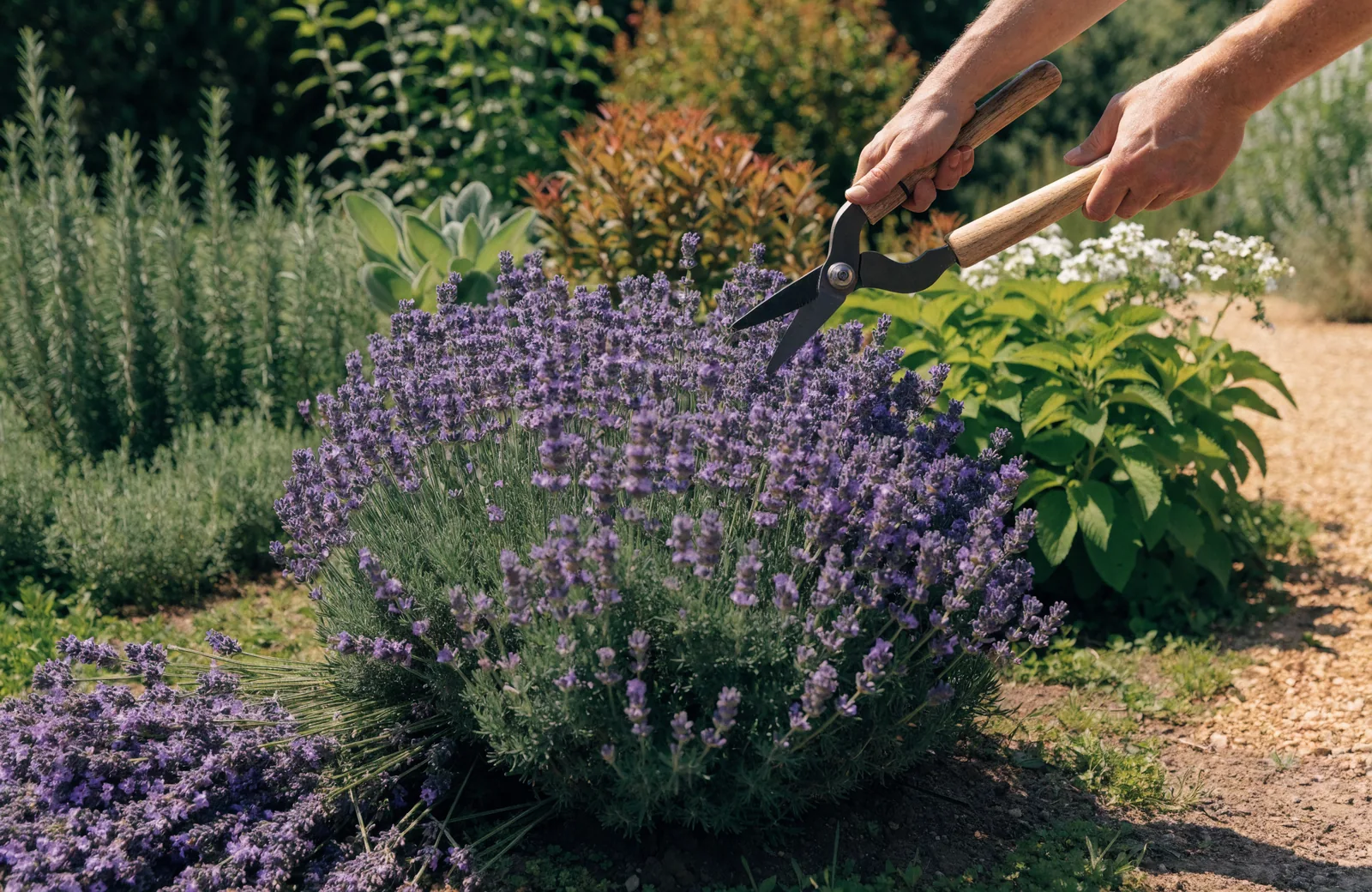
- Grab handfuls of stems and cut back the spent flower stalks plus about 2–3 cm of the leafy growth below them
- Aim for a rounded, slightly domed mound — a dome sheds rain and snow and keeps the centre from opening up
- Always leave some grey-green growth or visible small shoots below every cut
- Rake the clippings out of the plant's crown so air can circulate, and save a few non-flowered stems as cuttings if you want new plants
On a young or vigorous plant you can be braver than the classic 'third'. Established English lavender in good health can be cut back to a mound roughly 20–25 cm high, provided every cut stays above the small dormant shoots you can see on the stems. Growers who prune this firmly every August keep plants dense and productive for well over a decade.
The old-wood rule
Here is the one rule that genuinely matters: lavender does not reliably regrow from bare, brown, woody stems. Cut a stem below its lowest living shoots and that stem usually stays a stump forever; do it across the whole plant and the plant dies. This is why you can't renovate an old, leggy lavender the way you'd renovate a dogwood or a rose. Look closely before each cut — the tiny grey-green tufts on the brown wood are your safety line. Cut above them and the plant bounces back; cut below them and it won't.
What about old, woody, splayed plants?
If a lavender has been left unpruned for years and is now a ring of bare wood with growth only at the tips, be honest about the options. You can sometimes coax it back over two or three seasons by cutting one section at a time back to its lowest shoots and feeding lightly — but the shape rarely fully recovers. The more reliable route is replacement: lavender roots easily from summer cuttings and grows fast, so a cutting taken now, or a small new plant next spring, will out-perform the old one within two years. Even well-pruned lavender is not immortal; ten to fifteen good years is a normal lifespan.
After the cut
Pruned lavender needs very little aftercare. Don't feed with a rich fertiliser — lavender flowers best in lean, free-draining soil, and a late feed only pushes soft growth into winter. In heavy soil, a gravel mulch around the base helps keep the crown dry through the wet months. Then leave it alone: the fresh mound will sit silver-green through winter, and the reward comes in June, when a properly pruned plant carries noticeably more flower spikes than a neglected one — on stems that stand up instead of sprawling.
Sources & further reading
Frequently asked questions
Can I prune lavender in spring instead?
Yes, as a fallback. If you missed the late-summer window, give a lighter trim in mid-spring once hard frosts are over, removing winter-scruffy tips and any remaining old flower stalks. Spring-pruned plants flower slightly later, and spring pruning alone won't keep a plant as compact as the full August cut.
Should I deadhead lavender during summer?
For French and Spanish lavender, yes — regular deadheading keeps them flowering in flushes from spring onwards. For English lavender it's optional; most gardeners simply harvest stems for drying at peak colour, then do the one proper prune after flowering finishes.
Why is my lavender woody at the base?
That's the natural result of missed or too-timid pruning. Every year, the base of each stem matures into wood that won't resprout, so the leafy zone climbs higher. Annual late-summer pruning back to just above the lowest shoots is what keeps the woody zone from expanding.
About the author

Vegetable Garden & Seasons
Arthur has worked the same allotment for thirty years and measures the calendar in sowings, not months. He writes practical, no-nonsense guides to growing food and keeping a garden honest through the seasons — and has little patience for folklore that doesn't survive contact with a real plot.
Try it yourself
Diagnose it instantly with PlantMe
Snap a photo of any plant or leaf. Get the species, the diagnosis, and a care plan in seconds.
Download on theApp Store