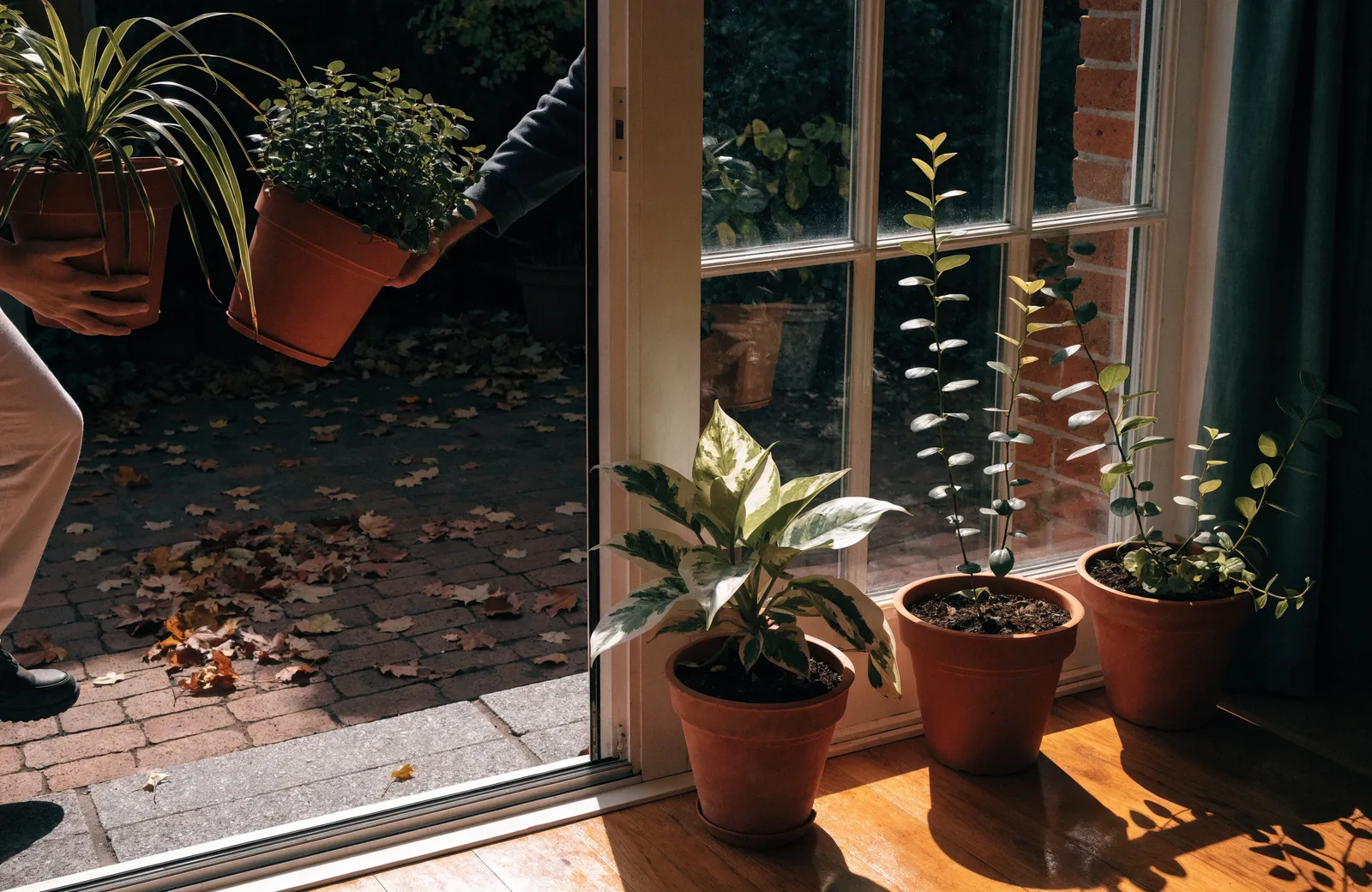
Journal/Seasonal · 7 min read
When to Bring Houseplants Back Inside (and How to Do It Without Bringing Pests)
Bring houseplants indoors before nights hit 10 °C. A step-by-step autumn checklist for pest inspection, quarantine and light acclimation.
Quick answer
Bring tropical houseplants back indoors once night temperatures dip consistently towards 10 °C — most are damaged in the 5–8 °C range and killed by frost, so do not wait for a frost warning. Before they come in, inspect and rinse every plant, soak the pot to evict soil pests, and quarantine returning plants away from your indoor collection for three to four weeks.
A summer outdoors is the best thing you can do for most houseplants: real light, moving air and rainwater produce growth no windowsill can match. Bringing them back in is the part people get wrong — either too late, or too fast, or with a colony of spider mites riding along. None of it is difficult, but the order matters.
The temperature rule
The trigger is not a date on the calendar, it is the overnight low. Bring tropical houseplants in once night temperatures dip consistently to around 10 °C (50 °F). That number is deliberately conservative: most tropicals suffer cell damage somewhere in the 5–8 °C range — blackened patches, collapsed stems, roots that stop absorbing water — and frost kills them outright. Chilling injury also frequently shows up days later, so a plant that looked fine after a cold night can still be quietly dying.
Do not wait for the first frost warning. By the time a frost is forecast, your plants have usually already sat through several nights near single digits. From late August onwards, watch the ten-day forecast rather than the calendar; in a variable autumn the right week can shift by a fortnight from one year to the next. Succulents, cacti and hardier plants like clivia or bay tolerate cooler nights and can stay out a little longer, but anything with soft tropical foliage — monsteras, philodendrons, calatheas, alocasias, ficus — comes in first.
Check for pests before they come in, not after
This is the step that saves a whole indoor collection. Outdoors, predators keep pest populations in check; indoors, in warm dry air with no natural enemies, a handful of spider mites becomes an infestation in three weeks. Inspect each plant properly in good light before it crosses the threshold.
- Turn leaves over. Almost everything that matters — spider mites, whitefly larvae, young scale — lives on the underside, along the midrib.
- Run a finger along stems and leaf joints for the raised brown discs of scale and the white cottony clusters of mealybug.
- Check the drainage holes and the underside of the pot, where slugs, woodlice and ant nests sit out the day.
- Look for fine webbing at the growing tips, stippled or dusty-looking leaves, sticky residue, or sooty black mould on the leaf surface — all are secondary signs of an active infestation.
Then wash everything. Take each plant to the garden and rinse all foliage thoroughly with a hose — top and underside — which physically removes the large majority of mites and their eggs before any treatment. Next, deal with the root ball: stand the pot in a bucket of water so the surface of the soil is submerged, and leave it for 15–20 minutes. Ants, earwigs, slugs, woodlice and centipedes will evacuate. Let it drain fully before it goes anywhere near a floor.
If your inspection found anything — scale, mealybugs, spider mites, whiteflies — treat before the plant comes in, using insecticidal soap or a neem-based spray, covering leaf undersides properly, and repeating after seven days to catch newly hatched eggs. One treatment almost never finishes the job.
Warning: a single hitchhiking pest can spread to your entire indoor collection within a month, and mealybugs and scale are far harder to eradicate indoors than to prevent. Quarantine every returning plant in a separate room, away from plants that stayed inside, for three to four weeks, and re-inspect weekly. That waiting period covers the egg-hatching cycle of the most common pests, which is exactly why a plant can look clean on day one and be crawling on day twelve.
If you find something and cannot tell scale from a harmless deposit, or mite damage from sun scorch, photograph the affected leaf in PlantMe — the app recognises 500+ diseases, pests and stresses and gives a treatment plan, which beats spraying neem at a problem you have not identified.
Acclimating to much lower light
People underestimate this enormously. Full shade outdoors on an overcast day still delivers far more light than a bright windowsill indoors — the drop can be an order of magnitude. A plant moved straight from a sunny patio to a living room corner experiences something close to darkness, and responds by dropping the leaves it can no longer afford to run.
Soften the transition. For a week or so before the move, shift plants to the shadiest outdoor spot you have, so the light drop happens in two steps rather than one. Alternatively, bring them in gradually — indoors overnight and back out during the day for several days. Once inside, give them your brightest available position, even if that is not where you eventually want them, and move them to their final spot after a few weeks.
Expect some leaf drop anyway; it is normal and not a sign you have failed. Leaves grown in high light are structurally different from shade leaves, and the plant discards them and builds replacements suited to indoor conditions. As long as the growing point is healthy and new leaves are coming, let it happen.
Switching to autumn and winter care
The plant that needed daily watering in August needs a fraction of that indoors in October. Lower light and cooler temperatures slow growth, so water use drops sharply — check the top few centimetres of soil and water only when they are dry, or you will convert a healthy plant into root rot within a month. Stop fertilising until spring for the same reason: unused feed accumulates as salt in the soil.
Mind the position, too. Radiators create a plume of hot dry air that crisps leaf edges, and a leaf pressed against cold winter glass suffers the same chilling injury you brought the plant inside to avoid. Keep plants clear of both, and if your heating dries the air severely, group plants together or run a humidifier. Clean the leaves after their summer outdoors — dust and rain-splashed soil reduce the light reaching a plant that already has too little.
The whole process, in order
- From late August, watch the ten-day forecast for overnight lows approaching 10 °C.
- A week ahead, move plants to the shadiest outdoor spot to begin acclimating them to lower light.
- Inspect each plant thoroughly — leaf undersides, stems, leaf joints, drainage holes.
- Rinse all foliage with a hose, top and underside.
- Soak the pot in a bucket of water for 15–20 minutes to evict soil-dwelling pests, then drain fully.
- Treat anything you found with insecticidal soap or neem, and repeat after seven days.
- Remove dead leaves and spent flowers, and top up soil that has washed away; only repot if the plant is genuinely rootbound.
- Bring plants in and quarantine them in a separate room for three to four weeks, re-inspecting weekly.
- Place them in the brightest position you have, away from radiators and cold glass.
- Cut watering back to match the slower growth, and stop feeding until spring.
Tip: label or photograph where each plant lived outdoors before you move it. Come spring, you will have forgotten which corner produced that season of good growth, and matching last year's spot is far more reliable than starting the experiment again.
Sources & further reading
Frequently asked questions
What temperature is too cold for houseplants outside?
Bring tropical houseplants in once nights consistently approach 10 °C. Most suffer chilling injury between 5 and 8 °C and are killed by frost. Cacti, succulents and hardier plants tolerate a few degrees lower, but the damage from waiting is not always visible immediately.
Should I repot before bringing plants back indoors?
Only if the plant is genuinely rootbound — roots circling the pot or growing out of the drainage holes. Otherwise wait for spring: repotting into a larger volume of soil going into a low-light season means wet, unrooted compost all winter, which invites root rot and fungus gnats.
Why is my plant dropping leaves after coming inside?
Almost always the drop in light. Leaves grown outdoors cannot sustain themselves at indoor light levels, so the plant sheds them and grows replacements adapted to the new conditions. Give it the brightest spot you have, water less, and stop feeding; as long as new growth appears, it is adjusting normally.
How long should I quarantine returning plants?
Three to four weeks in a separate room from plants that stayed indoors, with a weekly inspection of leaf undersides. That covers the egg-hatching cycle of spider mites, mealybugs and scale, which is why a plant that looked clean on arrival can show an infestation two weeks later.
Do I need to treat plants even if I see no pests?
Treating is not essential, but rinsing the foliage and soaking the pot is — both are preventative, take minutes, and remove passengers too small or too well hidden to spot. Combine that with a proper quarantine period and you catch anything the inspection missed before it reaches the rest of your plants.
About the author

Houseplants & Indoor Styling
Wren has killed enough houseplants to know exactly why yours is struggling — and kept hundreds more thriving in a small, bright flat that doubles as her test lab. She writes about reading plants instead of following rules, and believes every windowsill deserves at least one leaf.
Try it yourself
Diagnose it instantly with PlantMe
Snap a photo of any plant or leaf. Get the species, the diagnosis, and a care plan in seconds.
Download on theApp Store