Journal/Seasonal · 6 min
How to Plant Bare-Root Roses: The November Job Worth Doing Properly
Bare-root rose season runs from November to March. When to plant, how deep to set the graft union, and the aftercare that actually matters.
Quick answer
Plant bare-root roses any time between leaf fall in November and early spring, whenever the soil is neither frozen nor waterlogged. Soak the roots for an hour or two, dig a hole twice their width, and set the graft union at soil level in mild-winter climates — or 5–10 cm below it where winters are severe. Water in well, then leave the pruning until late winter.
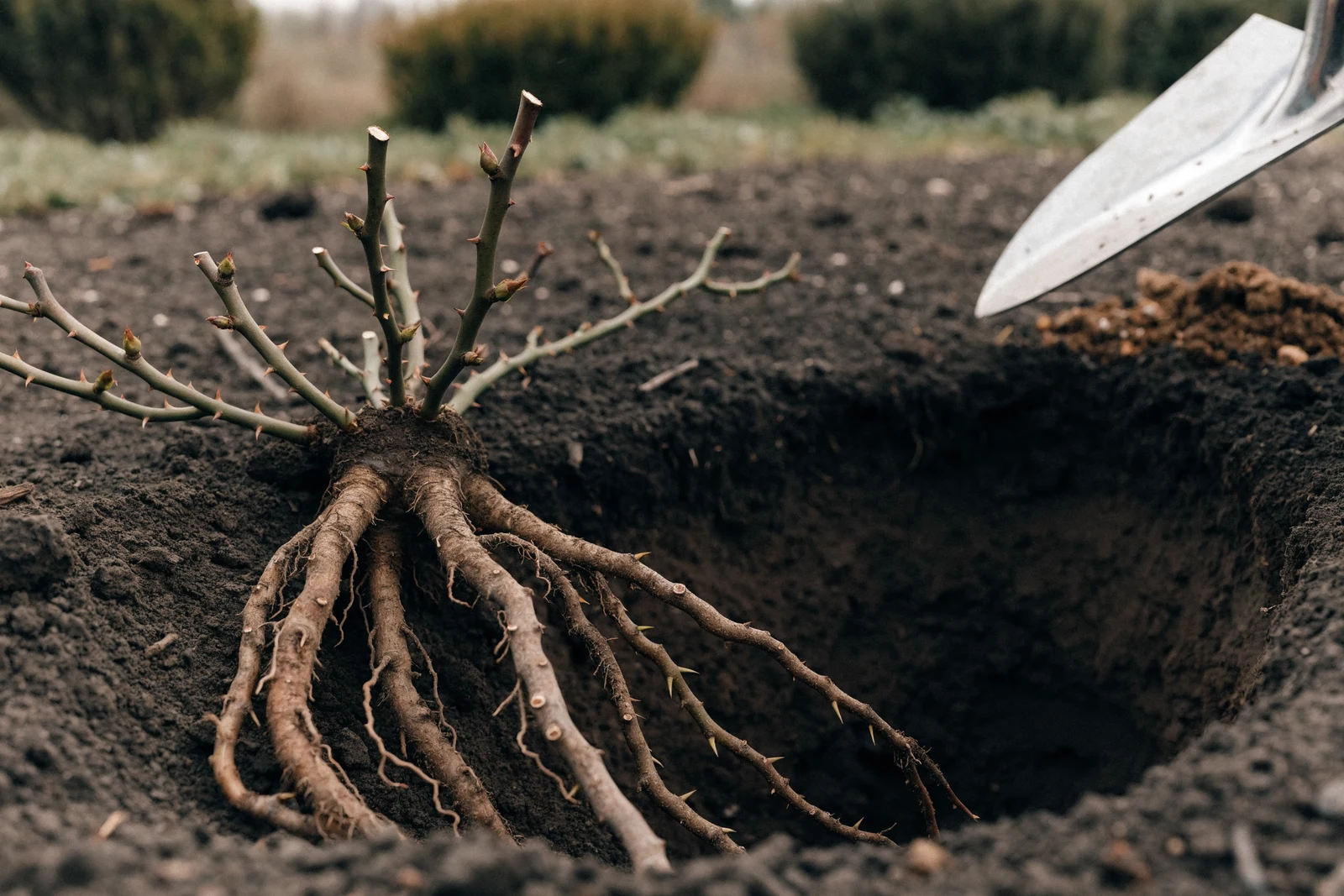
The first bare-root roses arrive in garden centres and courier boxes this month, and they keep arriving until March. If you have ever paid twice as much in June for the same rose in a plastic pot, this is the season that corrects the mistake. A bare-root rose is a dormant plant, field-grown, lifted and shaken free of soil — sold on the strength of its roots rather than the gloss of its leaves. Planted now, it establishes at least as well as the potted version, and there is no pot to throw away.
The window: leaf fall to bud break
Plant from late autumn, once the leaves are down, through to early spring, before growth restarts. November soil still holds summer warmth, so roots get on with the quiet work below ground while the top sits dormant. The RHS lists roses among the ideal plantings for this month, and the same window serves bare-root hedging and fruit trees — the timings in when to plant trees and shrubs apply here too.
Two conditions close the window temporarily: frozen ground and waterlogged ground. Dig neither. If your roses arrive in a bad week, do not leave them drying in the shed — heel them in (a shallow trench, roots covered with soil, firmed) or stand them in a container of slightly moist peat-free compost until conditions improve. An hour of wind on bare roots does more harm than a fortnight heeled in.
Before you dig
Three jobs first. Soak the roots in a bucket of water for an hour or two while you prepare the hole — dry roots are the most common reason a bare-root rose fails. Trim off any snapped or damaged roots with a clean cut. And check the history of the spot: a rose planted where a rose grew before often sulks for years, a problem known as replant disease. If there is no other place for it, swap out the old soil to about 45 cm deep and wide with soil from another part of the garden.
How deep? The graft union question
Most bare-root roses are grafted — the knuckle where the named variety meets the rootstock is the knobbly point just above the roots. How deep to set it is the one genuine argument in rose planting, and it is settled by climate, not by what your grandfather did. The RHS advises planting with the union at soil level, not below, since burying it is reported to increase the risk of dieback in mild-winter gardens. In cold-winter regions, Iowa State University Extension advises the opposite: set the union 5–10 cm (2–4 in) below the surface, where the soil protects it from hard freezes. Pick the rule that matches your winters and ignore the other one.
Planting, step by step
- 1. Dig a hole roughly twice the width of the root spread and about the depth of a spade blade.
- 2. Fork a bucket of well-rotted organic matter into the excavated soil — garden compost or rotted manure, not fresh.
- 3. Build a low mound in the centre of the hole, sit the rose on it and spread the roots down the sides.
- 4. Lay a cane flat across the hole to check the union height against the rule above.
- 5. Backfill with the soil-and-compost mix, firming gently by hand as you go — air pockets kill more roses than cold does.
- 6. Water thoroughly, even if rain is forecast. The first watering is for settling soil around the roots, not for thirst.
Aftercare: less than you think
No feed now — the plant is dormant and cannot use it. Water in dry spells through the first two summers; after that the roots are deep enough to fend for themselves. The first prune comes in late winter: hybrid teas cut hard to 10–15 cm, floribundas to about 15 cm, shrub and species roses left largely alone. In spring, mulch with up to 8 cm of organic matter, keeping a 10 cm collar of bare soil around the stems, and keep an eye out for black spot once the leaves return.
The November list
- 1. Order or buy while the field-fresh stock is best — the choice only narrows from here.
- 2. Soak, trim, plant on the next workable day after arrival.
- 3. Ground frozen or sodden? Heel in and wait. The rose does not mind.
- 4. After gales, firm back any newly planted rose that has rocked loose.
- 5. Planted before Christmas beats planted in March — the roots take the head start.
Sources & further reading
About the author

Vegetable Garden & Seasons
Arthur has worked the same allotment for thirty years and measures the calendar in sowings, not months. He writes practical, no-nonsense guides to growing food and keeping a garden honest through the seasons — and has little patience for folklore that doesn't survive contact with a real plot.
Try it yourself
Diagnose it instantly with PlantMe
Snap a photo of any plant or leaf. Get the species, the diagnosis, and a care plan in seconds.
Download on theApp Store