Journal/Care Basics · 7 min read
How to Care for Lucky Bamboo (Dracaena sanderiana)
How to care for lucky bamboo in water or soil: water quality, light, feeding, propagation, and why stalks turn yellow — with fixes.
Quick answer
Lucky bamboo isn't a bamboo at all — it's Dracaena sanderiana, and it grows in plain water or soil. Keep the roots plus 2–3 cm of stem submerged, change the water weekly, use filtered or overnight-rested tap water, and give it bright, indirect light at 16–29°C. Yellow stalks usually mean too much direct sun or chlorinated water.
Few houseplants survive as much neglect, low light, and questionable vase water as lucky bamboo. Sold in twists, braids, and tiered towers, it's often the first plant people ever own — and one of the most misunderstood. Here's how to keep those green stalks green for years, whether yours lives in water or soil.
It's not actually bamboo
Lucky bamboo is Dracaena sanderiana, a tropical understorey plant from Central Africa. The segmented stalks look like bamboo, but the two aren't related — real bamboo is a grass that would sulk indoors, while a dracaena is built for exactly the warm, low-ish light conditions of a living room. That mix-up matters for care: treat it like a dracaena, not like a garden bamboo, and everything gets easier. Snap a photo in PlantMe if you're not sure what you've got — the app recognises 35,000+ plant classes with 93% top-3 accuracy, so it will tell you in seconds whether you're holding a true bamboo or a dracaena in disguise.
Growing lucky bamboo in water
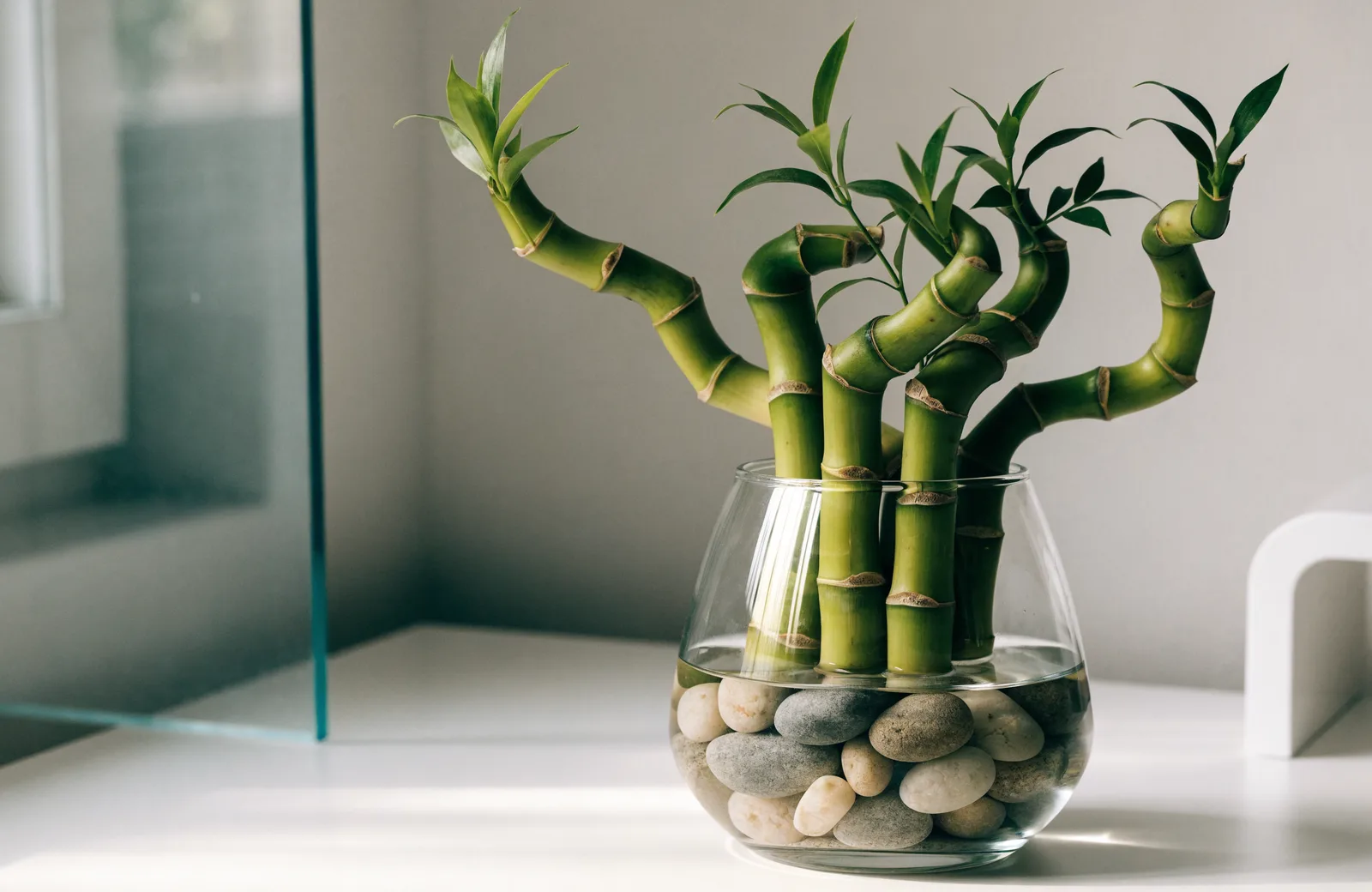
The classic setup: stalks in a vase of pebbles or marbles for support. Keep the roots and at least 2–3 cm of the stem submerged, and top up as it evaporates. The single most important habit is a full water change every week — stagnant water breeds bacteria and algae, and it's the fastest route to rotting stems and that telltale swampy smell.
- Change all the water weekly; rinse the pebbles and roots under the tap while you're at it.
- Keep the water level constant — roots that dry out mid-week stress the plant.
- Use an opaque container if algae keeps appearing; light plus nutrients is what algae wants.
- In water, feed only every other month with a liquid houseplant fertiliser at 1/4 the recommended strength — more will burn the roots.
Water quality: the make-or-break detail
Lucky bamboo is famously sensitive to the chlorine and fluoride in treated tap water, which scorch leaf tips and can slowly yellow whole stalks. Use filtered, distilled, or rain water — or simply fill a jug from the tap and let it sit uncovered overnight so the chlorine can dissipate before it touches your plant.
Growing lucky bamboo in soil
Less traditional, but the plant is actually longer-lived in soil. Vase-grown stalks often decline after one to two years; potted ones keep going far longer. Use a well-draining houseplant mix in a pot with a drainage hole, water when the top 2–3 cm of soil feels dry, and never leave the pot standing in a saucer of water. In soil, feed monthly through spring and summer with a standard houseplant fertiliser, and skip feeding in winter.
Light and temperature
Bright, indirect light — an east- or north-facing windowsill, or a metre or two back from a brighter window — is the sweet spot. Direct midday sun scorches the leaves and is one of the two big causes of yellowing. It tolerates surprisingly dim corners, but growth slows and stalks stretch. Keep it between roughly 16 and 29°C, away from cold draughts, radiators, and air-con vents; below about 16°C the plant starts to suffer.
Tip: rotate the vase a quarter turn each week. Lucky bamboo leans towards its light source, and regular turning keeps the stalks growing straight instead of curving.
Pruning and propagation
When a stalk gets top-heavy or leggy, trim the offshoots (not the main stalk) just above a node with clean scissors. Those trimmings are free plants: strip the lower leaves, stand the cutting in fresh water, and new roots usually appear within two to three weeks. The thick main stalk itself doesn't regrow a cut top attractively, so shaping is best done by managing the side shoots.
Why stalk numbers matter (to some)
In feng shui tradition the number of stalks carries meaning — two for love, three for happiness, five for wealth, six for health, eight for growth, nine for great luck. Whether or not you buy the symbolism, it explains why shops sell such specific arrangements. Four is skipped in most arrangements because the word sounds like "death" in several Asian languages.
Yellow stalks: causes and fixes
- Yellow from the top down usually means too much direct sun — move it somewhere shadier.
- Yellow from the bottom up in a vase points to stale or chlorinated water, or fertiliser burn — change the water, rinse roots and pebbles, and pause feeding.
- A soft, smelly, yellow-brown base is rot; cut the healthy green top section off and re-root it in fresh water, because the rotted portion won't recover.
- A stalk that's fully yellow won't turn green again — remove it so it doesn't foul the water for its neighbours.
Warning: lucky bamboo is toxic to cats and dogs if chewed, and the sap can irritate skin. Keep it out of reach of curious pets — and if you want to double-check any plant in your home, PlantMe's library flags pet-toxic species clearly.
Still not sure why yours is sulking? Photograph the worst stalk in PlantMe — the app's Plant Doctor checks it against 500+ diseases and problems and gives you a step-by-step rescue plan.
Sources & further reading
Frequently asked questions
Can lucky bamboo live in water forever?
In practice, vase-grown lucky bamboo tends to last one to two years — respectable, but soil-grown plants live considerably longer. If you love the vase look, refresh the water weekly, use filtered water, and expect to re-root healthy tops as older stalks fade.
Why are my lucky bamboo's leaf tips brown?
Almost always water quality — chlorine and fluoride in tap water scorch the tips. Switch to filtered, distilled, or overnight-rested water and trim the brown tips off with scissors, following the leaf's natural shape.
How fast does lucky bamboo grow?
It's a slow-to-moderate grower indoors: expect a few new leaves and several centimetres of shoot growth per season rather than dramatic changes. Brighter (indirect) light and occasional quarter-strength feeding speed it up a little.
Can I plant my water-grown lucky bamboo in soil?
Yes — and it will usually live longer for it. Move it gently into a well-draining houseplant mix, keep the soil lightly moist for the first few weeks while the water roots adapt, then water whenever the top 2–3 cm dries out.
About the author

Houseplants & Indoor Styling
Wren has killed enough houseplants to know exactly why yours is struggling — and kept hundreds more thriving in a small, bright flat that doubles as her test lab. She writes about reading plants instead of following rules, and believes every windowsill deserves at least one leaf.
Try it yourself
Diagnose it instantly with PlantMe
Snap a photo of any plant or leaf. Get the species, the diagnosis, and a care plan in seconds.
Download on theApp Store