Journal/Care Basics · 5 min read
Norfolk Island Pine Care Guide
The little living Christmas tree that wants to stay for decades: light, water, winter humidity, and how to keep those tiered branches green long past January.
Quick answer
Give your Norfolk Island pine the brightest window you have, water when the soil surface feels dry, and raise the humidity in winter — a pebble tray under the pot is enough. It's a subtropical tree, not a true pine: it sulks in cold draughts and dry radiator air, and it drops needles to tell you so. Rotate the pot a little every week and it will grow straight and even.
Every November they appear by the supermarket tills: little tiered trees in foil-wrapped pots, sometimes dusted with glitter, sold as Christmas decor with roots. Most get treated like a poinsettia with ambitions — enjoyed for a month, quietly binned by February. Which is a shame, because the tree in that foil pot can live in your home for decades if you learn three things about it this week.
Meet the tree that isn't a pine
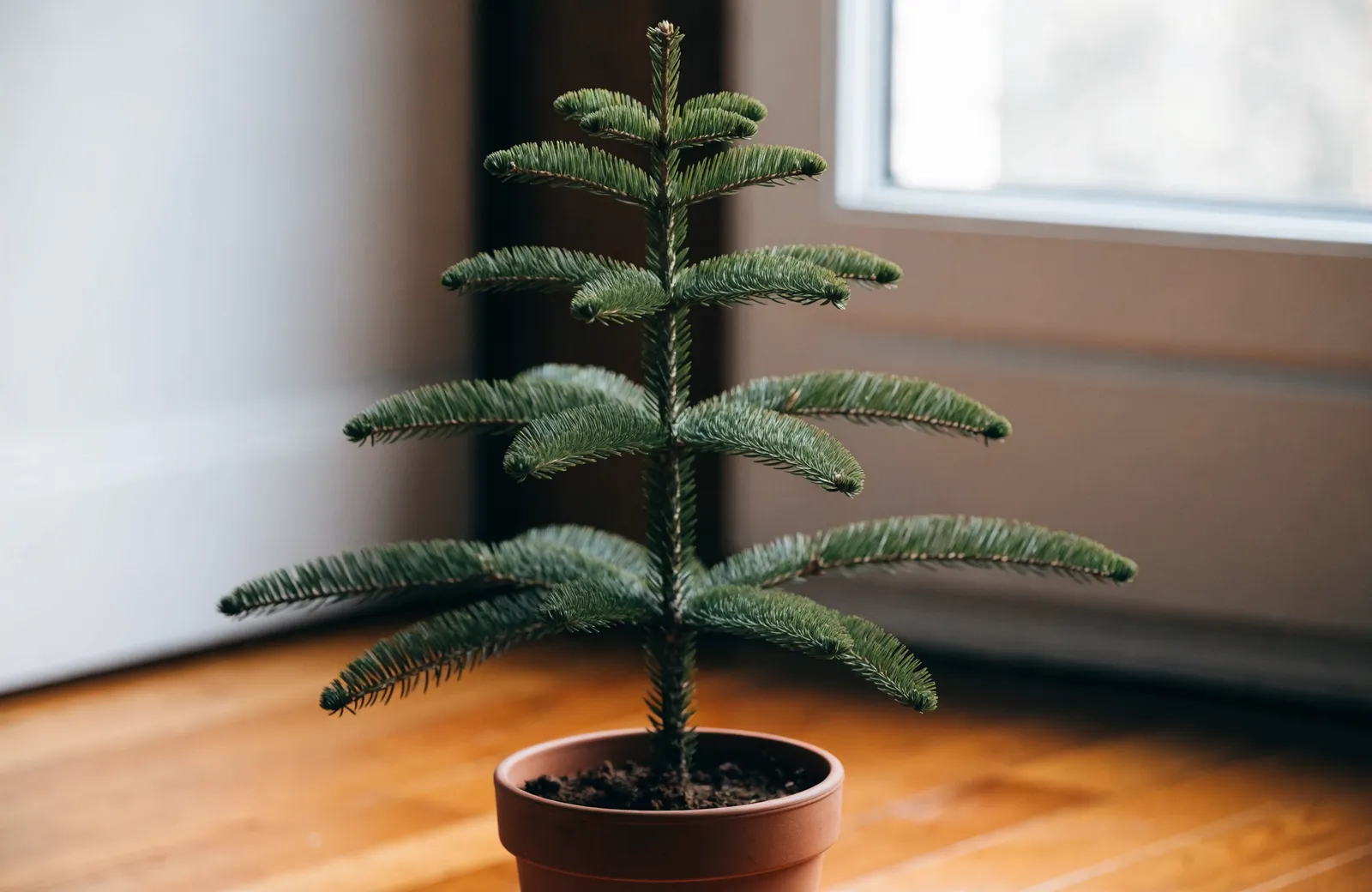
Despite the name, a Norfolk Island pine (Araucaria heterophylla) isn't a pine at all. Pines belong to the family Pinaceae; this tree is an araucaria, from a far older conifer family that kept company with dinosaurs and now survives mostly in the Southern Hemisphere. It comes from Norfolk Island, a speck in the South Pacific, where it grows into a 60-metre giant. Yours won't. Indoors it's a slow, polite grower — a few inches a year, usually staying under two metres — which is exactly what you want from a tree that lives beside the sofa.
That island origin explains almost everything it asks of you: steady warmth, bright light, and air that doesn't feel like a heated hallway in January.
Light: the brightest window wins
Put it near your brightest window — east, west or south all work. It will tolerate a dimmer corner, but only if you move it there gradually; shift it from bright to dark overnight and whole branches can yellow and die. In low light the branches stretch, droop and grow sparse, and the tidy tiered shape starts to slump. If you're not sure how your rooms measure up, our guide to how much light houseplants actually need is the place to start.
One habit worth building: give the pot a quarter-turn every week. The growing tip leans towards the light, and a tree this symmetrical shows every bit of lopsidedness it develops. Thirty seconds a week keeps it straight.
Water and winter air
Water thoroughly when the surface of the soil feels dry, let it drain, and tip away anything that collects in the saucer — this tree loses branches to soggy feet, and a lost branch spoils the silhouette for good reason: the shape is the whole point of the plant. Between waterings, let the top of the soil dry but don't let the root ball go bone dry for weeks.
Winter is when most Norfolk Island pines go wrong, and it's almost never the cold — it's the dryness. Central heating turns living-room air desert-dry just as the tree is coping with the darkest weeks of the year, and its answer is brown needle tips and falling lower branches. A pebble tray of water under the pot or a small humidifier nearby makes a real difference; our houseplant humidity guide covers the options honestly, including which ones barely work. If the tips are already browning, this guide to brown leaf tips will help you tell dry air from dry soil.
Temperature-wise it's easygoing in the range most homes sit in — roughly 13–21°C (55–70°F). A cool, bright room suits it well in winter. What it hates are extremes it can't see coming: a spot over a radiator, a draughty doorway, a freezing windowsill behind closed curtains.
Feeding, and the Christmas-tree question
Feed with a liquid houseplant fertiliser at half strength every two to four weeks from spring to early autumn, then stop for winter — it isn't growing then, and feeding a resting plant just salts the soil.
Can you decorate it? Of course — it's tradition, and a healthy tree doesn't mind lightweight ornaments. Two caveats. Buy the plainest tree you can find: many are sold spray-painted or glittered, and that coating sits on the needles and blocks the light they need. And skip real string lights that heat up; the needles are soft, living tissue, not cut-tree foliage. When January comes, don't retire it — just move it back to the bright window and carry on. It's one of the easiest ways to keep a bit of the season all year, alongside a Christmas cactus doing its own quiet thing on the shelf.
When needles turn brown
Browning tips and dropping lower branches are this plant's entire vocabulary of complaint, and three causes cover nearly every case: air that's too dry, soil that stayed dry too long, or light that's too low. Work through them in that order in winter, and in reverse in summer. The fix is always prevention-shaped — humidity up, watering steadier, position brighter — because a browned branch is a branch you'll be looking at for a long time. For the general winter routine that keeps most houseplants out of trouble, see our winter houseplant care guide.
Sources & further reading
Frequently asked questions
Can I plant my Norfolk Island pine outside after Christmas?
Not in most climates — it's a subtropical island tree and frost will kill it. Treat it as a houseplant. It can holiday outdoors in summer in bright shade once nights stay reliably mild (above about 10–13°C), moved out gradually and brought back in before autumn turns cool.
Why is my Norfolk Island pine dropping its lower branches?
Dry air, dry soil or too little light — often all three at once in winter. Raise the humidity, keep the watering steady, and move it closer to a bright window. Overwatering can cost branches too, so make sure the pot drains and the saucer stays empty.
How big will it get indoors?
On Norfolk Island these trees reach 60 metres; in your living room, expect a slow few inches a year, usually topping out under two metres. It won't outgrow the house in any hurry — it's one of the slowest, steadiest conifers you can grow indoors.
About the author

Houseplants & Indoor Styling
Wren has killed enough houseplants to know exactly why yours is struggling — and kept hundreds more thriving in a small, bright flat that doubles as her test lab. She writes about reading plants instead of following rules, and believes every windowsill deserves at least one leaf.
Try it yourself
Diagnose it instantly with PlantMe
Snap a photo of any plant or leaf. Get the species, the diagnosis, and a care plan in seconds.
Download on theApp Store