Journal/Troubleshooting · 5 min read
Corky Spots on Plant Leaves? That's Oedema
Rough rust-coloured bumps on the undersides of leaves usually aren't a pest or a fungus — they're oedema, a watering-and-weather disorder. How to confirm it, what causes it, and how to stop new spots.
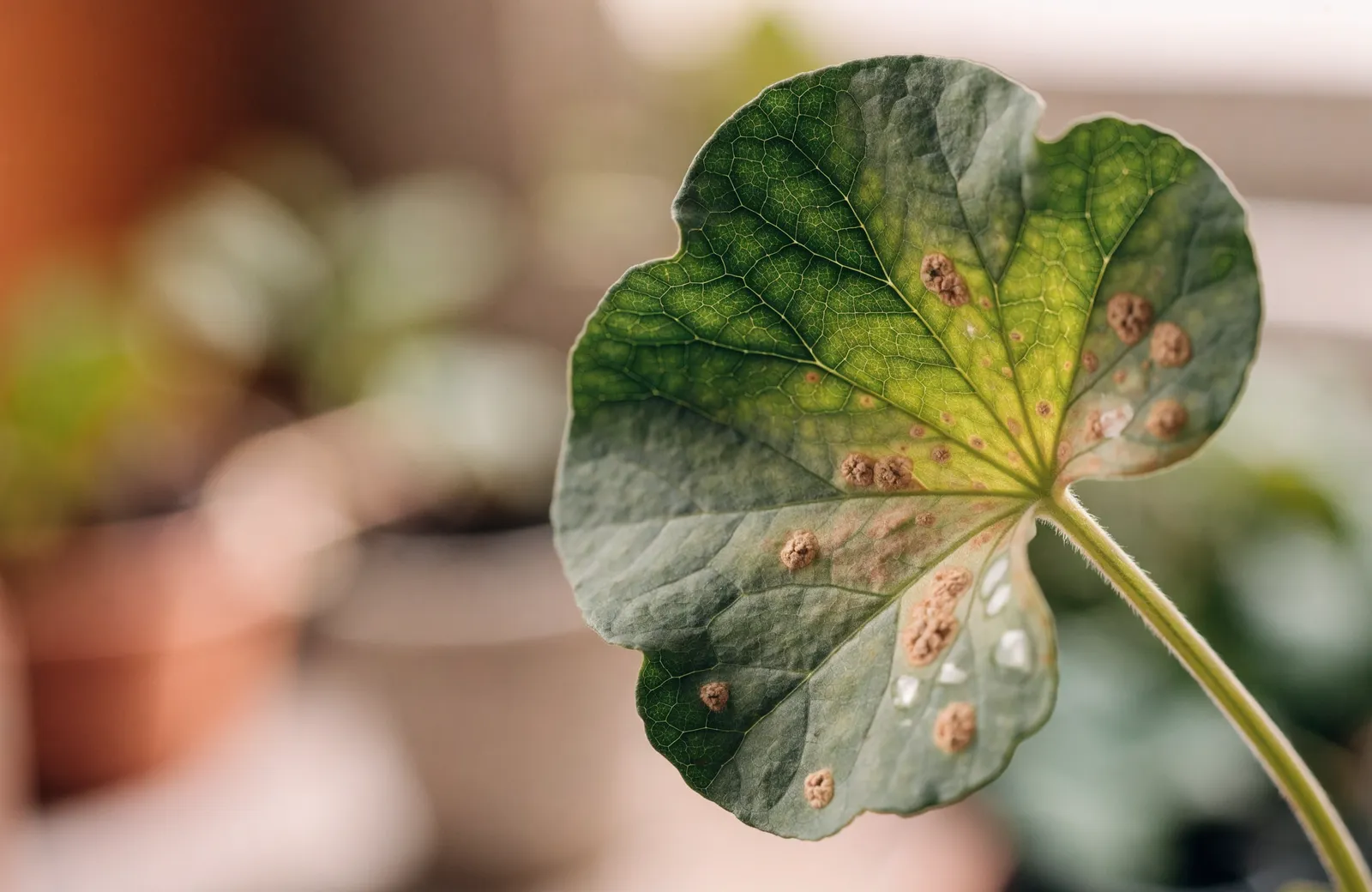
You turn a leaf over and your thumb catches on it: rows of small, rough, rust-coloured bumps, like cork or tiny scabs, on a leaf that looked fine from above. The first instinct is pest, the second is disease. Take a breath — on fleshy-leaved houseplants in autumn, it is very often neither. What you're probably looking at is oedema (also spelt edema): a physiological disorder, not an infection, and one correct decision from being solved.
What you're seeing
Oedema starts as small water-soaked bumps — a millimetre or two across — mostly on the undersides of leaves, sometimes on stems and leaf stalks. The blisters then turn tan to rust-brown and corky. The spots never spread from plant to plant, and on thin-leaved plants the dead patches can dry and drop out, leaving little shot-holes. Badly affected leaves may yellow and fall. The usual suspects indoors are the fleshy-leaved crowd — jade plants, peperomia, schefflera, begonias, cacti — plus ivy-leaf geraniums, where it's practically a signature complaint.
Rule out the look-alikes first
Two pests earn their reputation for impersonating oedema, and a ten-times hand lens (or your phone camera, zoomed) settles it in a minute.
Oedema vs. the pests it gets mistaken for
| Oedema | Spider mites | Thrips | |
|---|---|---|---|
| Where it shows | Leaf undersides, older leaves first | Spreads toward the youngest leaves | New growth, flowers |
| Texture | Raised corky bumps you can feel | Fine stippling, dusty webbing | Silvery-white scarring, distorted leaves |
| Movement | Nothing moving, ever | Tiny moving dots under the lens | Slim fast insects under the lens |
| Spread | Stays put; may stop on its own | Worsens and travels between plants | Worsens and travels between plants |
If the lens shows anything walking, you have a different (and very solvable) problem — start with the spider mite guide or the thrips guide. If the bumps are corky, fixed in place and lifeless, read on.
Why it happens
Oedema is a plumbing imbalance. Roots take up water faster than the leaves can release it through transpiration, pressure builds, and individual leaf cells swell until they rupture. The plant seals the damage with corky scar tissue — those are your bumps. Everything that slows transpiration stacks the odds: moist soil plus cool, humid, still air and short dull days, which is why cases surge indoors from autumn onward. An uneven watering rhythm — letting the pot go bone dry, then flooding it — produces the same pressure spike. None of this is infectious: no fungus, no bacteria, nothing to quarantine.
What to do today
- Confirm with the lens: corky, immobile bumps, no webbing, no insects.
- Feel the soil before you water, every time, instead of watering by the calendar — and if the pot is staying wet for days, reread your rhythm against overwatering vs underwatering.
- Water in the morning rather than the evening, so the plant transpires through the day's light.
- Move the plant somewhere brighter and give it moving air — space pots apart, crack a door, run a fan on low.
- Stop misting an affected plant; it slows the very transpiration you're trying to restore.
- Leave the leaves on unless a leaf is more scar than green — the plant is still feeding from them.
One expectation to set calmly: existing spots are scars, and scars don't fade. You're not treating the marked leaves — you're protecting the next ones. Judge your fix by the new growth: clean young leaves mean you've already won, and mildly affected plants usually carry on perfectly well.
Keeping it from coming back
Steadiness is the whole cure: even soil moisture (checked by touch), the brightest spot you can offer in the dark months, and air that moves. Outdoors, a mulch keeps soil moisture level through wet-then-bright spells. If you grow ivy-leaf geraniums under glass, variety choice matters more than any tweak — greenhouse trials found that neither supplemental calcium nor adjusting how wet the growing medium ran reduced oedema reliably, while some varieties simply shrug it off.
Sources & further reading
Frequently asked questions
Will the corky bumps on my plant's leaves go away?
No — once a cell has burst and the plant has sealed it with corky tissue, that mark is permanent, like a healed scab. The disorder itself stops as soon as conditions improve, so watch the new leaves: if they emerge clean, the problem is already behind you. Remove only the worst-marked leaves, and only once the plant is growing well again.
Is oedema contagious to my other houseplants?
Not at all. Oedema is a physiological disorder — a water-pressure problem inside the leaf — not a fungus, bacterium or pest, so there is nothing to spread. No need to isolate the plant. If several plants show it at once, they're simply sharing the same conditions: damp soil, humid still air and low light.
About the author

Plant Rescue & Troubleshooting
Camille spent years behind the counter of a plant shop where every customer arrived with the same question: what's wrong with it? She writes the Journal's rescue guides — calm, diagnosis-first, no guilt — because most 'dying' plants are one correct decision away from recovery.
Try it yourself
Diagnose it instantly with PlantMe
Snap a photo of any plant or leaf. Get the species, the diagnosis, and a care plan in seconds.
Download on theApp Store