Journal/Troubleshooting · 6 min read
Is Your Plant Root Bound? Signs and How to Fix It
Roots out of the drainage holes, water racing straight through, growth stalled? How to tell if a plant is root bound and repot it properly.
Quick answer
A plant is root bound when its roots have filled the pot and started circling with nowhere left to grow. Tell-tale signs: roots poking from the drainage holes or soil surface, water running straight through the pot, soil drying out in a day or two, and stalled growth. The fix is repotting one size up — or root-pruning to keep the same pot.
Every potted plant is on a countdown. Roots grow to fill whatever space they're given, and once they run out, they start circling the inside of the pot in a dense, tangled mat. At that point there's barely any soil left to hold water or nutrients — and the plant begins quietly starving in plain sight.
The good news: a root bound plant announces itself clearly once you know the signs, and the fix — repotting into a slightly bigger pot — takes ten minutes.
What "root bound" actually means
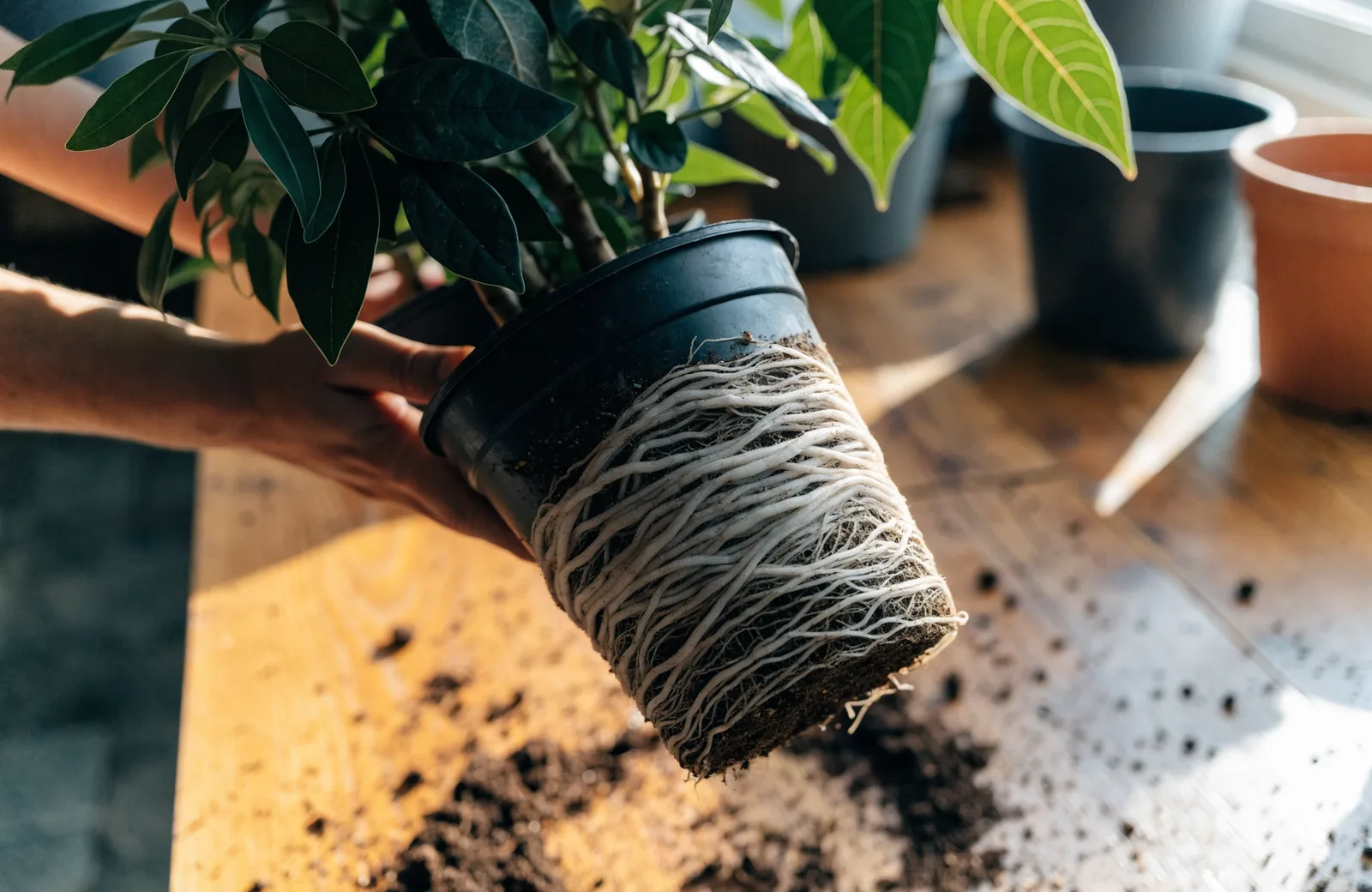
In a healthy pot, roots thread through a generous volume of soil that holds moisture and nutrients between waterings. In a root bound (or pot bound) plant, that ratio has flipped: the pot is mostly root, with thin veins of exhausted soil in between. Water has nothing to soak into, feed washes straight out, and the circling roots can eventually strangle the plant's own root flare — which is why a badly root bound plant wilts fast, feeds poorly, and stops growing no matter how well you care for it.
The tell-tale signs
- Roots growing out of the drainage holes, or coiling on the soil surface.
- Water races straight through the pot and out of the bottom within seconds of pouring.
- The soil dries out far faster than it used to — the plant wilts a day or two after a thorough watering.
- Growth has stalled: small new leaves, little or no new growth in the growing season.
- Lower leaves yellow and drop even though your watering hasn't changed.
- The root ball has pushed the plant up above the rim of the pot.
- A plastic pot feels rock-hard and bulges, or has visibly cracked.
The definitive check
Signs hint; the root ball tells the truth. Water the plant a day ahead, tip the pot sideways, support the stems between your fingers, and slide the plant out (squeeze a plastic pot gently around its sides first, or run a knife around the inside of a rigid one). A healthy root ball shows plenty of soil with white roots woven through it. A root bound one is a solid mesh of circling roots hugging the pot's shape, with roots wound thickly around the bottom — and in severe cases it holds the pot's shape like a cast, soil barely visible.
Which plants tolerate it — and which don't
A little snugness is not an emergency, and a handful of houseplants genuinely perform better slightly tight in the pot: peace lilies, hoyas, snake plants, spider plants and Christmas cactus often flower or grow best with their roots cosy. But even these have a limit — "snug" means the roots have reached the walls, not that the pot is solid root. Fast growers like pothos, monstera, ferns and most edibles or seedlings, on the other hand, decline quickly once bound.
How to fix a root bound plant
- Choose a pot just one size up — 2–5 cm wider than the old one, with drainage holes. Jumping several sizes leaves cold, wet soil around the roots and invites rot.
- Slide the plant out and loosen the root ball with your fingers, teasing the outer roots free so they point outward.
- If the roots are a solid circling mat, make three or four shallow vertical cuts down the sides with a clean knife and gently splay the bottom — it looks brutal, but it redirects roots outward instead of letting them keep circling.
- Trim off any black, mushy or clearly dead roots with clean scissors.
- Set the plant at the same depth in fresh potting mix, working soil into the gaps around the sides — never pile soil up the stem.
- Water thoroughly, let it drain, then hold off on fertiliser for four to six weeks; the fresh mix has nutrients and cut roots dislike salts.
Want to keep the same pot?
Root-prune instead: slide the plant out, shave 2–3 cm of roots off the sides and bottom of the root ball with a clean knife, and repot it back into the same container with fresh mix around the trimmed ball. Bonsai growers do this routinely — done in the growing season, most healthy plants take it in stride. Expect a short sulk while the plant regrows feeder roots.
When to do it
The ideal moment is just before or during active growth — spring and early summer for most houseplants — because the plant heals and colonises the fresh soil quickly. Avoid repotting a plant in full bloom or deep in winter dormancy unless it's an emergency; a severely root bound, constantly wilting plant is an emergency, and is better repotted immediately in any season than left to decline.
Stalled growth and fast-drying soil can also point to other problems — compacted mix, heat stress, or pests at the roots. If you're not sure what your plant is telling you, snap a photo in PlantMe and let the app narrow it down before you reach for a bigger pot.
Sources & further reading
Frequently asked questions
Can a root bound plant recover on its own?
No — the roots have nowhere to go, so the situation only tightens. Repotting one size up, or root-pruning back into the same pot, is the only real fix.
Should I break up the roots when repotting?
Gently, yes. Teasing the outer roots loose — or scoring a solid mat with shallow vertical cuts — makes new roots grow outward into the fresh soil instead of continuing to circle.
Is it bad to move a plant to a much bigger pot?
Usually. A pot more than a few centimetres wider holds soil the roots can't reach, which stays wet and turns sour. One size up (2–5 cm) is the safe rule.
How often do houseplants become root bound?
Fast growers can fill a pot in a single season; slow growers take three years or more. Checking the root ball once a year — or whenever water starts racing through — catches it early.
About the author

Plant Rescue & Troubleshooting
Camille spent years behind the counter of a plant shop where every customer arrived with the same question: what's wrong with it? She writes the Journal's rescue guides — calm, diagnosis-first, no guilt — because most 'dying' plants are one correct decision away from recovery.
Try it yourself
Diagnose it instantly with PlantMe
Snap a photo of any plant or leaf. Get the species, the diagnosis, and a care plan in seconds.
Download on theApp Store