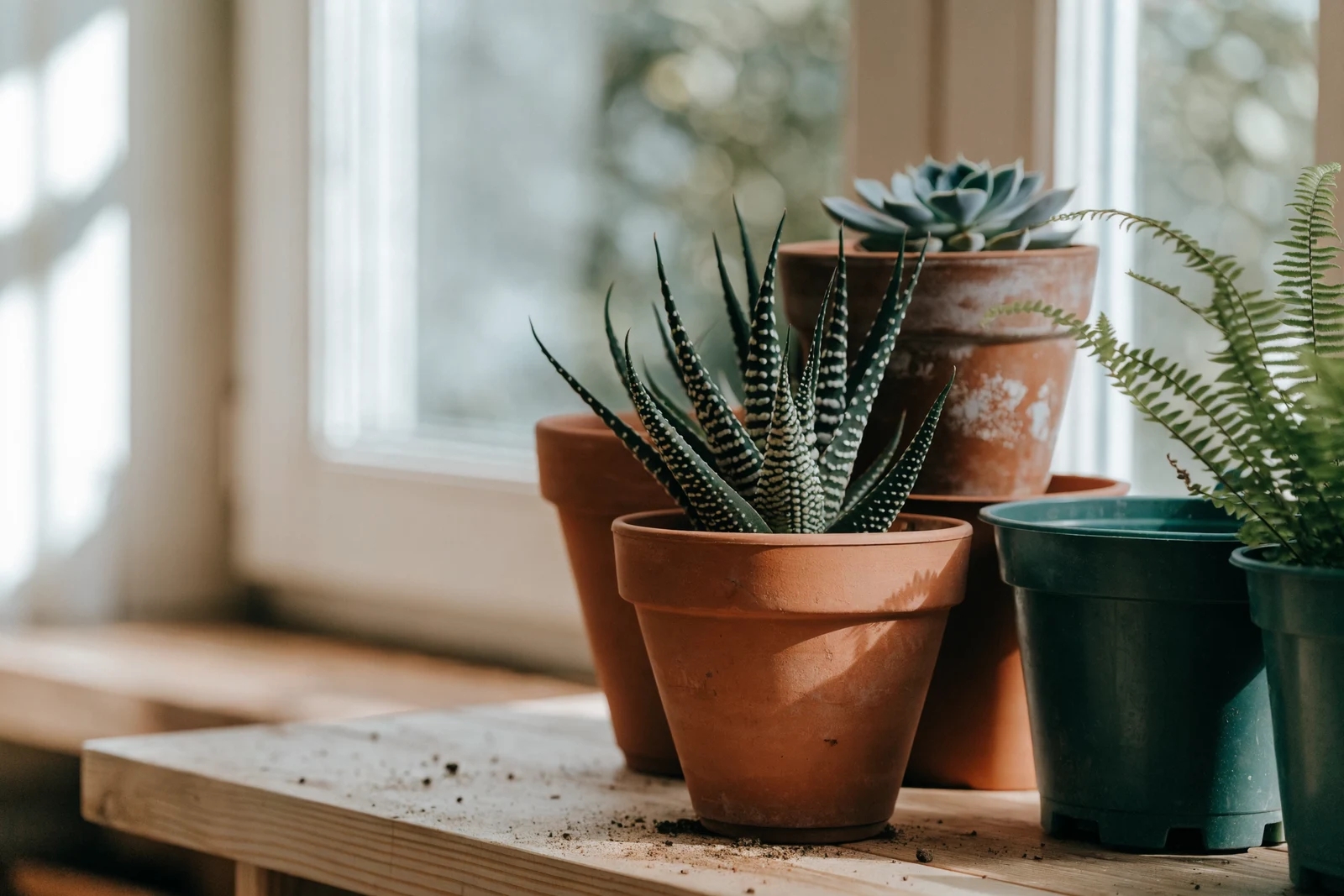
Journal/Care Basics · 5 min read
Terracotta or Plastic? How Your Pot Waters Your Plant
Wren Hollis on what pot material really changes — how terracotta wicks water and plastic holds it, which plants suit each, and how to pick the right pot for your own watering habits.
Quick answer
Terracotta is porous: it pulls moisture out of the compost and lets air reach the roots, which suits succulents, cacti and anyone with a heavy watering hand. Plastic holds water longer and weighs far less, which suits ferns, other moisture-lovers and forgetful waterers. Neither is better — match the pot to the plant, and to your own habits.
Walk into any garden centre and you're quietly asked to take a side: the warm orange stack of terracotta by the door, or the aisles of sensible plastic behind it. Most of us choose on looks, which is fair — pots are furniture, after all. But the material you pick changes how water behaves inside the pot, which makes it a care decision as much as a style one. The good news is that neither material is better. Each simply suits certain plants — and, just as much, certain people.
What terracotta actually does
Terracotta is fired clay left unglazed, and unglazed clay is porous. Water and air pass slowly through the walls themselves, so the pot behaves like a wick: it steadily pulls moisture out of the compost and evaporates it from its outer surface. Horticulturists at the University of Nebraska–Lincoln describe this wicking as both an advantage and a disadvantage, depending entirely on your watering habits. If you're generous with the can — and most of us are — the clay drinks up your enthusiasm and your plant's roots stay out of the swamp. If you water rarely, the same pot dries the compost out faster than you'd like.
Those breathing walls do something else valuable: they let air reach the fine roots at the edge of the root ball, exactly where a plant does much of its drinking, and their thickness buffers roots against sudden swings in temperature. You'll see the clay's honesty on its surface, too. As water evaporates through the pot, dissolved fertiliser salts travel with it and dry into a chalky white bloom on the outside — the same deposit that shows up as a white crust on the surface of the compost in any long-potted plant. It scrubs off, and it's a genuinely useful early warning that salts are building up in the compost.
What plastic does differently
Plastic is everything clay isn't. Nothing passes through the walls, so water leaves the pot only through the drainage holes and up through the plant itself, and the compost stays moist noticeably longer — one reason nurseries raise nearly everything in it. Nebraska's extension horticulturists recommend plastic for moisture-loving plants and for gardeners who wait for the wilting signal before reaching for the can; if you tend to water by the calendar rather than by touch, plastic is far more forgiving of a missed week than a thirsty clay pot.
It's also light, inexpensive and close to unbreakable, which matters more than it sounds once a plant gets big enough to need two hands. The caveats are real but manageable: thin walls insulate roots poorly, and a dark pot in strong sun behaves like a solar collector — black plastic can genuinely overheat a root ball on a bright windowsill or patio. Outdoors, sunlight slowly turns plastic faded and brittle, though many outdoor-grade pots now include UV inhibitors that stretch their lifespan.
Match the pot to the plant — and to yourself
The useful trick is to stop asking which pot is best and start asking which plant, and which waterer, it has to serve.
- Choose terracotta for plants that want to dry out between drinks — cacti, succulents, snake plants, most Mediterranean herbs — and for anyone who knows they have a heavy hand with the watering can. The clay quietly corrects your excess.
- Choose plastic, or glazed ceramic, which holds water the same way, for moisture lovers and for busy or forgetful waterers. Colorado State University's extension steers plants like Boston fern toward plastic or ceramic and keeps porous clay for cacti, succulents, orchids and bromeliads.
- Going big? Lightweight plastic keeps a large plant movable for cleaning and light-chasing, while weighty terracotta anchors anything tall and top-heavy against toppling.
- Whichever material wins, it needs holes in the bottom. No material advantage survives a pot that can't drain.
Three practical notes before you buy
First, size matters as much as material: pick a pot one to two inches wider in diameter than the root ball, not the palatial upgrade — in an oversized pot, any material holds water longer than the roots can use it. Second, if your pots spend winter outside, remember that terracotta's pores hold water and water expands as it freezes; that expansion is how pottery cracks over winter, so store empty clay pots somewhere dry, upside down so snow and leaves stay out. Third, a reused pot of either material deserves a proper scrub before a new tenant moves in, to shift old salt deposits and anything the last occupant left behind.
A pot is a small decision you and your plant live with every single day. Pick the material that covers for your habits rather than fighting them, and half your watering problems quietly solve themselves.
Sources & further reading
About the author

Houseplants & Indoor Styling
Wren has killed enough houseplants to know exactly why yours is struggling — and kept hundreds more thriving in a small, bright flat that doubles as her test lab. She writes about reading plants instead of following rules, and believes every windowsill deserves at least one leaf.
Try it yourself
Diagnose it instantly with PlantMe
Snap a photo of any plant or leaf. Get the species, the diagnosis, and a care plan in seconds.
Download on theApp Store