Journal/Plant Science & Curiosities · 5 min
Thanksgiving Cactus or Christmas Cactus? How to Tell Which One You Own
Dr. Lena Okafor explains how to tell a Thanksgiving cactus from a true Christmas cactus — by the teeth on the stem segments, the shape and pollen of the flowers, and the bloom date — and why the label on the pot is so often wrong.
Quick answer
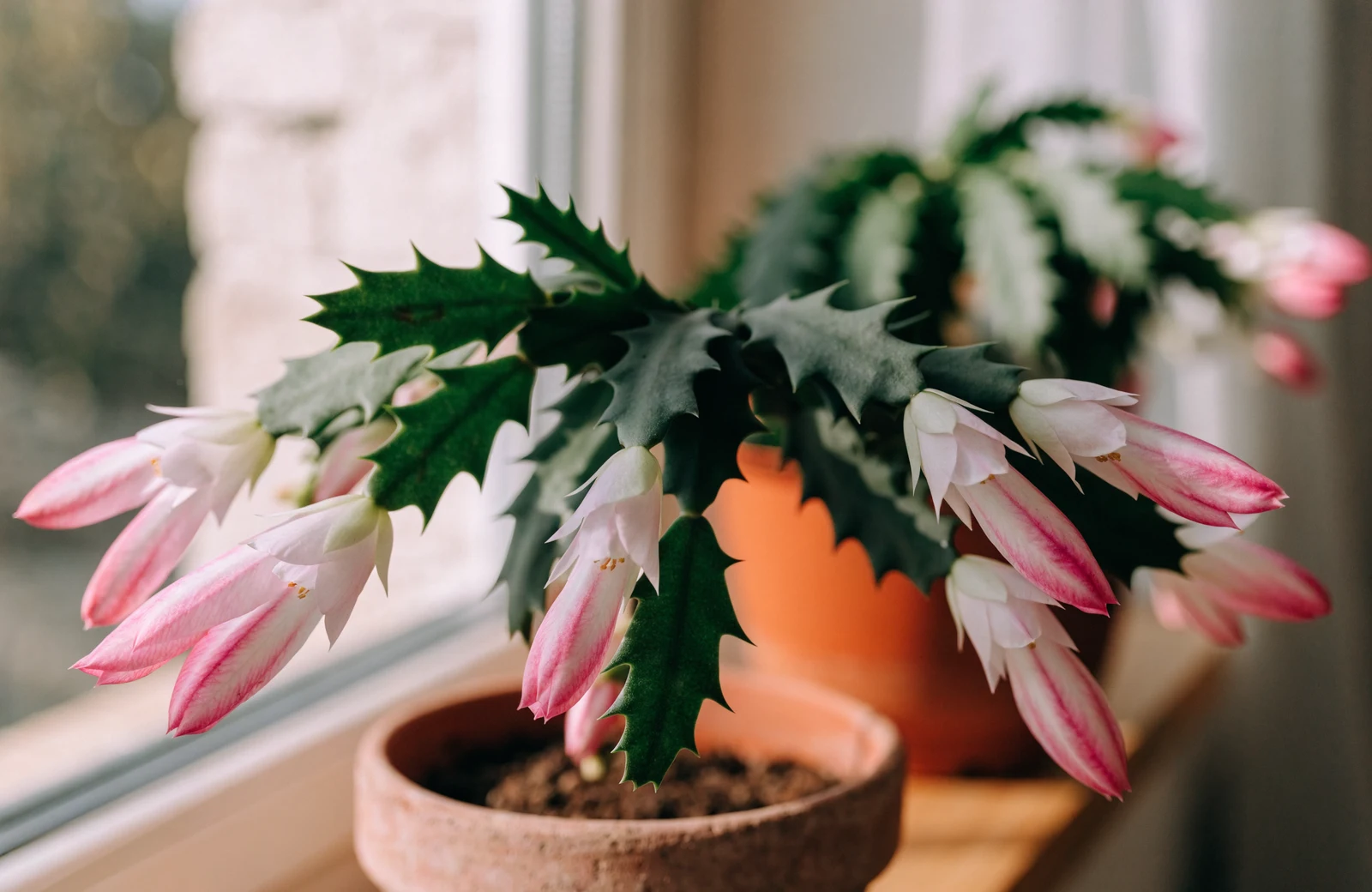
Look at the stem segments: sharp, claw-like teeth — often two larger ones at the tip — mean a Thanksgiving cactus (Schlumbergera truncata). Rounded, scalloped edges mean a true Christmas cactus (S. × buckleyi). In bloom, yellow pollen points to Thanksgiving, pink to Christmas. Most plants sold as 'Christmas cactus' are in fact the Thanksgiving species.
Somewhere in your home, there is probably a pot labelled "Christmas cactus" that has never once bloomed at Christmas. The buds arrive in mid-November, open before the turkey does, and the plant gets quietly accused of running fast. It isn't. In most cases the label is wrong, not the plant: the species sold in vast numbers each winter is the Thanksgiving cactus, a close relative of the true Christmas cactus that flowers roughly a month earlier. Telling them apart takes about ten seconds once you know which two details to read.
Three species, one label
"Christmas cactus" is used loosely for a small group of Brazilian forest cacti in the genus Schlumbergera — named in 1858 by the French botanist Charles Lemaire for the cactus collector Frédéric Schlumberger. Three plants wear the label in shops. Schlumbergera truncata, the Thanksgiving cactus, blooms earliest, usually in November. Schlumbergera × buckleyi, the true Christmas cactus, is a deliberate nineteenth-century hybrid of S. truncata and S. russelliana, first recorded in England in 1852; it flowers later, typically December into January. And Schlumbergera gaertneri, the Easter cactus, waits for spring. All three are epiphytes from the cool, humid coastal mountains of southeastern Brazil — rainforest cacti that grow on mossy branches rather than in desert sand, which is why their care has so little in common with a saguaro's. They are also remarkably long-lived: well-kept plants can pass fifty years, which is how so many end up as family heirlooms.
Read the stem segments first
These plants have no true leaves. The flat green "leaves" are phylloclades — photosynthetic stem segments — and their margins are the most reliable identity document the plant carries, readable twelve months a year. The label on the pot is marketing; the segment edge is anatomy.
On a Thanksgiving cactus the segments are dentate: armed with sharp, pointed teeth along each side, usually with two larger claw-like points at the tip of the segment — the reason one of its older common names is crab cactus. On a true Christmas cactus the segments are crenate: the edges are rounded and scalloped, with no points to snag a sleeve, and the branches tend to drape. The Easter cactus goes further still — very rounded segments with only small notches along the edge, often with fine bristles at the tips.
| What to check | Thanksgiving cactus (S. truncata) | Christmas cactus (S. × buckleyi) | Easter cactus (S. gaertneri) |
|---|---|---|---|
| Segment edges | Sharp, pointed teeth; two larger claws at the tip | Rounded, scalloped, symmetrical | Very rounded, small notches, fine bristles |
| Flower shape | Bilaterally symmetrical (zygomorphic), held level or above horizontal | More regular, hanging below horizontal | Radially symmetrical, opens like a starburst |
| Pollen | Yellow | Pink | — |
| Usual bloom time | November | December to January | Spring |
If it is flowering, read the flower
Botanists describe the Thanksgiving cactus flower as zygomorphic — bilaterally symmetrical, like a face, with a distinct top and bottom — and it is held level with the stem or angled above it, with yellow pollen at the anthers. The true Christmas cactus flower is more regular in form and hangs below the horizontal, and its pollen is pink. The Easter cactus breaks the pattern entirely: its flower is radially symmetrical, opening into a flat starburst rather than a tube within a tube. Flower colour, on the other hand, tells you almost nothing — both holiday species now come in reds, pinks, whites, oranges and golds, so ignore the petals and look at the geometry.
Why the shop label is so often wrong
The mislabelling is not a conspiracy, just commerce. Because S. truncata sets buds and flowers about a month earlier than the true hybrid, it is on the bench, in bud, exactly when retailers want holiday stock on display — which makes it the better seller under the more familiar name. The result is that the overwhelming majority of plants sold as Christmas cactus are Thanksgiving cactus by anatomy. If yours reliably opens in late November, that is not earliness; that is the species keeping its own calendar perfectly.
Does it change the care?
Not really — and this is the comforting part. Both holiday species want the same things: bright indirect light, a loose fast-draining mix, water when the top of the mix has dried, and no scorching heat. The identical machinery also governs their flowering: Schlumbergera are thermophotoperiodic, meaning bloom is triggered by the combination of cool nights (around 10–13 °C / 50–55 °F) and long uninterrupted darkness for six to eight weeks beforehand — the same short-day biology covered in what is photoperiodism and the practical routine in how to make a Christmas cactus bloom. Day-to-day care is in the Christmas cactus care guide, and if a plant in bud starts shedding them after you move it, that has its own explanation in why Christmas cactus buds fall off. The only thing identification really changes is your expectations: know which species you own, and the bloom date stops being a mystery and becomes a confirmation.
Sources & further reading
About the author

Plant Science & Curiosities
Lena is a botanist who thinks the strangest thing about plants is how rarely we ask why they do what they do. She covers the science side of the Journal — photosynthesis, plant communication, disease biology — translating research into things you can actually use at the potting bench.
Try it yourself
Diagnose it instantly with PlantMe
Snap a photo of any plant or leaf. Get the species, the diagnosis, and a care plan in seconds.
Download on theApp Store