Journal/Plant Science & Curiosities · 7 min read
What Is Marcescence? Why Some Trees Keep Their Dead Leaves All Winter
Oaks and beeches often stand in full copper-brown leaf long after every other tree is bare. The science of marcescence — and why nobody fully agrees on it.
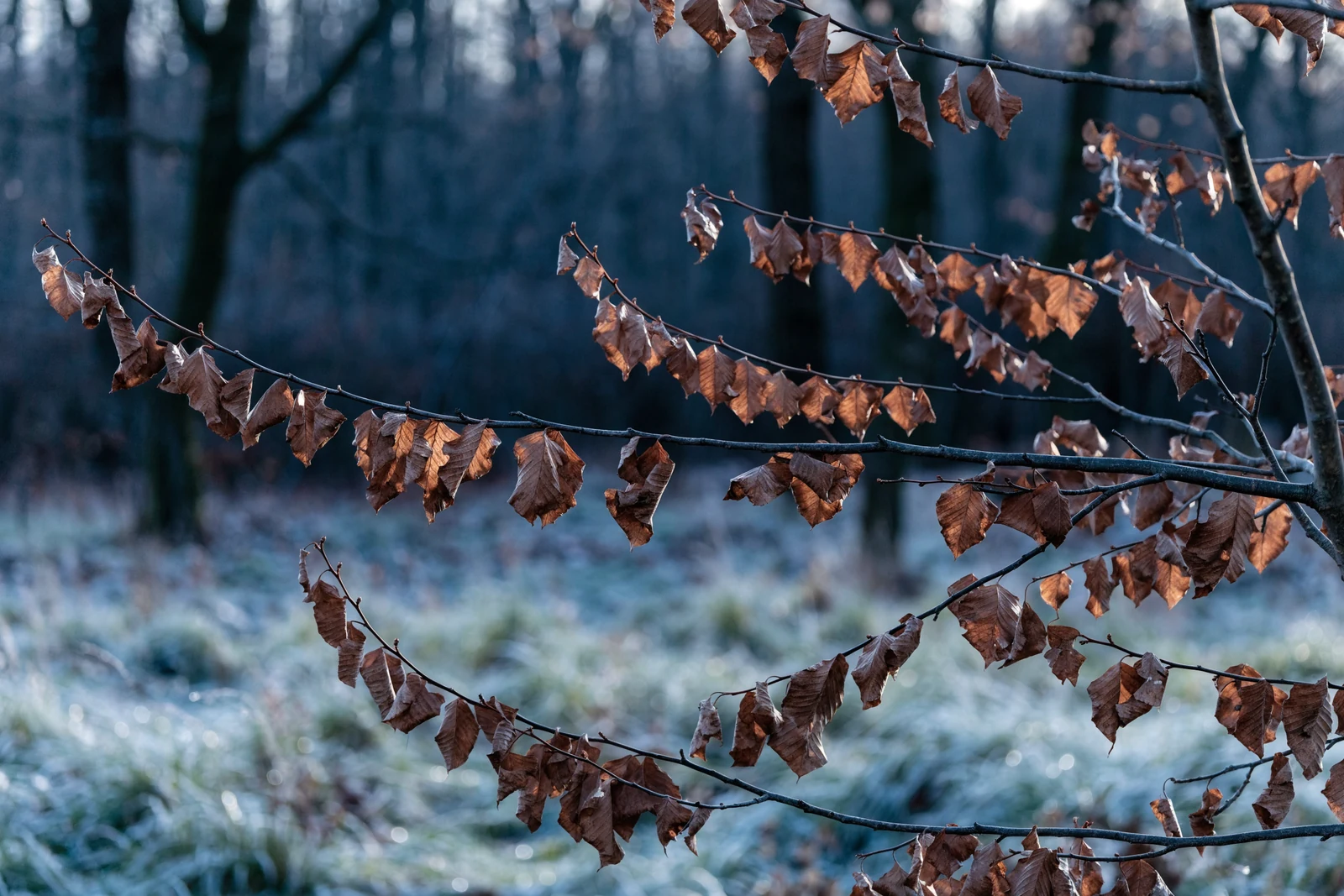
By early November, most deciduous trees have finished the business of autumn: the colour show is over, the leaves are down, and the canopy is reduced to bare architecture. And yet, walk past a young oak or a beech hedge in January and you will find it still fully dressed — in dry, papery, copper-brown leaves that rattle in the wind and simply refuse to drop. This stubbornness has a name: marcescence.
First, a definition
Marcescence (from the Latin marcescere, to wither) is the retention of dead leaves on a woody plant through winter, instead of shedding them in autumn. The leaves die on schedule — they brown and dry out like everyone else's — but they stay attached, often until the moment new buds open in spring. It is most familiar in oaks (Quercus) and beeches (Fagus), and it turns up in a scattering of other woody plants too.
It is not the same thing as being evergreen. An evergreen holds living, working foliage through winter — a strategy with its own logic, which we covered in why evergreens drop their needles. A marcescent tree holds dead foliage. The curious pattern is who does it most: marcescence is strongest in young trees, and on the lower branches of mature ones. That may be why a clipped beech hedge — whose growth is constantly renewed by trimming — keeps its copper leaves all winter while a tall old beech nearby goes almost bare.
The mechanism: an unfinished goodbye
To understand marcescence, start with how a normal leaf falls. As days shorten and temperatures drop, a deciduous tree builds an abscission zone at the base of each leaf stalk — a band of specialised cells that first seals the connection, then lets the leaf detach cleanly. (The same shutdown process drives the colour change beforehand, which we unpacked in why leaves change colour in autumn.) Think of it as a perforated line: the tree scores the tear-off point in advance, and the leaf comes away exactly where intended.
In a marcescent oak or beech, that perforation is never finished. The abscission zone begins to form, but a hardened, lignified layer develops across it and no functional separation layer appears. With nothing to tear along, the dead leaf stays bolted on — through gales, frost and snow. Oak leaves are well suited to the wait: they are tough and leathery, and endure months of winter exposure without breaking down.
The release finally comes in spring, when cork cells form at the base of the leaf stalk and the outer layer breaks, letting go of the old leaves — often just as the new buds are swelling. Months after its neighbours, the tree completes the same goodbye.
Why would a tree keep dead leaves?
Here is the honest answer: nobody is entirely sure. Researchers have put forward several hypotheses, none of them conclusively proven, and the real explanation may be a combination — or may differ between a young oak on an exposed ridge and a beech in a sheltered wood.
Leading hypotheses for marcescence
| Hypothesis | The idea |
|---|---|
| Bud protection | A coat of dead leaves shields overwintering buds from drying wind and cold — potentially most valuable on exposed, windy sites. |
| Browsing deterrence | Dry, rattling, unpalatable leaves may hide tender buds from deer and other winter browsers, or make feeding less rewarding. |
| Nutrient timing | Leaves that drop in late winter or spring decompose just as the tree resumes growth, delivering nutrients when they can be used rather than leaching away in winter rain. |
| A longer photosynthetic season | Observations that sun-exposed leaves persist longer — including a Spanish study of Quercus subpyrenaica — hint that leaf retention may be a by-product of squeezing more work out of each leaf. |
Notice that the first two hypotheses would make marcescence most useful to exactly the trees that show it most: young trees and low branches, which sit at browsing height and have the most vulnerable buds. That neat fit is suggestive — but suggestive is not proven, and the botanical literature is refreshingly candid about the gap.
Does it cost the tree anything?
Probably, sometimes. A canopy that holds its leaves presents far more surface area to wind, and catches more snow and ice. Leaf-covered limbs load up in winter storms and are more likely to break — a bigger problem for trees in streets and gardens than in the woodland conditions where the trait evolved. If you grow a marcescent oak in an exposed spot, it is one more reason to keep an eye on branch structure.
What it means in your garden: nothing to fix
A young oak or beech in full brown leaf in January is not sick, not drought-stressed and not dead — it is doing something oaks and beeches have always done. There is no need to strip the leaves from a beech hedge; they will release on their own in spring, and in the meantime the hedge gives you something rare in a winter garden: structure, movement and sound. Like a mast year, marcescence is one of those tree behaviours that looks like a malfunction and is anything but — the visible trace of a plant running its own winter program, on its own schedule.
Sources & further reading
Frequently asked questions
Which trees keep their dead leaves in winter?
Oaks and beeches are the classic examples, along with a few other woody plants. The trait is strongest in young trees and on the lower branches of mature ones, which is why clipped beech hedges hold their copper-brown leaves all winter.
Is a tree that keeps its dead leaves dying or diseased?
No. Marcescence is a normal trait, not a symptom. The leaves died on the usual autumn schedule — they simply never detached, because the tree did not complete its abscission (separation) layer. They will release in spring as new buds open. A healthy marcescent tree will leaf out normally.
Should I remove the dead leaves from my beech hedge?
No — leave them. They do no harm, they may help shelter the buds from wind and cold, and the hedge will shed them by itself in spring. Stripping them by hand risks damaging the buds you would be trying to protect.
About the author

Plant Science & Curiosities
Lena is a botanist who thinks the strangest thing about plants is how rarely we ask why they do what they do. She covers the science side of the Journal — photosynthesis, plant communication, disease biology — translating research into things you can actually use at the potting bench.
Try it yourself
Diagnose it instantly with PlantMe
Snap a photo of any plant or leaf. Get the species, the diagnosis, and a care plan in seconds.
Download on theApp StoreKeep reading