Journal/Care Basics · 6 min
Hellebore Care: Get to Know the Winter Flower Before You Bring One Home
Wren Hollis on hellebores — which type you're actually buying this winter, where it wants to live, the late-winter haircut that shows off the flowers, and why the famous Christmas rose is the tricky one.
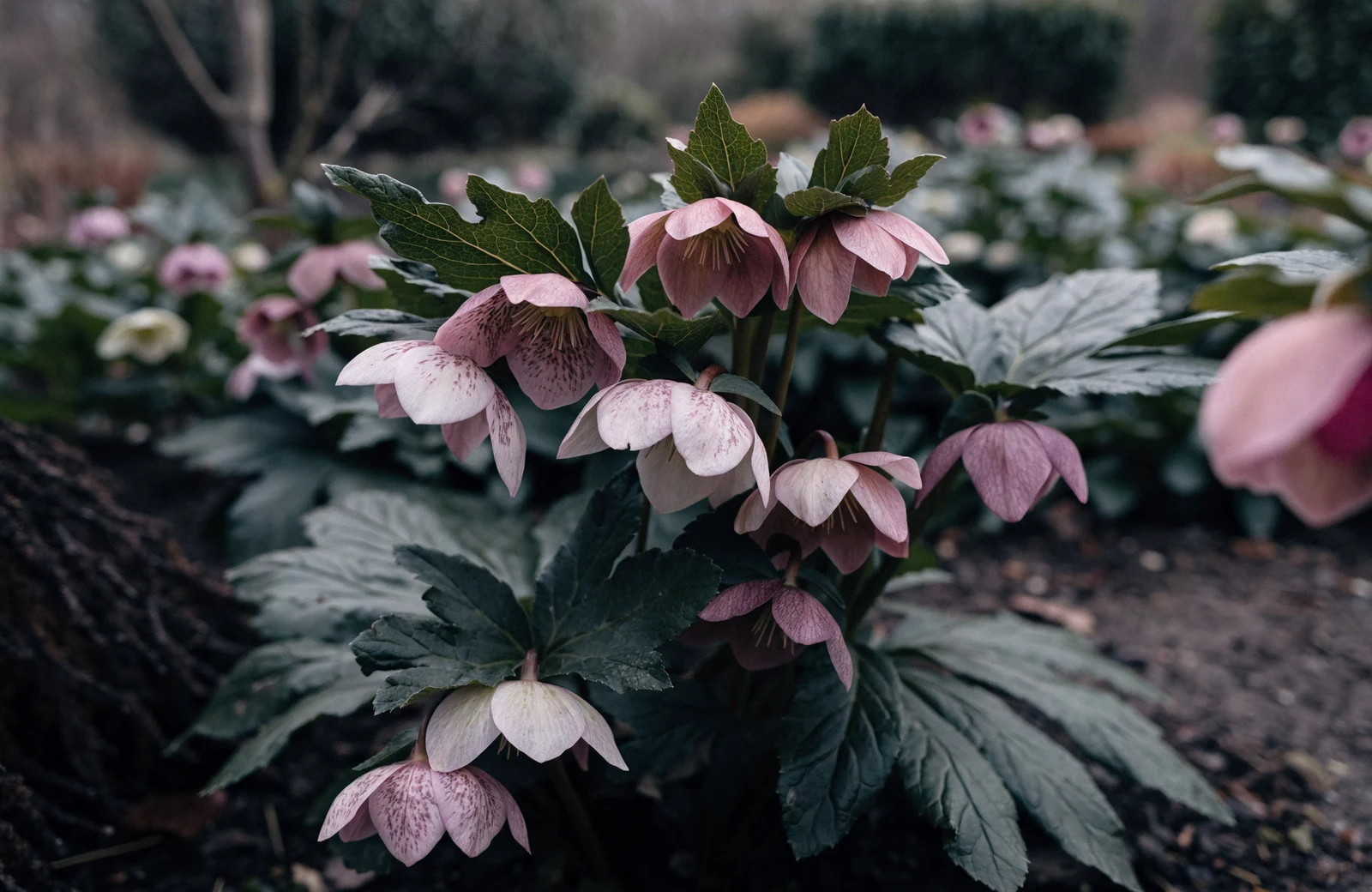
Walk into a garden centre any time between now and March and you'll find them: low pots of nodding, cup-shaped flowers in white, dusky pink and plum, blooming cheerfully while everything around them sleeps. Hellebores have a gift for exactly this moment of the year. The RHS describes them as hardy, compact and low maintenance, flowering in winter and early spring when little else is in its prime — and their blooms are a valuable nectar source for the first bumblebees of the season. They're also quietly long-lived, happy in the dappled shade most gardens have too much of, and almost completely ignored by deer. The one thing worth doing before you buy is learning which hellebore you're actually holding, because one famous member of the family plays by different rules.
First, which hellebore are you holding?
Hellebores are perennials from woodland edges, which explains most of their preferences. The ones you'll meet in shops fall into a handful of types, and the label matters more than it does with most plants.
| Name | What it's like | What it wants |
|---|---|---|
| Oriental hybrids (Helleborus × hybridus), 'Lenten rose' | The easy, long-lived classics — hundreds of varieties in cream, pink, ruby and near-black plum, often speckled inside, with evergreen leaves | Dappled shade with some sun; ordinary soil that's neither parched nor waterlogged |
| Christmas rose (H. niger) | Snowy white flowers from the festive season onwards — and the trickiest of the family to keep going | Excellent winter drainage; often happiest in a container |
| Stinking hellebore (H. foetidus) | A handsome architectural native with lime-green bells over finely divided leaves — it only smells when the leaves are crushed | Tolerates deeper shade than the rest |
| Holly-leaved hellebore (H. argutifolius) | A larger clump-former with glossy, holly-like foliage and pendent green flowers | Sun, with shelter from strong cold winds |
If you're choosing an Oriental hybrid, buy it in bloom. They're often sold as mixed 'selections' whose flower colours vary, so the RHS suggests picking plants when you can see exactly the shade you're getting. And part of the charm is in the construction: what look like petals are actually sepals, which is why a hellebore flower holds its colour for so astonishingly long — the University of Wisconsin–Madison's horticulturists note the sepals stay on the plant for a month or two after pollination, and a mature clump can carry fifty or more flowers.
Where they want to live
Think woodland edge: light or dappled shade with sun for part of the day, and soil that's neither very dry nor waterlogged. Wisconsin's guidance adds a climate wrinkle — in cooler regions Lenten roses will happily take more sun, while in hotter ones they need the shade. Plant from autumn to spring (avoiding dry summer months), set each plant at the same depth it was growing in its pot — hellebores resent being buried deep — and space them 35–45 cm apart. Then lay an organic mulch over the surrounding soil, keeping a gap around the base of the plant so the crown doesn't sit damp.
The non-negotiable is drainage. Wisconsin's growers call Lenten roses very sensitive to soggy soil, and it's the most common way a hellebore dies: not cold, which they shrug off, but wet winter feet. If your ground is heavy clay, a spot on a slope, a raised bed or a generous helping of garden compost worked in at planting all tilt the odds your way.
The Christmas rose is the difficult one
It feels unfair that the most famous hellebore is the fussiest, but there it is. The RHS is frank that Helleborus niger, for all its popularity, can be challenging to keep going because it demands excellent drainage in winter — and suggests the neatest solution is not to plant it in the border at all. Grow it instead in a pot of free-draining, peat-free compost as a winter display, tucked somewhere sheltered such as the base of a sunny house wall, and you get the snowy flowers from the festive season onwards without asking your soil to be something it isn't. Most other hellebores only visit containers temporarily: enjoy them potted through winter, then move them into the garden in spring once the flowers fade.
Care through the year: mostly restraint
A newly planted hellebore needs regular water through its first spring and summer while the roots take hold. After that, established plants in the ground only want help in hot, dry spells — Wisconsin describes them as fairly drought-tolerant once settled. Feeding is even simpler: the RHS says border hellebores seldom need it at all, and that poor growth is far more likely to be a watering problem than a hunger problem. If you do feed, a general-purpose fertiliser in spring at 50–70 g per square metre is plenty. Potted hellebores are the exception — compost runs out of nutrients, so give them a regular balanced liquid feed, switching to a potassium-rich one (tomato feed works) to encourage flowering. Top up the mulch annually and you're done.
The late-winter haircut
Here is the one job that makes a visible difference. The old leaves of Oriental hybrids come through winter looking tattered, and they hang over the emerging flowers like a bad fringe. Cut them off at the base in late winter or early spring, just as the flower stems push up. The RHS gives two reasons: the nodding flowers go on full display, and removing the old foliage helps control hellebore leaf spot, the fungal disease that blotches the leaves. Wisconsin's timing is the same — take the previous season's leaves off at the ground as the flowers emerge. For the stemmed kinds like H. foetidus and H. argutifolius, the routine differs: leave the stems alone in winter (they carry the flowers), then cut spent flower stems and ageing leaves back once blooms fade in late spring.
Gloves on, deer out
Hellebores sit in the buttercup family, and like their relatives they carry alkaloids in the leaves and seeds that can cause mild skin irritation in sensitive people — Wisconsin's practical advice is simply to wear gloves for the cutting-back jobs. The same chemistry is why deer and rabbits leave hellebores almost entirely alone, which in some gardens is reason enough to grow them. The flip side is that they're not a plant for nibbling pets either; if you share your home with a determined chewer, the toxic plants for pets list is worth a read. The one creature undeterred? Slugs, which will occasionally eat the flowers.
More plants, for the patient
A happy clump of Oriental hybrids can sit untouched for twenty years and more, so division is a choice, not a chore. When you want more plants, divide in early autumn or in spring straight after flowering, making sure each piece has several growth buds, and accept that divisions sulk — they can take a couple of years to flower well again. The lazier route is to let the plant do the work: undeadheaded hybrids self-seed freely, and the easiest propagation of all is digging up the volunteer seedlings that appear around the skirts of the parent. Raising hellebores from stored seed is a project for the truly patient — germination is slow and erratic, and Wisconsin puts the wait at four to five years from seed to a flowering-sized plant, with seedlings that won't match their parent. Sometimes the best answer is also the nicest one: let the clump get on with it.
Trouble, briefly
- Hellebore aphids — cluster on flowers and young leaves; small infestations can simply be rubbed off by hand.
- Hellebore leaf spot — dark blotches on foliage; prune out infected leaves in autumn, and keep up the late-winter clear-out.
- Hellebore leaf miner — tunnels in leaves, affects H. foetidus only; remove damaged leaves in winter.
- Hellebore black death — streaky black markings and distorted growth. This one is serious: there is no cure, and the RHS advice is to destroy affected plants to stop it spreading.
Sources & further reading
Frequently asked questions
Are hellebores evergreen?
Most garden hellebores keep their leathery leaves all year, though they look increasingly battered by late winter — in cold areas the old foliage often ends up flattened to the ground by spring. That's exactly why the late-winter cut-back exists: the plant replaces everything with fresh growth as it flowers.
Why hasn't my hellebore flowered since I moved it?
Patience. Divisions and transplants recover slowly — a couple of years without good flowering is normal, not a verdict. Hellebores also set their flower buds in the previous summer, so a plant stressed by a move has often already skipped a season before you see it. Keep it watered through its first growing season and let it settle.
Can I grow a hellebore indoors?
Not for long. A hellebore bought in bloom will tolerate a short stay in a cool, bright room, but it's a hardy garden perennial that wants cold winters and outdoor seasons. Enjoy it inside for the display, then plant it out — or keep it in a pot outdoors, which suits the Christmas rose especially well.
About the author

Houseplants & Indoor Styling
Wren has killed enough houseplants to know exactly why yours is struggling — and kept hundreds more thriving in a small, bright flat that doubles as her test lab. She writes about reading plants instead of following rules, and believes every windowsill deserves at least one leaf.
Try it yourself
Diagnose it instantly with PlantMe
Snap a photo of any plant or leaf. Get the species, the diagnosis, and a care plan in seconds.
Download on theApp Store