Journal/Seasonal · 6 min
How to Keep a Real Christmas Tree Fresh: Buy Well, Cut Fresh, Never Let It Dry
Arthur Meade on cut Christmas tree care: the freshness tests to run before you pay, the fresh cut that restarts water uptake, how much water a tree really drinks, and the additives to skip.
Quick answer
A cut Christmas tree stays fresh on three things: buy a genuinely fresh tree (pliable needles that stay on when you bounce the trunk on the ground), saw 1–2.5 cm (0.5–1 in) off the base just before it goes in the stand, and never let the water reservoir run dry. A fresh tree can drink about a litre of water a day for every 2.5 cm (1 in) of trunk diameter — plain tap water, no additives — and should hold up indoors for three to four weeks.
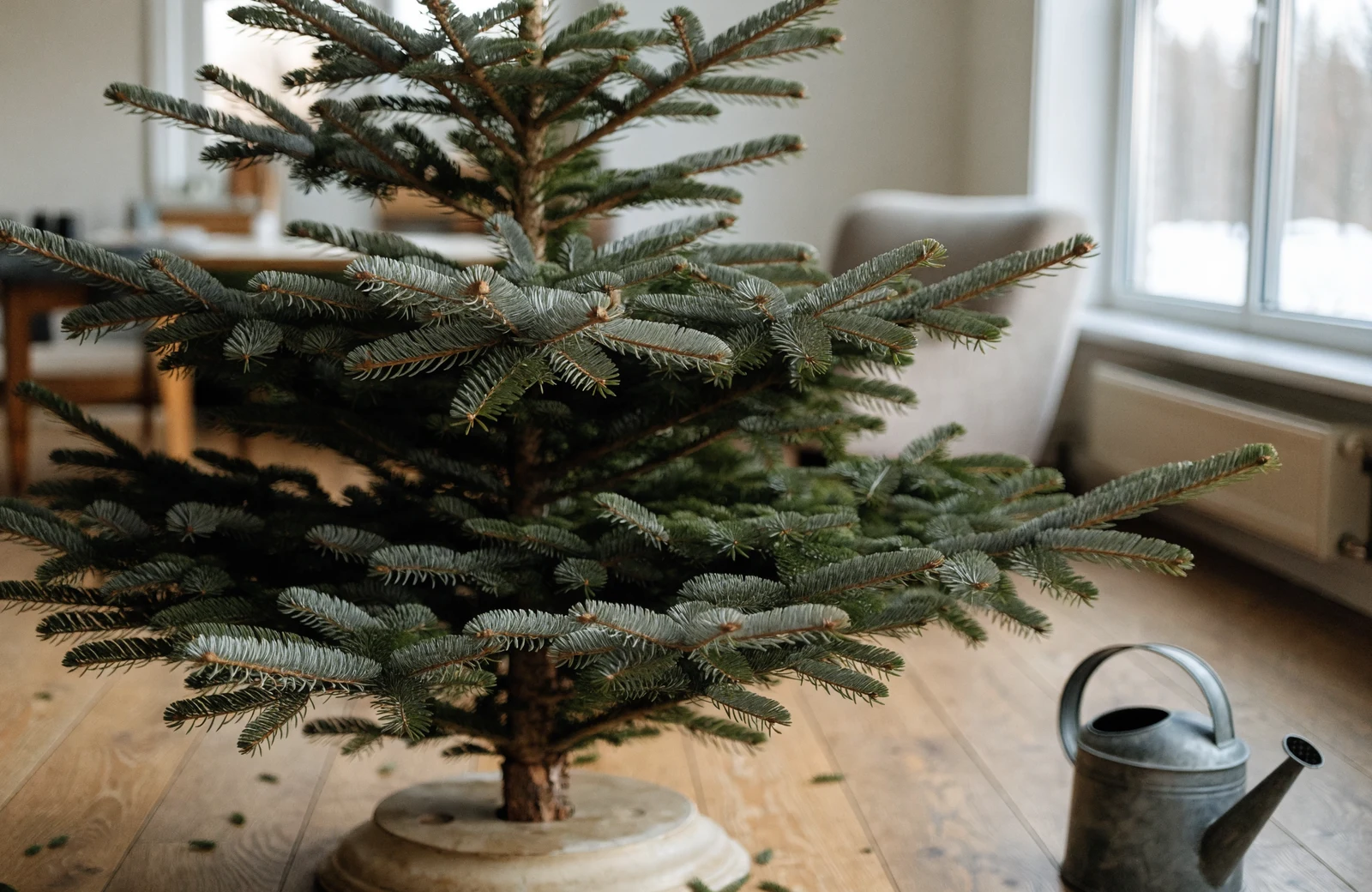
The first trees are on the lots this week, and the arithmetic of the season is simple: a cut Christmas tree is a very large cut flower. It has no roots, no prospects, and one job — to look alive until January — and whether it manages that is mostly decided in the first forty-eight hours. Three decisions do nearly all the work: which tree you buy, what you do to the trunk before it goes in the stand, and whether the water reservoir ever runs dry. Everything else is detail.
Freshness is decided at the lot, not in your living room
A tree cut at a choose-your-own farm is fresh by definition. A tree on a commercial lot is another matter — Iowa State University Extension notes that pre-cut trees may have been cut and stored for four or more weeks before they ever reach the lot, and no amount of care at home resurrects a tree that was already dry when you paid for it. So test before you buy. Run a hand along a branch: fresh needles are pliable, dry ones brittle. Bend the outer branches: they should flex, not snap. Then lift the tree by the trunk and bounce the butt lightly on the ground — a shower of green needles means a dry tree. A few old, yellowed needles from the interior falling out is normal; evergreens shed their oldest needles every year, cut or not.
The wait at home: a bucket, not the living room
If the tree is not going up the day it arrives, do not lean it against the house wall and hope. Store it in a cool, sheltered spot — an unheated garage or shed is ideal, since sun and wind strip moisture from a tree stored in the open — and stand the butt in a bucket of water. A tree can wait like this for days in good order. It cannot wait dry.
The fresh cut is not optional
Within hours of cutting, a conifer seals its wound with resin, and that resin clogs the water-conducting tissue in the trunk — which is why a tree set straight into a stand days after it was cut often refuses to drink at all. Michigan State University Extension's fix is the standard one: saw 1–2.5 cm (0.5–1 in) off the base immediately before the tree goes into the stand. Make the cut straight across — an angled or V-shaped cut takes up no more water and makes the tree harder to hold upright, and drilling a hole in the base does nothing. One more prohibition worth knowing: never shave the sides of the trunk to fit a too-small stand. The outermost wood just under the bark is where nearly all the water moves; shave it off and you have cut the tree's supply lines. Buy a bigger stand instead.
Water: the whole job
- 1. Use a stand with a generous reservoir — a fresh tree drinks roughly a litre (a quart) of water a day for every 2.5 cm (1 in) of trunk diameter, so a 2 m tree on a 7–8 cm trunk can take three litres a day in its first week.
- 2. Check the water level once or twice a day, every day. Heavy drinking is a good sign: it means the tree is still hydrated and fresh.
- 3. Never let the level drop below the base of the trunk. Once the cut surface is exposed to air it seals again, and uptake drops or stops even after you refill.
- 4. If the base has stood out of water for days, the fix is the saw, not the jug: make a fresh cut so the tree can drink again.
- 5. Fill with plain tap water. Sugar, soft drinks, aspirin, molasses and commercial preservatives add nothing — NC State's extension agents note that research shows additives are unnecessary and in many cases do harm.
Placement, lights, and the fire question
Where the tree stands matters nearly as much as what is in the stand. Keep it away from radiators, heat vents, wood stoves and fireplaces, close any vent that blows directly at it, and think twice about a south-facing window — direct sun dries a tree the way it dries laundry. Tree lights go off when you leave the house and when you go to bed. And respect the endpoint: a fresh, well-watered tree should hold up indoors for three to four weeks, and when the needles have gone dry and brittle, the season is over — a dried-out tree indoors is a fire hazard, and the only correct response is to take it down, not to water harder.
The January plan, decided in November
A cut tree has an afterlife, and it is worth deciding on it now. Stood in the garden, the tree becomes winter shelter for birds — hang it with fruit slices or seed cakes and it earns its keep until spring. Pruned apart, the boughs are exactly the loose, airy material that winter-protection mulching calls for over perennials and bulbs. Chipped, the whole tree becomes a season of path or border mulch. Most towns also run collection or recycling schemes in the first weeks of January. The one thing not to do is burn it in the fireplace: dry evergreen branches burn explosively and load the flue with creosote. A tree that spent a month drying in your living room is kindling, not firewood.
This week's list
- 1. Measure the room before the lot — height, width, and the stand's maximum trunk diameter.
- 2. Buy fresh, or buy early and store cool with the butt in a bucket of water.
- 3. Keep the saw by the door: the fresh cut happens minutes before the stand, not the day before.
- 4. Pot the second batch of paperwhites while you are at it — planted now, they flower as the tree goes up.
- 5. And when the tree comes home, give the poinsettia its own spot away from the same radiators and doorways — the two share enemies.
Sources & further reading
- Guide to Selection and Care of Christmas Trees — Iowa State University Extension and Outreach, Yard and Garden
- Making your real Christmas tree last through the holidays — Michigan State University Extension
- Fresh Cut Christmas Tree and Other Holiday Decoration Tips — N.C. Cooperative Extension, Granville County Center
Frequently asked questions
How long will a cut Christmas tree last indoors?
A fresh, well-watered tree in a cool spot away from heat sources should hold up for three to four weeks. The variables are the species, how fresh it was when you bought it, and whether the reservoir ever ran dry. Take it down once the needles turn dry and brittle.
Should I add anything to the tree's water?
No. Plain tap water is all a cut tree needs. Sugar, aspirin, soft drinks and commercial tree preservatives have been tested repeatedly; they provide no benefit, and some do harm. Spend the effort on checking the water level twice a day instead.
About the author

Vegetable Garden & Seasons
Arthur has worked the same allotment for thirty years and measures the calendar in sowings, not months. He writes practical, no-nonsense guides to growing food and keeping a garden honest through the seasons — and has little patience for folklore that doesn't survive contact with a real plot.
Try it yourself
Diagnose it instantly with PlantMe
Snap a photo of any plant or leaf. Get the species, the diagnosis, and a care plan in seconds.
Download on theApp Store